
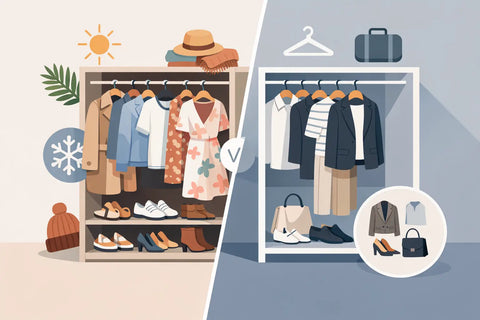
A full closet can still leave you with nothing that feels right at 8 a.m. The issue is rarely quantity. It is usually a lack of relationship between the pieces. Seasonless wardrobe vs capsule wardrobe is not a choice between minimalism and excess. It is a question of whether your clothing can keep working as weather, schedules, and personal taste shift.
Both approaches reject disposable buying. Both ask for more intention. But they organize that intention differently. One is built around a defined edit. The other is built around endurance, layering, and a wider range of use.
Seasonless wardrobe vs capsule wardrobe: the difference
A capsule wardrobe is a deliberately limited set of garments designed to make getting dressed easier. It often follows a fixed number, whether that is 20, 30, or 40 pieces, and favors a controlled palette with clear outfit combinations. The appeal is obvious: fewer decisions, fewer duplicates, and a closet where most items work together.
A seasonless wardrobe is less concerned with a number. It is built around garments that can move through much of the year, then adjust through layering, footwear, and fabric weight. A cotton poplin shirt works alone in heat, under a sweater in fall, and beneath a worker jacket when the temperature drops. The piece remains useful because its construction is sound and its form is not tied to a short-lived moment.
The distinction matters. A capsule is a system of reduction. A seasonless wardrobe is a system of continuity.
Neither is inherently better. A person who travels often, works in a uniform environment, or wants a quieter morning routine may benefit from strict capsule rules. Someone living across variable temperatures, dressing for studio work and dinner in the same day, or drawn to tactile fabric may need more range. A compact wardrobe can be seasonless. A seasonless wardrobe does not need to be compact.
The capsule wardrobe: clarity through limits
At its best, a capsule wardrobe makes the useful visible. It reveals that three excellent shirts may do more for daily life than fifteen mediocre ones. It also helps identify what you actually wear, rather than what seemed persuasive in a fitting room.
The strength of the capsule model is repetition. Wearing the same trousers often teaches you whether the rise is right, whether the cloth relaxes well, and whether the pockets are placed for real use. Repetition gives garments a chance to become personal.
Its limitation is that a fixed count can become a performance. If every item must coordinate perfectly, the result can feel overly neutral or too carefully optimized. The clothing may be functional, but not expressive. A capsule also struggles when climate is extreme or life is varied. One lightweight jacket cannot cover a humid summer commute and a cold winter evening simply because the spreadsheet says it should.
A good capsule should be edited by use, not by an arbitrary number. Keep the pieces that earn their place. Let a few specialized garments exist when they solve a real problem.
The seasonless wardrobe: built for longer use
Seasonless dressing starts with a more practical question: can this garment adapt? That depends on fabric, cut, and construction.
Natural fibers with substance tend to travel well across the year. Midweight cotton twill, denim, cotton poplin, brushed canvas, and wool layers each have a clear role without feeling locked to one calendar window. They can be worn directly against the skin, over a T-shirt, or under an outer layer. Their value is not that they work in every condition. No garment does. Their value is that they work in more than one.
Silhouette matters just as much. A slightly generous shirt can hold a base layer without becoming restrictive. Straight or balloon pants allow air in warm weather and room for thermal layers in winter. A worker jacket, cut with enough ease through the shoulder, can function as an overshirt, a mid-layer, or light outerwear.
This is where heritage workwear remains relevant. Its original logic was use: room to move, cloth that could take wear, pockets placed with purpose, and shapes that did not need constant revision. Those ideas still hold. Details with a past. Forms for now.
Seasonless does not mean season-blind. Linen may still be the right answer in August. A proper wool coat still has a place in January. The goal is not to pretend that weather does not exist. It is to avoid buying an entirely different identity for each season.
Start with anchors, not outfit formulas
The most durable wardrobes are usually built from anchors. These are the garments you reach for without negotiation: the trousers that work with boots and sneakers, the shirt that looks considered whether tucked or loose, the jacket that gives a simple outfit structure.
Choose anchors according to your real week. If you cycle to work, fabric that resists abrasion and a jacket with useful pockets may matter more than a fine knit. If your work moves between meetings, workshops, and travel, a relaxed button-front shirt and well-cut utility trousers may be more useful than formal separates. The right wardrobe system should make room for your body and your habits, not ask you to adopt someone else’s.
Color can support this without becoming restrictive. Start with a stable base such as ecru, charcoal, navy, olive, black, or faded blue. Then add variation through texture and tone: washed denim against crisp poplin, dry canvas against soft jersey, dark brown alongside black. When the materials carry visual interest, every garment does not need to announce itself.
Build range through layers and duplicates with purpose
A seasonless wardrobe gains flexibility through layers, not endless options. A T-shirt, an open photographer shirt, a knit, and a utility jacket can create several useful temperatures from a small group of garments. Each layer should make sense on its own. If it only works as part of one prescribed outfit, it has limited value.
There is also nothing wasteful about owning more than one version of a garment you wear constantly. Two pairs of well-made work pants can be more rational than a single pair worn past its limit. The same applies to shirts in different weights: one crisp cotton for warm days, one brushed cotton for cooler months. This is not duplication for its own sake. It is rotation, care, and prolonged wear.
The test is simple. Does the second piece solve a different need, or does it merely repeat a passing impulse?
What to look for before you buy
A seasonless garment should improve with familiarity. Check the elements that determine whether it will last in your rotation:
- Fabric weight that can stand alone but layer comfortably
- A cut that allows movement without excessive volume
- Seams, buttons, closures, and pocket construction that support regular wear
- Colors that will still feel useful beside what you already own
- Enough visual character to wear repeatedly without becoming costume
Let the wardrobe change slowly
The strongest closet is not assembled in one order. It is observed over time. Notice what you repair, what you wash and wear again immediately, and what remains untouched despite being technically useful. Those patterns are better guides than seasonal trend reports.
A capsule wardrobe can give you the discipline to remove noise. A seasonless wardrobe can give you permission to keep the pieces that grow more useful with age. The best system may borrow from both: a clear edit, with enough depth for weather, work, and repeat wear.
Buy better. Keep forever. Then let the evidence of your own life decide what stays.