
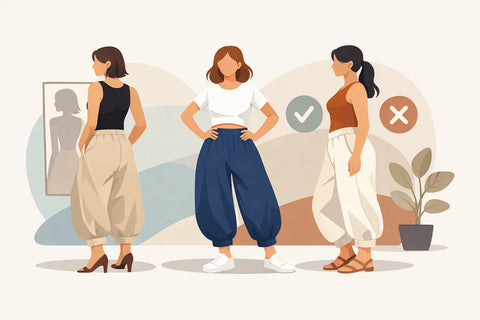
A straight leg follows the body. A balloon leg creates its own architecture. That difference is why the question, are balloon pants flattering, has no universal answer. The silhouette is not designed to make every body look narrower or taller. It is designed to create proportion, movement, and a clear point of view.
For some, that means an immediate sense of ease. For others, it takes a few adjustments before the shape feels right. The deciding factors are less about body type than rise, volume placement, fabric weight, and what happens above the waistband.
What Makes Balloon Pants Different
Balloon pants are full through the thigh and knee, then taper toward the hem. The effect is rounded rather than oversized. A well-cut pair has volume with control: room where the body bends and a narrower opening that prevents the leg from falling into a shapeless column.
The form has practical roots. Workwear and military trousers often allowed space for movement, layering, and long days of wear. Contemporary balloon pants retain that utility, but the shape now does more than solve a functional problem. It changes the visual balance of an outfit.
That is also why they can feel unfamiliar. Most modern trousers are built around reduction: slim the thigh, straighten the line, minimize the profile. Balloon pants do the opposite. They give the leg presence.
Are Balloon Pants Flattering on Every Body?
They can be, but flattering should not mean disappearing into a smaller silhouette. A good pair of balloon pants can make a frame feel grounded, lengthen the visual line through a higher waist, or bring welcome balance to broader shoulders. On another person, the same pair may feel too low in the crotch, too full at the hip, or too abrupt at the ankle.
The useful question is not whether the pants make you look thin. It is whether the proportions feel intentional.
A shorter wearer may prefer a higher rise and a hem that ends cleanly at the ankle or just above the shoe. This keeps the leg shape contained and gives the waist a clear starting point. A taller wearer can often carry more volume and a longer break, though excess fabric at the ankle can still make the silhouette look heavy.
Those with fuller hips or thighs often find balloon pants more comfortable than a tapered or straight cut because the volume is built into the pattern rather than forced by sizing up. The key is that the fullest point should sit through the upper leg, not pull across the seat or balloon outward from the side seam. Ease should look deliberate, not strained.
For a straighter frame, the shape can add dimension without relying on a dramatic waist treatment. For a body with a defined waist, a higher rise and a tucked or shorter top can preserve that definition. Neither approach is a rule. They are simply different ways to let the trouser do its work.
The Rise Sets the Entire Silhouette
Rise is often more important than leg width. A high-rise balloon pant places the volume below the waist, creating a compact upper body and a longer-looking leg. It is usually the easiest entry point for anyone uncertain about the cut.
A mid-rise version feels more relaxed and closer to traditional utility trousers. It can work especially well with a boxy shirt, knit, or work jacket, but it needs attention to length. If the rise is low and the top is long, the torso can feel compressed.
Look for a waistband that sits where you naturally want the outfit to begin. If you spend the day pulling the pants up or tugging your shirt down, the fit is asking too much of you.
Volume Needs a Destination
The taper is what gives balloon pants their discipline. The leg should narrow enough to show where the garment ends, without becoming tight around the calf. When the hem is too wide, the pants can read as simply baggy. When it is too narrow, the shape becomes exaggerated and may feel costume-like.
Hem length matters here. A slight crop reveals the ankle and gives the silhouette lift. A full length can work with a substantial shoe, especially a leather derby, service boot, or low-profile sneaker, but it should not collapse into repeated folds. The trouser is already carrying volume. It does not need more visual weight at the floor.
Fabric Changes the Answer
The same pattern behaves differently in cotton twill, denim, linen, wool, or a soft jersey. Fabric determines whether the volume holds its form or falls close to the body.
A dense cotton twill gives balloon pants their clearest outline. It has enough structure to maintain the rounded leg and enough durability for daily wear. This is the natural choice for a workwear-informed pair, especially when finished with practical details such as deep pockets, reinforced seams, or a firm waistband.
Denim adds weight and gradual character. A rigid or lightly washed denim balloon pant begins with definition, then becomes more personal through wear. It can feel substantial, so balance it with a simple shirt or fine knit rather than another oversized layer.
Linen and lighter cottons make the silhouette softer. They are useful in warm weather, but they need a considered cut. Too much fabric in a light cloth can lose its shape and appear untidy by midday. A cleaner taper and a more precise hem help.
Wool or wool-blend versions can be unexpectedly refined. The volume remains, but the surface reads less casual. Pair them with a tucked poplin shirt, a compact sweater, or an unstructured jacket when the setting calls for more restraint.
How to Style Balloon Pants Without Overworking Them
Balloon pants are easiest when the rest of the outfit is edited. They already establish the silhouette, so the upper half should either clarify the waist or provide a clean counterweight.
A fitted or lightly tucked T-shirt works because it lets the trouser shape remain visible. So does a short worker jacket that ends near the waistband. The result is compact and balanced: volume below, structure above.
A boxy overshirt can work as well, particularly with a mid-rise pair, but proportion matters. Choose one with a firm collar, useful pockets, or a cropped length. A long, soft shirt over full trousers can feel unresolved unless the shirt is partially tucked or layered under a shorter outer piece.
Footwear should give the hem an anchor. Canvas sneakers keep the look easy. Leather shoes introduce contrast. Boots add weight and suit a sturdier twill or denim. Delicate footwear is possible, but it creates a sharper fashion contrast and asks more of the overall styling.
Color is a quiet advantage. Olive, charcoal, ecru, navy, and washed black allow the shape to lead without making the pants feel like a statement piece. A neutral balloon pant can function like a favorite straight leg, only with more room and more character.
Common Fit Mistakes
The usual problem is not that balloon pants are too voluminous. It is that several sources of volume are competing at once. An oversized sweatshirt, a long coat, a loose pant, and a bulky shoe can work together, but only if each piece has a reason. Most of the time, one clear full shape is enough.
Avoid sizing up solely for a wider leg. The waistband and seat still need to fit. A pair that is loose everywhere tends to sag at the rise and distort the intended taper. If you need more room through the thigh, look for a pattern designed with that room from the start.
Also resist treating the hem as an afterthought. A small adjustment can change the entire garment. The right length makes the pants look settled on the body, not borrowed from a different one.
A Better Measure of Flattery
Clothing does not need to follow the body closely to honor it. Sometimes the most convincing shape is the one that gives you space: to move, to layer, to sit on a train, to work through a long day, to wear the same garment again tomorrow.
Balloon pants are flattering when their volume feels balanced, their fabric holds a purpose, and their proportions belong to the wearer. Try them with patience. Let the silhouette become familiar. Good clothes do not always make their case in the mirror at first glance - they prove themselves in use.