
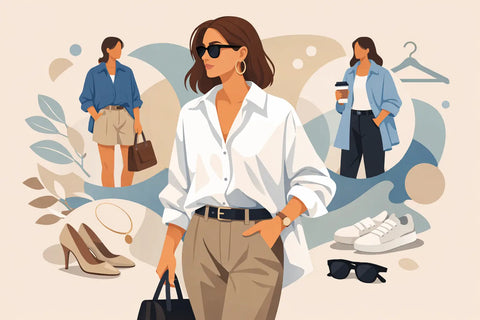
An oversized shirt earns its place when it creates shape rather than hiding it. The question of how to dress oversized shirting is less about making a large garment look smaller and more about controlling proportion: where the fabric falls, what anchors it, and how much ease the rest of the outfit can hold.
A well-made oversized shirt has range. It can sit over a narrow trouser, move with a full work pant, function as a light outer layer, or take the place of a casual jacket. The difference is not styling tricks. It is balance.
Start with the shirt’s construction
Not all oversized shirting behaves the same way. A crisp cotton poplin holds an architectural line. A brushed flannel softens around the body. Dense twill has weight and reads closer to a shirt-jacket, while linen or lightweight cotton gives more movement and air.
Look first at the shoulder, collar, sleeve, and hem. A dropped shoulder signals ease, but it should still feel deliberate. The collar should retain enough structure to frame the face. Sleeves can stack slightly at the wrist or be rolled once with purpose. A curved hem is useful untucked; a straight hem often works well layered or half-tucked.
Size is only one part of the equation. The best oversized shirts are cut with room through the body while preserving key points of construction. If the collar collapses, the sleeve overwhelms the hand, and the shirt pulls broadly across the back, the garment may simply be too large rather than intentionally oversized.
How to dress oversized shirting through proportion
An oversized shirt needs a counterweight. That counterweight may be a cleaner lower half, a visible waist, a shorter layer underneath, or the grounding effect of substantial footwear. There is no fixed rule that a relaxed shirt requires slim pants. It does require a point of definition somewhere in the look.
Pair it with a straight or tapered pant
A straight-leg jean, fatigue pant, or tapered utility trouser gives oversized shirting a stable base. Let the shirt fall freely over the waistband when the hem is not excessively long. This creates an easy vertical line without turning the outfit into a volume exercise.
For a more finished shape, tuck the front section loosely and leave the sides and back relaxed. Avoid a tight, symmetrical tuck. The goal is not polish for its own sake. It is to show the rise of the pant and establish where the body begins.
This combination is especially effective with a broad-shouldered shirt or a dense fabric. The trouser carries enough visual weight to support the shirt, while the cleaner leg keeps the silhouette from becoming indistinct.
Wear volume with volume, but change the scale
Wide balloon pants and oversized shirting can work together. The mistake is letting both garments expand at the same point. If the shirt is long and boxy, choose pants that taper toward the ankle or have a cropped break. If the pants are broad and full, consider a shirt with a shorter hem, a partial tuck, or open buttons over a fitted base layer.
This is where fabric matters most. A heavy overshirt with heavy canvas pants can feel purposeful in cold weather, especially with boots. In warmer conditions, use one structured piece and one lighter one. A textured cotton shirt with airy, wide-legged trousers keeps the proportions generous without becoming dense.
Use an open shirt as a layer
Worn open, oversized shirting becomes a light piece of outerwear. Start with a plain T-shirt, ribbed tank, or fine knit that sits closer to the body. The base layer establishes a center line; the open shirt creates movement around it.
Keep the underlayer simple. A graphic, oversized shirt over another loose graphic layer can compete for attention. A quiet base lets the shirt’s fabric, buttons, pockets, and collar do the work.
An open overshirt also gives a practical answer to transitional weather. It is easier than a jacket when a full layer is unnecessary, and more considered than carrying a shirt only for warmth. Roll the sleeves if the fabric allows it. Leave them down when the cuff and placket are part of the garment’s character.
Decide whether to tuck, crop, or let it fall
The hem changes everything. Before adding accessories or another layer, decide what the shirt should do at the waist.
Untucked works best when the hem ends around mid-fly to upper thigh, depending on height and pant rise. A longer shirt can still be worn loose, but it needs a narrower or more intentional lower half. Think straight denim, a tapered work trouser, or shorts with a clean, substantial leg.
A partial tuck gives shape without removing ease. Take a small section at the front, just off center, and let the rest of the shirt hang. This works particularly well with high-rise trousers and soft fabrics. It should look used, not arranged.
A full tuck is sharper and can make a large shirt feel surprisingly formal. Choose this route when the shirt has enough body to blouse slightly above the waistband. With pleated trousers, the result has a quiet work-to-dinner utility. With jeans, it reads more direct. If the shirt is very long, a full tuck may create excess bulk. In that case, wear it open or choose a shorter proportion instead.
Build around fabric, not trend
Oversized shirting often gets treated as a seasonal statement. It is more useful as a wardrobe system. The same shirt should change function as the weather and setting shift.
In warm months, a lightweight cotton or linen shirt can sit open over a tank with shorts, or buttoned loosely with fatigue pants and canvas sneakers. The air between body and cloth is part of its utility. Do not erase that quality by over-layering.
When temperatures drop, move toward brushed cotton, denim, wool blends, or dense twill. Wear the shirt over a thermal or fine gauge knit, then add a worker jacket or coat with enough room through the arm. Avoid forcing a wide sleeve into a narrow jacket. Restriction at the armhole makes good layering feel accidental.
Color should support repeat wear. Faded blue, chalk, olive, charcoal, ecru, and washed black allow an oversized shirt to work across different trousers and layers. Strong color is not off limits, but a large silhouette already occupies visual space. A considered color palette lets texture and construction remain visible.
Choose footwear that grounds the silhouette
Footwear is not an afterthought with oversized clothes. A broad shirt changes the visual weight above the knee, so the shoe needs to settle the look.
Canvas sneakers keep lightweight shirting casual and mobile. Leather derbies add structure when the shirt is tucked or paired with tailored trousers. Service boots and lug-soled shoes suit twill, denim, and workwear fabrics because they carry a similar material honesty. Sandals can work with an open shirt and loose pants, but the rest of the outfit needs restraint. Too many relaxed elements can make the silhouette lose its edge.
The same principle applies to socks, belts, and bags. Use them as functional punctuation. A sturdy belt is useful when a tuck reveals the waist. A compact crossbody or simple tote can balance a loose shirt without introducing decoration for its own sake.
Let the garment fit your life
Oversized shirting should not demand a different personality from the wearer. It should accommodate movement, temperature, work, travel, and changing bodies. This is one reason unisex proportions have lasting value: they leave room for interpretation rather than prescribing a single way to wear them.
For work, button the shirt and pair it with clean trousers, a belt, and leather shoes. For a studio day or weekend, wear it open over a base layer with utility pants. For travel, choose a shirt with pockets and enough fabric weight to function as a light jacket. One garment. Different bodies. Different lives.
There are trade-offs. A very oversized fit can be less practical under close-cut outerwear. A stiff fabric gives definition but may feel less relaxed than a washed cotton. A cropped shirt can sharpen wide pants but offers less coverage and layering range. Buy according to the situations you actually dress for, not the photograph you are trying to recreate.
The most convincing oversized outfit looks unforced because every piece has a job. Start with the shirt, give the silhouette one clear anchor, and leave room for the garment to age into your own habits.