
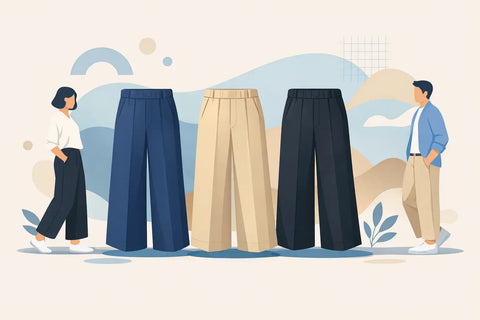
A wide leg can look careless or exact. The difference is usually not styling. It is cut.
That is why unisex wide pants matter more than they first appear to. They ask more from a garment than narrow trousers do. The pattern has to hold proportion across different bodies. The fabric has to carry volume without collapse. The rise, seat, and leg opening have to work together, not just look generous on a hanger.
For anyone building a wardrobe around fewer, better pieces, this silhouette earns its place when it is done with discipline. Not oversized for effect. Not trend-driven. Just clear in shape, easy in wear, and strong enough to return to every week.
Why unisex wide pants keep coming back
Wide pants have deep roots in workwear, military dress, and utility clothing. Volume was often practical before it was expressive. A fuller leg gave movement. A higher rise sat securely. A stronger fabric resisted strain at points of wear. Those decisions still read well now because they were never decorative to begin with.
In a unisex context, the shape becomes even more relevant. A straight, roomy leg does not depend on a narrowly gendered idea of fit. It creates space around the body rather than forcing the body into a fixed line. That is a meaningful distinction. Good unisex design is not about removing character. It is about building form that can adapt.
The appeal is also seasonal. Wide pants ventilate better in heat, layer better in cold, and tend to work with more footwear than slimmer cuts. Sandals, heavy derby shoes, sneakers, clogs, boots - each changes the read, but the foundation remains stable.
The silhouette lives or dies by proportion
Not all wide pants are balanced. Some are simply enlarged. That usually shows up first in the seat and thigh. If the top block is too loose, the garment loses structure before the leg even begins. If the rise is off, the volume below can feel heavy rather than intentional.
The best unisex wide pants usually rely on a few quiet corrections. The waist is clean. The hip has enough ease but not excess. The rise is considered, often slightly higher, so the leg can fall from the right point. From there, width feels architectural instead of inflated.
This is where experienced buyers tend to look first. Not at the word wide, but at how the width starts. A trouser can be broad through the hem and still look sharp if the upper block is controlled. It can also be mildly wide and look awkward if the proportions above are unresolved.
Rise changes everything
Rise is often treated as a comfort detail. It is more than that. On wide pants, rise sets the entire stance of the garment.
A higher rise usually gives the silhouette more authority. It anchors the volume, lengthens the visual line, and works especially well with cropped jackets, tucked shirting, or a knit that sits close to the body. A lower rise can work too, but it tends to make wide legs feel more casual and more dependent on styling. Neither is universally better. It depends on whether you want ease, structure, or something between them.
Hem width is only part of the story
Many shoppers focus on the leg opening, but the break and drape matter just as much. A dense cotton twill with a moderate opening can look wider than a lighter fabric cut more generously. Volume is visual, not just numerical.
That is why measurements alone rarely tell the whole story. A pant with front pleats, a curved side seam, or a slight taper can behave very differently from a flat-front straight wide leg, even if the hem widths are similar.
Fabric decides whether the shape lasts
The simplest test for wide pants is this: do they still look good after hours of wear?
Lightweight fabrics can be useful, especially in warm weather, but they demand precision. Too soft and the silhouette loses definition. Too crisp and it can stand away from the body in the wrong places. Midweight and heavyweight fabrics often serve this category better because they give the leg a stable fall.
Cotton twill remains one of the strongest options. It has enough body to support shape, enough durability for regular wear, and enough familiarity to age well. Herringbone, canvas, and dense poplin each bring a different surface and stiffness. Denim can also work, though it shifts the pant toward a more grounded, workwear-driven read.
The fabric should not only hold shape. It should improve with use. That is the point of buying into this silhouette as a staple rather than a seasonal experiment. Creases settle. High-contact areas soften. The pant becomes more specific to its wearer without losing integrity.
How unisex fit works across different bodies
The phrase unisex can mean very little if the garment has not been developed with real variation in mind. Wide pants expose that quickly. If the waistband is too rigidly graded, one group of wearers gets ease while another gets drag lines or unnecessary bulk. If the seat is cut with only one body shape in mind, the leg will not fall cleanly.
Well-made unisex wide pants solve this by prioritizing the overall line rather than chasing a perfect conventional fit for every body. That can mean a slightly roomier top block, a flexible waistband treatment, a forgiving rise, or a leg shape that does not cling where bodies differ most.
This is also where styling becomes practical, not performative. One person may wear the same pant high and clean with a belt. Another may wear it lower and softer with a longer shirt. The garment should accept both without losing itself.
At WORKWARE, that idea sits at the center of the wardrobe - one garment, different bodies, different lives. A useful silhouette should not need translation every time it changes wearer.
What to look for before you buy
The strongest pair usually reveals itself in small decisions. Belt loops should feel substantial enough for the weight of the fabric. Pocket placement should not interrupt the line. Bar tacks, seam finish, and waistband construction matter because wide pants often become high-rotation pieces.
Pleats are worth attention too. They can add movement and comfort, especially through the thigh, but they also shift the character of the trouser. A flat front reads cleaner and more utilitarian. Single pleats often feel more relaxed and tailored at once. Double pleats can be excellent, though they ask for more discipline elsewhere in the cut.
Length is another trade-off. A full break gives drama and weight. A slight crop sharpens the shape and shows footwear. Neither is fixed. The right choice depends on the width of the leg, the fabric, and how you want the pants to move through a day.
Styling wide pants without overworking them
The easiest mistake with wide pants is trying to compensate for the volume. Too many visual signals and the silhouette turns noisy.
A better approach is restraint. Let the pant carry the space. Pair it with a compact knit, a boxy worker jacket, a plain tee with enough weight to hold its own, or a crisp shirt with a clean tuck. Footwear should ground the shape rather than fight it. Shoes with some presence usually work best, though in summer a simple sandal can make the whole look lighter.
Texture matters more than decoration here. Washed canvas, dry twill, brushed cotton, broken-in denim - these surfaces create depth without asking for attention. The result feels lived in, not styled for effect.
Color follows the same logic. Navy, black, olive, ecru, charcoal, and faded earth tones tend to give the silhouette a longer life. They integrate easily and let the cut do the work. Brighter colors can be strong, but they make the pant more specific. Sometimes that is right. Sometimes it limits wear.
Why this silhouette earns a permanent place
There are garments you buy for novelty and garments you build around. Wide pants belong in the second category when they are cut with purpose.
They work because they do not rely on a moment. They allow movement. They accept wear. They cross styling habits, age groups, and gender lines without becoming bland. Most of all, they create a clear shape in a wardrobe that often becomes cluttered with compromise.
If you are choosing carefully, choose the pair that looks settled even before it is broken in. Good unisex wide pants should feel like they already know what they are for. Wear them hard. Let them age. Keep the ones that keep their form.