
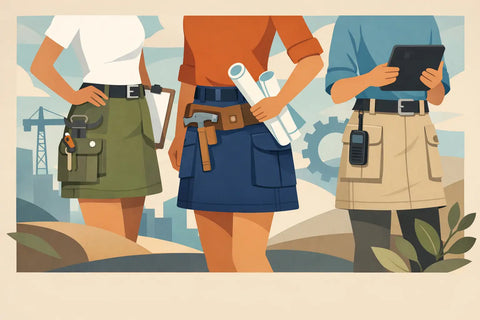
Some skirts ask for an occasion. Utility skirts ask for a place in rotation.
That distinction matters. A good utility skirt is not decorative workwear, and it is not a trend piece dressed up in pockets. It is a practical garment built with the same logic that makes a worker jacket or fatigue pant worth keeping - structure, movement, storage, and repeat wear. When it is done well, the result feels direct. Less styled, more used.
For a wardrobe built on longevity, utility skirts make sense because they solve a specific problem. They offer the openness and ease of a skirt, but with the purpose and discipline of workwear. That balance is harder to achieve than it looks.
What utility skirts are really for
The best utility skirts come from function first. Their roots sit close to military garments, field uniforms, workshop aprons, cargo constructions, and industrial dress adapted for daily life. The details were never arbitrary. Patch pockets carried tools. Reinforced seams took strain. Dense cottons held shape through long wear.
Modern versions often borrow the language without keeping the logic. A row of oversized pockets can make a skirt look useful while adding bulk in all the wrong places. Heavy stitching can signal toughness while limiting drape. This is where experienced buyers tend to separate costume from clothing.
A utility skirt should do three things well. It should move comfortably, carry what needs carrying, and maintain its line through repeated wear. If one of those falls away, the garment starts to lean either too technical or too ornamental.
The anatomy of a good utility skirt
Construction matters more here than on a simpler skirt. Because utility skirts borrow from garments designed to work, every choice becomes visible in wear.
Fabric comes first. Midweight cotton twill, canvas, ripstop, and dense sateen all make sense, but they behave differently. Twill tends to soften and age well while keeping enough body to hold a silhouette. Canvas brings more structure and a slightly drier hand, though it can feel rigid if the cut is narrow. Ripstop introduces a lighter, more technical read, which suits warmer weather but can lose some of the grounded quality people want from heritage utility wear.
Then there is the question of shape. A straight utility skirt can feel clean and architectural, especially in a firm cloth, but it depends on vent placement and ease through the hip. Without that, movement gets compromised quickly. An A-line cut is often easier to live with. It preserves function while giving room to walk, cycle, and sit without strain. Volume can work too, particularly when gathered or paneled, but only if the fabric has enough weight to avoid looking too soft.
Pocket placement is where design discipline shows. Side-entry pockets are usually the most wearable because they preserve line and remain useful. Large cargo pockets can be excellent, but they need to sit low enough to avoid widening the hip and flat enough to stay quiet when empty. A utility skirt should never look busiest at the exact point where the body already carries shape.
Waist construction changes the character of the whole garment. A fixed waistband with belt loops feels closer to classic workwear and usually gives a sharper fit. Elastic or partially elastic waists add adaptability and broaden who can wear the piece comfortably. Neither is better in absolute terms. It depends on whether the skirt is meant to read more structured or more relaxed.
Utility details that matter
Hardware should feel considered, not aggressive. Metal tack buttons, zip flies, bar tacks, reinforced pocket corners, and deep hems all belong here when they serve a purpose. Too much exposed hardware can push the garment into costume. Too little structure and it loses the utility language entirely.
This category rewards restraint. One strong pocket treatment is often enough. One good fabric is enough. One precise silhouette carries further than a pile of references.
Why utility skirts work in a modern wardrobe
A lasting wardrobe needs range, not novelty. This is where utility skirts quietly outperform expectation.
They pair with garments already doing heavy lifting: crisp poplin shirts, heavyweight tees, knit tanks, worker jackets, short chore coats, soft tailoring, substantial socks, hard-wearing shoes. Nothing needs to be over-styled because the skirt already brings shape and purpose. That makes it especially useful for people who prefer systems over outfits.
They also sit well inside a gender-inclusive wardrobe. A utility skirt does not rely on fragility or overt femininity. It earns its place through construction and proportion, which allows it to move across different bodies with credibility. That matters. The strongest garments are often the ones that are not over-assigned.
There is also a practical reason they last in rotation. Many people want the comfort and air of a skirt without stepping into something precious. Utility skirts offer a tougher answer. They can take repeated wear, shift between work and weekend, and look better once the fabric starts to break in.
Fit is where utility skirts succeed or fail
A utility skirt can have the right cloth and the right references and still miss the mark if the fit is unresolved.
The first thing to consider is where it sits on the body. A high-rise utility skirt often feels more stable and intentional, especially with tucked shirts or cropped outerwear. It also gives pocket placement more clarity. Mid-rise can work, though it tends to feel more casual and depends more heavily on the exact cut through the hip.
Length changes function more than most people expect. Mini lengths can look sharp with utility details, but they often lose some practical credibility unless the cut is generous and the cloth substantial. Midi lengths are usually the strongest option. They offer enough space for movement, enough coverage for real life, and enough surface area for pockets and seaming to feel proportionate. Full-length versions can be excellent, but they need venting, volume, or both.
The useful question is not whether a utility skirt is flattering. It is whether the proportions are resolved. Does the fabric support the shape? Do the pockets sit where they should? Can you move without adjusting the garment every few minutes? Good design answers these quietly.
How to wear utility skirts without forcing the point
The easiest way to wear utility skirts is to let them behave like workwear. Keep the rest direct.
A rib tank and substantial overshirt make sense. So does a faded oxford, a boxy tee, or a fine merino knit. Footwear can shift the reading quickly: clogs and loafers sharpen it, sneakers relax it, boots return it to its workwear roots. The skirt does not need much help.
The trade-off is that utility details already carry visual weight. If everything else is heavily detailed too, the look can become crowded. This is why clean layers matter. A skirt with cargo pockets usually pairs better with a plain top than with decorative knitwear or elaborate accessories.
Color should stay grounded if longevity is the goal. Olive, black, ecru, navy, stone, and washed khaki all age well inside this category. They also reveal wear attractively. Bright fashion color can work, but it usually changes the garment from system piece to statement piece, and that limits repetition.
What to look for before you buy
Start with fabric weight. If the cloth feels too light for the amount of detailing, the skirt may lose shape quickly. If it feels too stiff for the cut, it may never settle into easy wear. Then check the seams, hem depth, closure, and lining, if there is one. Utility garments should feel stable in the hand.
Look closely at pocket construction. Are the pockets usable, or are they there to create an image? Can they hold a phone without pulling the skirt off line? Do they add shape where you want shape, or where you do not?
Finally, think about repetition. Not styling potential in the abstract, but actual repetition. Can you wear it twice a week for months with the clothes you already own? Can it move across weather with a change of layer and shoe? Pieces built for longevity tend to answer yes without much persuasion.
At WORKWARE, that is usually the measure. Not whether a garment announces itself on first wear, but whether it keeps returning to the front of the wardrobe.
Why utility skirts endure
Some garments stay because they flatter a moment. Others stay because they solve dressing with clarity. Utility skirts belong to the second group.
They carry the right kind of tension - structured but easy, functional but pared back, grounded in heritage but not locked to the past. That is why they continue to make sense, especially for wardrobes shaped by use rather than impulse.
The best one will not ask much from you. It will hold its form, take wear well, and work with what is already there. That is usually enough reason to keep it for a long time.