
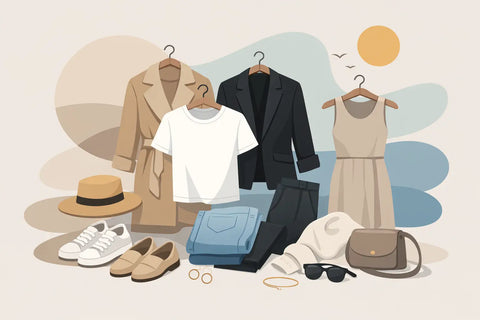
The best seasonless clothing pieces earn their place the hard way. Not through novelty, and not through a single well-styled month, but through repetition. They handle cold mornings, overheated interiors, late spring wind, and the long in-between stretches that make up most real wardrobes. If a garment only works in a narrow window, it is seasonal. If it adapts, layers, and still looks right after a year of wear, it belongs.
Seasonless dressing is less about climate denial and more about better systems. Most people do not need four separate wardrobes. They need a tighter set of garments with enough structure, fabric intelligence, and visual restraint to move across conditions. The point is not minimalism for its own sake. The point is utility with form.
What makes the best seasonless clothing pieces work
A seasonless piece usually gets three things right: material, silhouette, and function. Miss one, and wearability narrows fast.
Fabric comes first. Mid-weight cotton twill, dense poplin, washed canvas, dry-hand denim, and compact jersey all have range because they layer well and hold shape. They are breathable enough for warmer months, substantial enough to sit under outerwear, and durable enough to improve with wear. Very light fabrics can feel effortless in summer but often disappear once temperatures drop. Heavy wool and padded nylons have the opposite problem. Useful, but not seasonless.
Silhouette matters just as much. A slightly relaxed cut has more range than a very slim one because it leaves room for layers and movement. That does not mean oversized for effect. It means measured volume. A jacket that fits over a shirt and knit. A trouser with enough ease through the thigh to work with both sandals and boots. A shirt that can be worn open, buttoned, tucked, or overshirt-style.
Then there is function. Pockets, reinforced seams, adjustable cuffs, sturdy plackets, hard-wearing closures. These details are not decoration. They expand how often a garment gets used. Heritage workwear understood this early. Good design still does.
1. The worker jacket
If one garment defines seasonless dressing, it is the worker jacket. Not too heavy, not too polished, and rarely out of place. It sits between shirt and coat, which is exactly why it works.
A good version is cut in cotton drill, moleskin, or washed canvas with enough body to hold its line. In early fall, it works over a tee. In winter, it becomes a mid-layer under a coat. In spring, it replaces outerwear entirely. The shape is direct, the utility is obvious, and the styling burden is low.
The trade-off is that fabric weight matters. Too stiff and it becomes outerwear only. Too soft and it loses authority. The best ones land in the middle.
2. The photographer shirt or overshirt
This is one of the quiet workhorses of a wardrobe system. A substantial shirt with utility pockets and a clean front can behave like three garments at once: shirt, light jacket, and layering piece.
Poplin can work if it is compact and crisp, but this category often improves in denser cottons. Twill, brushed cotton, or cotton-linen blends give enough structure to wear open over a tank or tee, while still sitting cleanly under a jacket. A neutral tone keeps it moving across outfits without becoming invisible.
The advantage here is flexibility. The risk is redundancy. If it is too similar to every other casual shirt you own, it will not earn repeat wear. Pocket placement, fabric density, and proportion are what separate a real overshirt from a basic button-up.
3. Straight or balloon trousers
Seasonless trousers need shape. Not trend shape. Functional shape. A straight leg or softly rounded balloon cut offers room, drape, and enough air circulation for warmer days while still accommodating socks, boots, and layers when it cools down.
Cotton twill is the standard for good reason. It wears hard, resists collapse, and becomes more convincing with age. Fatigue cloth, herringbone, and lighter denim also work well. A trouser with a little volume tends to outlast narrower cuts stylistically, and it reads more modern without asking for attention.
For experienced buyers, rise matters here. A higher rise usually gives more styling range and comfort across body types. It also allows the trouser to sit properly with tucked shirts, cropped jackets, and longer outer layers.
4. Raw or rinse-wash denim
Denim remains one of the most reliable seasonless fabrics because it adjusts through wear. A mid-weight raw or rinse-wash pair can move through nearly the entire year, especially in a straight or relaxed fit.
The appeal is not novelty fading or rigid purism. It is stability. Denim works with knits, shirting, jackets, and simple jerseys without forcing a mood. It can take abrasion, gain character, and still remain structurally sound years later.
There is one limitation. Very heavy raw denim can feel punishing in hotter months. For true seasonless use, mid-weight denim is often the better choice. Enough substance to age well, enough give to stay in rotation.
5. The substantial white tee
A seasonless tee should not be tissue-thin. It needs density, a firm collar, and a shape that survives washing. In a strong wardrobe, the white tee is not filler. It is the base layer that lets everything else function.
A substantial cotton jersey works alone in heat, under an overshirt in spring, beneath a jacket in fall, and under knitwear in winter. The best versions have a dry hand and a silhouette with slight ease through the body. Too fitted and they become restrictive. Too loose and they lose precision.
White is classic, but ecru, off-white, and washed natural shades often age better and feel less clinical. This is one place where small shifts in tone can increase wearability.
6. The striped or chambray shirt
Not every seasonless piece needs to be plain. A striped shirting fabric or good chambray adds pattern and texture without becoming trend-led. These fabrics carry enough visual interest to break up a uniform wardrobe, but they remain grounded in utility and heritage.
Chambray in particular performs well across seasons because it has the familiarity of denim with less weight. Stripes can sharpen a look under tailoring or soften it under workwear, depending on scale and color. The key is restraint. Fine stripes and washed blues tend to travel better than loud contrast.
7. The knit that is not too precious
Seasonless knitwear is often misunderstood. It is not about heavy winter sweaters. It is about medium-gauge cotton, cotton-wool, or dry merino pieces that layer without overheating and wear without fuss.
A crewneck or zip cardigan in a compact knit can sit over a tee, under a jacket, or on bare skin in mild weather. This kind of garment adds texture and warmth without turning the whole outfit into a cold-weather proposition.
It depends on your climate, of course. In very warm regions, knitwear may function more as travel or evening wear than daily use. But in most wardrobes, one practical knit is enough to extend every other piece.
8. The utility skirt or work dress
Seasonless wardrobes should not default to trousers alone. A utility skirt in twill or a workwear-informed dress in sturdy cotton can do the same job if the silhouette is clean and the fabric has backbone.
The right skirt works with boots, sandals, tees, knitwear, and jackets. The right dress can be worn alone, layered over a tee, or paired with a worker jacket. What matters is construction. If the fabric is too delicate or the shape too decorative, range disappears.
This is where unisex thinking is useful even in traditionally gendered categories. Simpler forms, better pockets, stronger materials, fewer unnecessary details. More ways to wear the garment. Longer life.
9. The all-purpose cap or tote
Accessories rarely get included in discussions of the best seasonless clothing pieces, but they should. A cotton twill cap or hard-wearing tote extends the same logic as the garments themselves.
They solve practical problems, absorb wear well, and move across months without looking out of sync. The trick is to avoid novelty branding and overly technical finishes unless your wardrobe already leans in that direction. Seasonless accessories should recede slightly. Useful first. Recognizable later.
10. The light trench or car coat
For those who want one cleaner outer layer beyond a worker jacket, a light trench or car coat is hard to beat. It brings weather protection and length without the bulk of winter outerwear.
Cotton gabardine, tightly woven poplin, or dry waxed cloth all work, depending on climate. The best versions are pared back: enough room for layers, enough structure to keep the line, and details that serve a purpose. This is not a dramatic coat. It is the one by the door.
How to build around seasonless pieces
A seasonless wardrobe does not mean every garment must perform every job. It means most of the wardrobe should do more than one. Start with a jacket, a trouser, a shirt, and a tee that all work together. Then add one textured layer, one alternate bottom, and one outer layer with weather range.
Color helps. Ecru, navy, black, olive, washed blue, and tobacco are stable because they combine easily and age well. So does repetition. Wearing the same shape in different fabrics often makes more sense than chasing new categories. At WORKWARE, that principle sits at the center: one garment, different bodies, different lives.
The strongest wardrobes are rarely the largest. They are the ones where each piece has been tested, adjusted, repaired if needed, and worn again. Buy for that rhythm. Choose garments that can take friction, hold form, and keep making sense six months from now, not just this week.
That is usually where real style begins.