
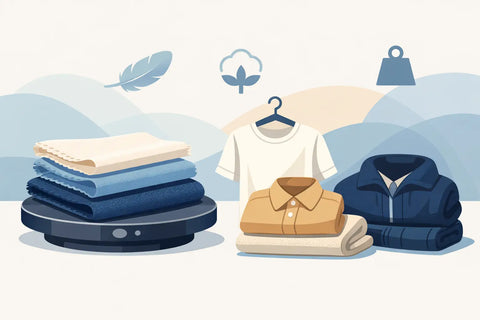
A shirt can look right on the hanger and still feel wrong the moment you put it on. Too light, and it loses shape by noon. Too heavy, and it fights the body. That tension is exactly why a guide to garment fabric weights matters. Weight is not a technical footnote. It is one of the clearest signals of how a garment will wear, move, age, and earn its place in a wardrobe.
For anyone building a considered wardrobe, fabric weight helps separate surface appeal from long-term value. It tells you whether a worker jacket will hold structure, whether a poplin shirt will stay crisp, and whether a pair of trousers will feel useful across more than one season. It also keeps expectations honest. A heavier fabric is not automatically better. Lighter is not automatically inferior. The right weight depends on the garment, the climate, the weave, and the life you expect it to have.
Guide to garment fabric weights: what weight actually means
Fabric weight is usually measured as GSM, or grams per square meter. In practical terms, GSM tells you how much one square meter of fabric weighs. The higher the number, the denser or heavier the fabric tends to feel. In the US, you may also see ounces per square yard, especially in denim and heritage workwear. Both measurements are useful. GSM is just easier to compare across categories.
Still, weight alone never tells the whole story. A 250 GSM jersey and a 250 GSM twill will behave very differently. Knit versus woven matters. Fiber matters. Finish matters. A brushed cotton can feel warmer than its number suggests, while a tightly woven plain weave may feel crisp and cool even at a moderate weight. Think of fabric weight as a strong clue, not a verdict.
How garment fabric weights affect the way clothes wear
The first thing weight changes is drape. Lighter fabrics tend to sit closer to the body or fall with more fluidity. Heavier fabrics hold a line. That is why a utility shirt in a denser cotton can feel more architectural, while a lighter shirting cloth reads softer and more relaxed.
The second is durability, though this needs nuance. Heavier fabrics often resist abrasion better and tolerate hard wear. That makes sense in chore coats, fatigue pants, and overshirts. But durability is also about staple length, yarn quality, weave density, and construction. A poorly made heavy fabric can break down faster than a well-made midweight one.
Then there is seasonality. Light fabrics release heat more easily and layer without bulk. Heavy fabrics trap warmth and create more visual presence. But seasonless dressing usually lives in the middle. Midweight cloth is often the most worn because it can move between temperatures, interiors, and travel without becoming too specialized.
A practical range for common garment categories
There is no universal chart that applies to every fabric, but broad ranges help.
Lightweight shirting often falls around 90 to 140 GSM. This is where you find crisp poplins, airy voiles, and lighter chambrays. These fabrics work well in warm weather or under tailoring, but some can feel too slight if you prefer structure.
Midweight shirting and overshirt fabrics usually sit around 140 to 220 GSM. This range often gives the best balance of body and ease. It can hold a collar better, wear longer, and move from standalone shirt to light layer without strain.
Trouser fabrics often begin around 200 GSM and move upward fast. Around 220 to 300 GSM, you get year-round cotton twills and canvases with enough substance to keep shape. Heavier versions above that start to feel more distinctly workwear-driven and can be ideal if you value structure over softness.
Denim has its own language, but the principle is the same. Lighter denims can feel easier and more flexible from the start. Midweight and heavy denims usually offer better shape retention, stronger fades, and a more substantial break-in. They also demand more patience.
Jackets and outerwear cover the widest range. Some lightweight shell fabrics are low in GSM but high in performance. A chore jacket in cotton drill or canvas often lands in a much heavier bracket because it is built to protect, carry, and age visibly.
Why the same weight can feel completely different
This is where experienced buyers tend to look past the number.
A plain weave at 180 GSM will often feel cleaner and flatter than a twill at the same weight. Twill lines create flexibility and a slightly softer hand, which is one reason it appears so often in utility trousers and work shirts. Canvas, by contrast, feels firmer and more resistant. Sateen can feel smoother and denser against the skin, even when the scale says otherwise.
Fiber content changes the reading too. Cotton is often the baseline reference because it is familiar, but linen feels lighter and drier in wear, wool regulates temperature differently, and synthetics can vary from crisp to slick depending on construction. A dense wool at a moderate weight can feel warmer than a heavier cotton. A technical blend may weigh less but wear tougher.
Finishing also matters. Garment washing can relax a heavy cloth and make it feel less rigid. Waxing adds protection and perceived density. Brushing increases surface softness and warmth. These details alter the experience of weight as much as the number itself.
Choosing the right fabric weight for the garment
If you are buying a photographer shirt, fatigue pant, or worker jacket, start with the job the garment needs to do. A shirt that is meant to layer under outerwear and move through long days benefits from enough body to hold shape, but not so much bulk that it becomes restrictive. That usually points to a midweight cloth.
For trousers, ask how much structure you want through the leg. Balloon and utility shapes often look better in fabrics with enough density to maintain volume. Too light, and the silhouette collapses. Too heavy, and movement can feel forced. The right middle gives shape without stiffness.
Outer layers can carry more weight because they do more work. They frame everything underneath. But there is still a trade-off. A heavier jacket brings authority and durability, while a lighter one offers range. If you travel, move between climates, or prefer one garment to work across most of the year, moderate weight usually earns more wear.
The case for midweight, seasonless fabrics
The most useful wardrobes are rarely built from extremes. They are built from fabrics that can shift context.
That is why midweight cloth matters so much in modern workwear and utility dressing. It supports silhouette, takes abrasion, layers cleanly, and stays relevant beyond a single season. It also tends to wear in rather than wear out. Creases settle. Surface character develops. The garment becomes more specific to the person wearing it.
This is part of the appeal behind brands like WORKWARE. Not novelty. Not seasonal performance. Just the quiet confidence of fabric chosen to hold up, soften gradually, and remain useful.
What to ask before you buy
A good guide to garment fabric weights should leave you with better questions, not just numbers.
Ask whether the fabric suits the silhouette. Ask whether the weight supports the garment’s purpose. Ask whether you want immediate softness or a longer break-in. Ask how often you realistically wear pieces that are very light or very heavy. Most people know the answer once they look at their own wardrobe honestly.
If product descriptions list GSM, use it. If they do not, look for clues in words like poplin, twill, canvas, drill, brushed, washed, or densely woven. Those terms often tell you as much about the garment’s behavior as the exact measurement.
And if you can handle the piece in person, trust your hands. Lift it. Scrunch it. Notice whether it springs back or collapses. See how it hangs from the shoulder. Fabric weight is felt before it is understood.
A well-made garment does not need to announce itself. You notice it later, in the way it keeps its line, takes wear, and returns to use without effort. That is usually the sign that the weight was right from the start.