
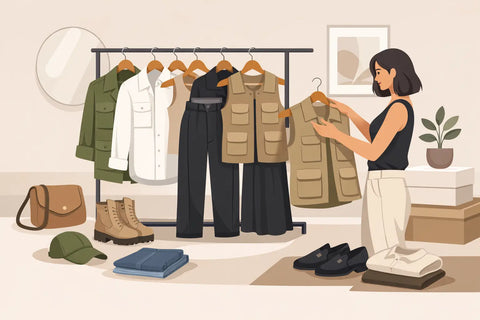
A shirt that carries like outerwear. Trousers with room to move. A jacket that works across six months, not six weeks. That is the logic behind a capsule wardrobe with utility separates - fewer garments, more function, and enough character to avoid uniformity.
For a certain kind of dresser, the problem is rarely having nothing to wear. It is having too many pieces that do too little. Trend product fills space, then fades. Utility dressing solves that by asking more of each garment: durability, versatility, and a silhouette that holds up after the novelty is gone.
Why a capsule wardrobe with utility separates works
A standard capsule wardrobe often leans abstract - a white shirt, a blazer, a jean, a knit. Useful, but generic. Utility separates make the system sharper. They bring structure, pockets, weight, and purpose. A worker jacket does more than a cardigan. A utility trouser carries differently than a slim chino. A photographer shirt can sit between shirting and light outerwear without feeling indecisive.
The point is not to dress like a mechanic or borrow workwear as costume. It is to use garments designed with function in mind, then refine the mix. Utility references matter because they produce better forms: fuller sleeves for movement, patch pockets that are actually usable, denser cottons that age with wear, and silhouettes that can hold their shape without stiffness.
This matters even more in a capsule. When the wardrobe is smaller, every weak piece is exposed. If a jacket only works with one pant, it is wasting space. If a shirt wrinkles into apology after two hours, it does not belong. Utility separates earn their place because they can absorb repetition. They look better for being worn often.
Start with silhouettes, not categories
Most people build a capsule by counting categories. Two shirts. Two pants. One jacket. That is tidy, but not always intelligent. A better approach starts with shape.
If your wardrobe depends on one narrow silhouette, it can feel stale fast. Utility separates give you room to build variation while staying coherent. Think of three lanes: a relaxed straight line, a fuller volume, and a clean layer that contains both. That might mean a straight utility trouser, a balloon pant, and a structured jacket with enough boxiness to sit over either.
This is where experienced buyers tend to make better decisions. They know a wardrobe is not just a checklist. It is proportion. A cropped worker jacket changes the stance of a wider pant. A longer overshirt can calm a fuller leg. A heavier shirt fabric can replace a light jacket in transitional weather. These are small shifts, but they create range without increasing quantity.
The core pieces
A useful capsule wardrobe with utility separates usually begins with six to ten garments that can be worn across most of the week. Not identical basics. Distinct forms with overlap.
The first anchor is outer layer territory: a worker jacket or chore coat in cotton drill, canvas, or a substantial twill. It should layer over a tee and a shirt without strain. Too fitted, and it becomes occasion-specific. Too oversized, and it loses precision.
The second is the overshirt or photographer shirt. This is one of the most efficient garments in a modern wardrobe because it can function as shirt, layer, or light jacket. It travels well across settings. On some days it replaces tailoring entirely.
Then come trousers. One pair should be clean and direct - straight utility trousers or fatigue-inspired pants in a durable cotton. The second can carry more shape: balloon pants, fuller carpenter forms, or a softly tapered volume. Together, they prevent sameness.
From there, add a denim piece if denim suits your life, a crisp jersey tee or two, and one knit or sweatshirt with enough density to hold its line. If skirts or dresses are central to the way you dress, the same principle applies. Choose utility-inflected forms with structure, pocketing, and seasonless fabric rather than decorative detail.
The strongest capsules are not crowded with options. They are edited around garments that can rotate roles.
Fabric is the real strategy
Fabric decides whether a capsule is practical or merely photogenic. Utility separates work best when the cloth has enough body to create shape, enough durability for repetition, and enough ease for year-round wear.
Cotton twill is an obvious foundation because it wears in well and carries utility references honestly. Herringbone, ripstop, poplin, chambray, and mid-weight denim all have their place too. What matters is balance. Heavy fabrics add authority, but if every piece is too dense, the wardrobe becomes rigid and climate-dependent.
A good capsule mixes weights. One heavier jacket. One mid-weight shirt layer. Trousers that can handle daily wear without feeling armored. The goal is not maximal toughness. It is sustained use.
Natural wear should also be part of the appeal. Fading, softening, edge abrasion - these are not flaws in a utility-based wardrobe. They are evidence of a garment entering your life properly. Buy better. Keep forever only works if the materials can age without collapsing.
How to keep utility from feeling literal
The best utility dressing is restrained. Once every garment starts shouting pocket, tab, strap, and contrast stitch, the system breaks.
The fix is simple. Let one detail speak at a time. If your trouser has volume and patch pockets, your top layer can stay cleaner. If your jacket has strong structure, the pant can be more neutral. Utility should guide the wardrobe, not costume it.
Color matters here as well. A capsule built around utility separates usually benefits from a reduced palette: off-white, washed black, olive, navy, khaki, ecru, indigo. These shades carry workwear heritage naturally and combine without effort. You can add one sharper note if it suits you - rust, deep green, faded red - but the base should remain calm.
This is also where unisex dressing becomes especially effective. Many utility garments are already designed around movement, layering, and tolerance in fit. They do not rely on overtly gendered styling to make sense. One garment. Different bodies. Different lives. The strength is in the form.
What to buy first, and what can wait
If you are building from scratch, start with the piece that solves the most use cases. For many people, that is the jacket. A good worker jacket can replace a casual blazer, a light coat, and the throw-on layer you reach for most weekdays.
If you already own solid outerwear, begin with trousers. Utility trousers tend to change a wardrobe quickly because they alter proportion while staying wearable. They also reveal what your existing tops can and cannot do.
Shirts and overshirts come next. They create the connective tissue between pants and outerwear. After that, fill true gaps only. Not imagined ones.
There is a trade-off here. A highly disciplined capsule can save time and sharpen personal style, but it also asks for honesty. If you attend formal events often, utility separates alone may not cover everything. If you live in high heat year-round, some classic workwear fabrics may feel excessive. The answer is not abandoning the system. It is adjusting the materials and counts to your real conditions.
A capsule wardrobe with utility separates across seasons
Seasonless does not mean one fabric for all weather. It means the forms remain relevant while material weight shifts.
In cooler months, the system leans into brushed twill, heavier denim, layered shirting, and jackets with enough room for knitwear underneath. In warmer months, the same wardrobe can move through poplin shirts, lighter cotton canvas, relaxed trousers, and an overshirt worn open over a tee. The silhouette language stays intact.
That consistency is what gives the capsule its staying power. You are not reinventing yourself every quarter. You are refining the same vocabulary.
At WORKWARE, that principle sits at the center of the wardrobe. Details with a past. Forms for now. Utility is not there for nostalgia. It is there because function produces clarity, and clarity wears well.
The pieces should get better together
A real capsule is not a stack of individual heroes. It is a set of garments that improve one another. The jacket sharpens the tee. The fuller trouser gives presence to a plain shirt. The overshirt closes the gap between casual and considered.
That is why utility separates belong in this kind of wardrobe. They carry enough substance to stand alone, but they are not precious. They can repeat. They can travel. They can pick up wear and still look intentional.
When a wardrobe starts working at this level, getting dressed becomes quieter. Less searching. Less compromise. Just garments with purpose, built to hold their place over time.
If you are editing your closet this season, choose the pieces that can do more than one job and still age with dignity. The rest is noise.