
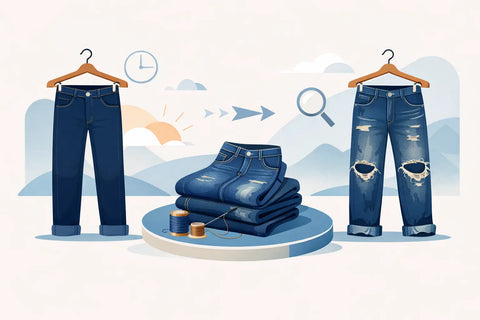
A good pair of jeans tells on you. Not in a romantic way. In a precise one. The crease behind the knee, the wallet shadow, the softened seat, the bright edge at the pocket opening - these are denim aging examples over time that record how a garment was actually lived in.
That is the appeal. Raw denim does not age evenly, and it should not. It responds to fabric weight, yarn character, cut, movement, laundering, climate, and patience. Two pairs made from the same mill run can end up looking unrelated after a year. For anyone who buys clothing with a long view, that variability is the point.
What denim aging examples over time really show
When people talk about denim aging, they often mean fading. That is only part of it. Aging also changes hand feel, drape, structure, and shape retention. A rigid jean becomes more fluent through the thigh and seat. High-friction zones brighten. Seams begin to stand out. The cloth loses some surface starch and gains a more personal architecture.
In raw or one-wash denim, indigo sits mostly on the yarn exterior while the core stays lighter. Wear removes that surface dye gradually. This is why movement creates contrast. Areas that fold and rub often fade first. Areas with less stress stay darker longer. The result can be subtle and tonal or sharp and high-contrast, depending on the cloth and the wearer.
Not every jean should age dramatically. Some denims are designed for slower, quieter change. A left-hand twill may soften faster. A loosely woven fabric may drape earlier. A slubby denim may develop more visual texture, while a cleaner ring-spun denim can look more restrained. Aging is not a contest. It is a material response.
Denim aging examples over time by stage
First 30 wears
At the beginning, most change is structural rather than visual. Raw denim feels firm, sometimes dry, and often slightly resistant at the waist and top block. After a few weeks, the fabric starts to relax at pressure points. The knees set. The hips settle. The waistband eases a little with body heat and movement.
Visually, you may notice only the earliest signs: slight lightening at the fly, pocket bags faintly telegraphing through the front, and the first crease memory behind the knees. Dark indigo still reads as dark indigo. The pair looks cleaner than it feels.
Three to six months
This is when character begins to appear. Whiskers at the lap become clearer if you sit often and the fit is close enough to hold crease patterns. Honeycombs behind the knees start to stack if the inseam and knee position work with your stride. Pocket edges brighten. Hems may show abrasion, especially on longer inseams or wider cuts that break on the shoe.
For straight and tapered jeans, contrast often develops faster because the fabric folds in more repeatable places. Wider silhouettes can age more softly. Less tension means less sharply drawn crease lines. Neither is better. They simply record movement differently.
Six months to one year
By this stage, the denim starts to look owned rather than new. The front thigh may show broader fade fields. A phone outline can emerge in the pocket. The back pockets begin to reveal use patterns, and high-contact seams along the outseam or yoke can pop slightly lighter than the body cloth.
Texture becomes easier to read. Nep, slub, or vertical grain shows more clearly as indigo lifts unevenly from the yarn surface. This is often the period when wearers decide whether they like the direction of the fade. If the pair has been worn hard with minimal washing, contrast can be pronounced. If it has been washed earlier and worn more evenly, the result is usually flatter and more understated.
One to three years
This is where the best examples become specific. Repairs may enter the picture at the crotch, pocket corners, or hem. The denim softens enough to drape with less memory, but durable cloth still holds form at the seam lines. Indigo loss is now legible from a distance. The jean has a topography.
A heavily worn pair might show bright whiskers, deep honeycombs, roping at the hem, and seat fading. A more gently worn pair may develop broad atmospheric fading without sharp lines. In both cases, the garment is better for time. It has moved past novelty and into use.
What shapes the result
Fabric comes first. Heavier denim, especially 14 oz and above, usually takes longer to break in and can produce stronger contrast if worn consistently. Lighter denim softens sooner and often fades more diffusely. Neither is inherently superior. Heavy cloth gives resistance and structure. Lighter cloth gives mobility and a quicker sense of ease.
Yarn matters too. Uneven yarns create irregular fading. Slubby denim can develop a more animated surface because the raised sections abrade first. Cleaner yarns fade in a calmer, flatter way. Rope-dyed indigo tends to produce more visible contrast over time because the dye does not fully penetrate the yarn core.
Fit is the second major factor. A slim or close straight fit creates repeated friction in the same places, so whiskers and knee stacks become more defined. A relaxed or balloon silhouette distributes wear across a wider area. The fade is often less graphic, more tonal, and sometimes more modern for that reason. It depends on whether you want the denim to map your body tightly or move around it.
Washing habits change everything. Frequent washing removes dirt and sweat that can otherwise grind into the fibers, but it also softens contrast and resets crease memory. Delayed washing preserves sharp fade patterns longer, though there is a trade-off. Too much accumulated stress in one area can weaken the cloth sooner. For most people, a sensible middle ground works best: wear the jeans enough to set character, then wash when they need it, not by rule.
Common fade patterns, without mythology
Whiskers are the horizontal crease fades at the lap. They come from sitting, bending, and how the top block fits. Honeycombs form behind the knees from repeated stacking and flex. Train tracks can appear along the outseam, where raised seam construction abrades more slowly or differently than the surrounding fabric. Roping at the hem comes from chain-stitched hems twisting and wearing unevenly after repeated laundering and abrasion.
These patterns are real, but they are not mandatory. Not every quality jean develops textbook whiskers or dramatic combs. If the fit is relaxed, the wearer rotates pairs often, or the denim is washed early and regularly, the result may be more uniform. That is still honest aging.
The difference between good wear and damage
Beautiful aging has tension in it. Enough friction to reveal the cloth, not so much that the garment fails before its time. The crotch is usually the first high-risk zone because it carries stress, heat, and constant movement. Pocket corners, hems, and knees are also vulnerable.
Repair is part of the life of denim, not a failure of it. A discreet darn at the crotch or pocket edge can add years without changing the character of the jean. In fact, repaired denim often looks better because it shows stewardship rather than disposal. Buy better. Keep forever. The phrase only means something if maintenance is included.
How to read a pair before you buy it
If you care about aging, look beyond color. Check the fabric weight, weave character, and whether the denim is raw, rinsed, or washed down. Raw and one-wash pairs usually offer the most visible personal evolution. Pre-washed denim has already been guided to a finish, which can be useful if you want softness and stability from day one but less transformation later.
Look at the cut with equal attention. A jean that fits your movement will age better than one chosen for theory alone. If you bike, sit long hours, squat, commute, or wear boots daily, those habits will shape the cloth. The right pair makes room for that life rather than fighting it.
For a brand like WORKWARE, where form and function are inseparable, the strongest denim is the kind that improves with repetition. Not louder. More precise.
Why time is the real finishing process
The best denim aging examples over time are rarely the most extreme. They are the most convincing. A pair with measured fading, softened edges, and one or two careful repairs often feels more resolved than a pair pushed too hard for contrast. You can see the difference between denim worn for life and denim worn for effect.
That is what makes aging worth paying attention to. It turns denim from a product into evidence. Fabric records habit. Construction reveals its strengths. Indigo gives way where the body insists. If you choose well and wear honestly, the finish arrives slowly, exactly where it should.