
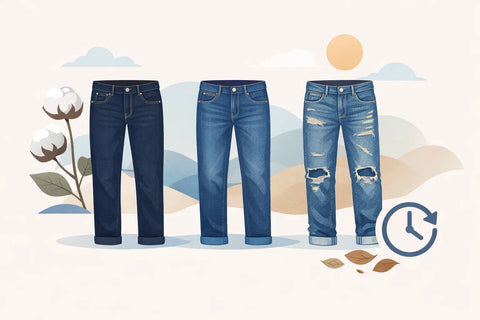
A good pair of slub denim rarely stays polite for long. The surface starts with visible irregularity - raised streaks, thicker yarn sections, a dry handfeel, a little friction in the fabric. Wear it for a few months and the question becomes less theoretical: how does slub denim age when those inconsistencies meet real movement, pressure, and time?
The short answer is beautifully. But not evenly, and not in the same way as flatter, cleaner denim.
How does slub denim age differently?
Slub denim is woven from yarns with deliberate variation in thickness. Some sections are fuller, some are finer. That unevenness changes the surface of the cloth before it has even been worn. It also changes how indigo sits on the yarn and how abrasion reveals what sits underneath.
As the fabric ages, the higher and thicker areas tend to catch more friction. Knees, thighs, seat, pocket edges, hems, and any place that folds repeatedly start to fade with more texture and more contrast. Instead of a smooth, even washout, slub denim often develops a broken-in look with visible dimension. The fade pattern can feel sharper, more tactile, and a little more alive.
That is the appeal. Slub denim records wear with more definition. It does not simply get lighter. It gets more articulate.
The first phase - stiffness, grain, and shine
In the early wears, especially if the denim is raw or only lightly rinsed, slub can feel structured and slightly coarse. This is normal. The uneven yarns create micro-high points across the surface, so the fabric may feel drier and more textured than standard denim with a smoother weave.
At this stage, aging is subtle. You may notice faint brightening at the whisker area, behind the knees, or along the outseam. Wallet and phone outlines can appear earlier on slub denim because the raised texture takes abrasion quickly. But the fabric still holds much of its original depth.
There is often a slight sheen on darker indigo pairs in the beginning, particularly where the yarn twist is pronounced. With wear, that shine settles. The cloth starts to look less new and more specific to the person wearing it.
What fading looks like on slub denim
The most distinctive thing about slub denim aging is the way light catches the surface as it fades. Because the yarns are uneven, the fade is uneven too - in a good way.
On a smooth denim, fading can read as soft and uniform. On slub denim, it often appears streakier, more vertical, and more textured. Some sections hold indigo longer. Others lose surface dye faster. This creates a high-low effect that gives the cloth depth even from a distance.
High-contrast fading is common, but not guaranteed. It depends on the denim weight, dye method, yarn irregularity, and how you wear it. A heavily slubbed 14-ounce raw denim will usually age with more drama than a softer 10-ounce washed slub fabric. The first can produce sharp train tracks and strong combs. The second may soften into a more relaxed, vintage surface.
Neither outcome is better. It depends on whether you want precision or ease.
Vertical fading and rain lines
Many slub denims develop vertical character over time. You may hear people describe this as rain lines or striations. These are subtle streaks running with the warp yarns, created by uneven yarn thickness and irregular dye loss.
That vertical movement is part of what makes slub denim feel more architectural. Even when the garment is simply cut, the fabric carries visual structure on its own.
Creases become more visible
Because the cloth has more surface variation, creases often age with stronger contrast. Honeycombs behind the knees, whiskers at the lap, and stacks near the hem can look more pronounced than they would on a flatter denim. If you prefer a denim that tells the truth about how it is worn, slub usually does that better.
Softening is part of the story
People often focus on fading, but handfeel matters just as much. Slub denim does soften with wear, though the process can be slower than expected.
The fabric usually starts by relaxing at stress points first. The waistband molds. The seat eases. Knees and elbows loosen if the garment is cut close enough to crease there. After repeated wear and a few washes, the denim loses some of its initial crispness and begins to drape better.
What is interesting is that slub rarely becomes bland. Even when softened, it tends to keep a dry, grainy character. The surface remains expressive. That balance - softer body, visible texture - is one reason slub denim feels so satisfying after a season of wear.
Washing changes the result
If you are asking how does slub denim age, washing is one of the biggest variables.
Frequent washing usually leads to a cleaner, lower-contrast fade. The denim softens sooner, shrinkage settles earlier, and the indigo releases more gradually across the garment. This can produce a more natural, understated finish - closer to an old favorite than a fade project.
Infrequent washing tends to preserve sharper contrast in the crease points, at least for a while. The worn areas abrade against a darker base for longer, so the highs and lows become more visible. But there is a trade-off. Dirt, sweat, and pressure can also stress fibers in concentrated spots. Wait too long and the denim may age harder, not necessarily better.
For most people, the best approach is simple. Wear the garment regularly. Wash it when it actually needs washing. Let the fabric age in a way that supports longevity, not just contrast.
Weight and construction matter
Not all slub denim ages with the same intensity. The yarn character matters, but so do weight and weave.
A lightweight slub chambray-style denim shirt may soften quickly and develop gentle highs and lows around the collar, cuffs, and placket. A midweight pair of work pants will show more structure through the thigh and knee. A heavier selvedge slub denim can become highly personalized, with sharper crease memory and more visible tonal separation.
Construction also shapes the outcome. Felled seams, reinforced pocket openings, chain-stitched hems, and heavy stress stitching create distinct wear zones. The fabric tells one story. The build tells another. Together, they decide how the piece matures.
Color depth and indigo behavior
Slub denim is often dyed with rope-dyed indigo warp yarns and white weft yarns. That matters because rope dyeing leaves the core of the yarn lighter than the surface. As the outer indigo abrades, the lighter core begins to show, producing the familiar fade.
With slub yarns, some parts of the yarn catch and lose dye differently than others. That is why the surface can shift from deep indigo to electric blue in streaks rather than across a flat plane. If the starting shade is very dark, the contrast may be more dramatic. If the denim has already been stone-washed or enzyme-washed, aging may be subtler from day one.
Black slub denim behaves differently. It often fades to charcoal, graphite, or smoky gray instead of bright blue. The texture is still there, but the effect is quieter.
What to expect after one year
After consistent wear over a year, slub denim usually shows itself fully. Not finished, but established.
The areas you move in most will have softened and brightened. Pocket entries may feather. The seat will read smoother from pressure. The thighs may show pale, textured patches where the surface has been polished by repetition. Hems can fray slightly, especially on heavier denims with a hard break. Shirts may show subtle fading at the collar stand and cuff edge.
More importantly, the fabric starts to feel less like stock and more like ownership. Slub denim gains identity because its aging is difficult to fake perfectly. Industrial washes can imitate the broad strokes. They rarely capture the specific irregularity of lived-in wear.
Is slub denim more durable?
Not automatically.
Slub refers to yarn irregularity, not guaranteed toughness. Some slub denims are dense and long-wearing. Others prioritize texture over tensile strength. If the yarn is very uneven or loosely woven, certain high points may abrade faster. If the denim is tightly woven and well made, that same texture can age beautifully without compromising lifespan.
This is where fabric quality matters more than marketing language. A well-developed slub denim should feel intentional, not just rough. Texture should serve the cloth, not distract from weak construction.
Why people keep coming back to it
Slub denim is not for everyone. Some people prefer a clean, uniform fabric that fades quietly and softens fast. That makes sense.
But for those who like garments to hold memory, slub offers more. More surface. More change. More evidence of wear. It starts with character and then earns more of it.
That makes it especially at home in a wardrobe built on repetition - worker jackets, utility shirts, easy trousers, straight denim, pieces worn across seasons until they become part of your proportions. At its best, slub denim does what good workwear always does. It improves through use.
Choose it if you want denim that reveals time, not hides it. Then wear it without ceremony. The fabric will do the rest.