
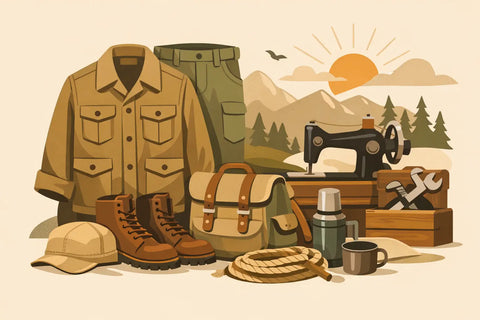
A jacket with real pocket depth changes how you move through the day. Trousers cut with room where it matters get worn on repeat. That is the appeal of vintage inspired utility clothing - not costume, not nostalgia for its own sake, but clothes shaped by use and refined for now.
The best versions do not imitate the past too literally. They borrow what still works: hard-wearing fabrics, practical construction, generous proportions, and a clarity of purpose. Then they adjust the silhouette, weight, and finish for contemporary life. The result feels grounded. Useful. Quietly distinct.
What vintage inspired utility clothing gets right
Utility clothing began with a job to do. Work jackets, fatigue pants, chore coats, field shirts, and carpenter trousers were designed around movement, durability, and storage. Vintage references matter because those garments solved real problems. Their details were earned.
That is why this category continues to resonate. A well-cut utility jacket does more than signal taste. It layers easily, carries what you need, and improves with wear. A fatigue-style pant with a fuller leg feels current not because it is trendy, but because the shape makes sense. It sits away from the body, creates ease, and allows the fabric to hold its form.
There is also a visual honesty to these clothes. Bar tacks, patch pockets, reinforced seams, washed canvas, herringbone twill, garment-dyed cotton - each element tells you something about function. Even when a piece is elevated, the logic remains visible.
Vintage inspired utility clothing is not reproduction
This is where the distinction matters. Reproduction clothing aims to replicate a period piece as closely as possible. That can be compelling, especially for collectors, but it is not always the best fit for everyday wardrobes. Original military or workwear proportions can be narrow in one area, oversized in another, or built around fabric weights that feel too rigid for daily city wear.
Vintage inspired utility clothing takes a more disciplined approach. It keeps the character, edits the excess, and updates what needs updating. A worker jacket may hold its square stance and patch-pocket layout, but the shoulder line is cleaner. Balloon pants may reference old labor uniforms or military volume, but the taper is controlled. A photographer shirt might pull from fieldwear utility while feeling sharper and lighter in practice.
That balance is what gives the category longevity. Too much historical accuracy and the piece can feel theatrical. Too little, and it becomes a generic basic with a few decorative pockets. The strongest garments sit in between.
Fit is where the modern shift happens
Silhouette carries most of the difference between heritage costume and modern utility dressing. Older workwear often had practical volume, but contemporary design reframes that volume with more intention.
A wider trouser, for example, can create structure rather than bulk when the rise, leg shape, and hem are considered together. The same goes for jackets. Slightly boxy fits feel cleaner over knitwear, shirting, or a tee. They also make the garment more shareable across wardrobes, which is one reason unisex utility clothing has such lasting appeal.
The trade-off is that fit needs attention. A roomy cut should feel deliberate, not simply oversized. Fabric matters here. Crisp cotton twill holds architecture. Softer washed canvas collapses more naturally. Denim sits somewhere in between, depending on weight and finish. The same pattern can read very differently across materials.
For experienced dressers, this is often the point of entry. They are not looking for novelty. They are looking for proportion that adds something to the wardrobe system they already have.
Fabric decides whether a piece earns its place
In utility clothing, fabric is not background. It is the garment.
A cheap fabric can mimic the look of heritage workwear for a season, but it rarely carries the same authority. It loses shape, pills at stress points, or feels flat after washing. Better fabrics gain character. The twill softens. The denim creases with definition. The surface records wear without looking tired.
This is part of the appeal of buying fewer, better pieces. A utility trouser in dense cotton with a proper hand does more across the year than several lighter, trend-driven alternatives. A structured overshirt can function as a shirt, a layer, or a light jacket depending on temperature and styling. Seasonless versatility is not marketing language when the fabric and cut are doing real work.
There is, of course, an it depends element. Heavier fabric gives presence and durability, but not everyone wants weight. If you run warm, travel often, or need more indoor versatility, a midweight cloth may be the better choice. Utility does not always mean rugged in the bluntest sense. Sometimes it means adaptive.
The details worth paying attention to
Good utility design is usually quiet. It is easy to miss unless you know what to look for.
Pocket placement matters because it changes both function and line. A chest pocket set slightly lower can soften a shirt front. Deep front pockets on trousers improve use without distorting the silhouette. Reinforced stitching matters because it extends wear, but it also creates subtle visual rhythm. Adjustable cuffs, action pleats, side tabs, and cinch backs can all add flexibility if they are integrated cleanly.
The restraint matters just as much as the detail. Too many references in one piece can flatten it. A little military, a little railroad, a little mechanic, a little safari - together it becomes styling rather than design. The strongest garments choose one language and speak it clearly.
How to wear it without looking styled
The easiest way to wear utility clothing well is to treat it as foundation, not costume. Start with one clear piece - a worker jacket, a pair of utility trousers, a structured overshirt - and build around it with similarly direct items. Clean jersey, knitwear, straight denim, leather shoes, simple sneakers. Let the cut and fabric do the work.
Tone also helps. Utility clothing tends to look strongest in grounded colors: ecru, washed black, olive, indigo, khaki, tobacco, navy. These shades reinforce the function-first character and make layering easier across seasons.
If your wardrobe already leans minimal, vintage inspired utility clothing adds texture and shape without disrupting the overall line. If your wardrobe is more fashion-led, it provides a stable counterpoint. Either way, the point is wearability. A good utility piece should become instinctive to reach for.
Why this category keeps returning
Some trends burn bright because they photograph well. Utility clothing lasts because it lives well.
People are buying differently now, especially those who understand construction and cost per wear. They want clothes that justify space in the closet. Pieces that can move between weekdays and weekends, studios and offices, heat and layering season. Utility wear answers that need with more character than standard basics and more discipline than trend fashion.
That is also why vintage references remain useful. They bring a tested vocabulary to modern dressing. Not romance. Proof. Details with a past. Forms for now.
A brand like WORKWARE sits naturally in this space because the proposition is not about chasing a mood. It is about building a wardrobe with shape, integrity, and repeat-wear value. Buy better. Keep forever. The phrase only works when the garments do.
What to look for before you buy
If you are considering a piece of vintage inspired utility clothing, pause at three things: silhouette, fabric, and purpose. Ask how it fits into what you already wear, whether the cloth will improve with time, and what role the piece will play across the week.
A striking shape can still be practical if the fabric and styling support it. A simpler piece can still feel special if the construction is right. Price matters, but value sits in longevity. The best utility garments do not peak on first wear. They settle in, gain ease, and become more themselves over time.
That is the real test. Not whether a jacket looks heritage-inspired on a product page, but whether it still feels essential six months later. When a piece has clarity of form, purpose in the details, and enough restraint to live beyond a season, it earns its place without asking for attention.
Choose the garment that works hard in silence. That is usually the one you keep.