
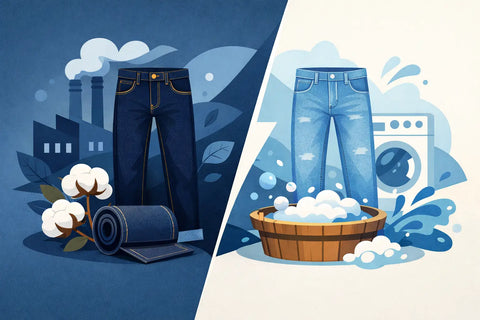
The difference between raw denim vs washed denim shows up fast - in the hand, on the body, and years later in the wear. One starts rigid and unfinished, asking for patience. The other arrives softened and settled, with much of its character established before the first wear. Neither is inherently better. The right choice depends on how you want your clothes to live with you.
For a wardrobe built on utility, that distinction matters. Denim is not just a color or a category. It is structure, surface, and behavior over time. If you care about longevity, fit, and how a garment ages, the wash is not a minor detail. It is the starting point.
Raw denim vs washed denim: the real difference
Raw denim is denim fabric that has been dyed and woven, then cut into garments without a post-production wash. It keeps the starch, tension, and deep indigo surface from the mill. The fabric feels crisp, often dry, sometimes almost board-like at first. It has a clean, architectural quality that many experienced wearers value.
Washed denim goes through an additional finishing process after construction. That wash may be light or aggressive. It can simply remove stiffness, or it can soften the fabric, reduce shrinkage, alter the shade, and introduce visible fading. The result is a garment that feels more broken-in from day one.
This is why raw denim often reads sharper at the start, while washed denim feels easier. Raw holds shape with more authority. Washed tends to drape sooner and move with less resistance. If you are choosing between the two, you are really choosing how much of the garment's life you want to shape yourself.
Why raw denim appeals to purists
Raw denim asks for commitment. That is part of its appeal.
Because the surface has not been pre-faded or heavily softened, wear patterns develop from your body, your habits, and your environment. Wallet outline, phone pocket shadow, knee movement, cuff stacks, seat creases - these are not decorative effects added in production. They are records of use. For many wearers, especially those drawn to workwear and heritage construction, that kind of personalization is the point.
There is also a structural advantage. Raw denim usually retains more firmness in the early stage of wear, which can make a silhouette look cleaner. Straight legs stay straighter. Wide shapes hold volume. Jackets keep their frame. If you appreciate garments that feel precise rather than relaxed, raw can offer that in a way washed denim often cannot.
That said, raw denim is not automatically tougher or longer-lasting. Durability depends on fiber quality, yarn size, weave density, fabric weight, and construction. A well-made washed denim can outlast a mediocre raw one. The idea that raw always means superior is too simple.
Where washed denim makes more sense
Washed denim has practical strengths that are easy to underestimate.
First, comfort. A washed pair of jeans or a denim jacket feels more approachable immediately. There is less break-in, less friction, less negotiation with the fabric. If you wear your clothes hard, rotate them often, and want them to integrate into daily life without ceremony, washed denim can be the more useful choice.
Second, predictability. Because the garment has already been processed, the handfeel and appearance are closer to what you will live with long term. There is usually less dramatic shrinkage, less stiffness, and fewer surprises after the first few wears or washes. For people who build wardrobes as systems, not trophies, that reliability matters.
Third, versatility of mood. Washed denim can feel less formal, less severe. It works well when you want workwear roots without the visual density of dark raw indigo. A faded wash can soften an outfit built from utility pieces, making it easier to wear across work, travel, and everyday use.
Raw denim vs washed denim in fit and break-in
Fit behaves differently in each.
Raw denim often starts tighter, especially in the waist, thigh, or sleeve bend, then relaxes with wear. Areas under tension can give back noticeably over time. This is why some buyers size raw denim with the break-in phase in mind. But that only works if you know the fabric. Sanforized and unsanforized raw denim do not behave the same, and neither responds exactly like a washed garment.
Washed denim is usually closer to its final state when you try it on. What you feel in the fitting room is often what you get after a month. There may be some easing with wear, but the change is usually smaller. For buyers who want cleaner decision-making around fit, washed denim removes some guesswork.
This is especially relevant in looser, unisex silhouettes. In a balloon pant, carpenter trouser, or boxy jacket, raw denim can exaggerate volume and edge early on. That can be beautiful if you want shape and presence. Washed denim, by contrast, will often settle faster and feel less sculptural. Neither is wrong. The question is whether you want the garment to stand away from the body or live closer to it.
How fading works over time
Raw denim fades with contrast. Washed denim fades with continuity.
On raw denim, the indigo sits more intact on the yarn surface. Friction removes it gradually, revealing brighter highs and deeper lows. This creates the high-contrast aging that denim enthusiasts chase. But it takes time, repetition, and a certain tolerance for inconsistency in the early months.
Washed denim begins with some of that contrast already introduced. The fade is more even, the look more settled. Future wear still adds character, but usually in a quieter way. If raw denim tells a sharp story of accumulation, washed denim tends to read as a softer continuum.
There is also a design question here. Factory washing can look honest and restrained, or overly scripted. The best washed denim respects the cloth. It softens and opens the fabric without forcing a false history onto it.
Care, maintenance, and longevity
Raw denim often comes with mythology. Some of it is useful. Some of it is not.
You do not need to avoid washing raw denim indefinitely to make it age well. In fact, refusing to wash it for too long can create unnecessary stress on the fibers, especially in high-friction areas. Sensible care extends life. The real discipline is washing less often, washing gently, and understanding that denim should earn wear without becoming fragile from neglect.
Washed denim is generally lower maintenance from the start. Because the garment has already gone through a wash process, there is less anxiety around first care. It is easier to treat as a daily tool rather than a project.
Still, both benefit from the same fundamentals: air between wears, spot clean when possible, wash inside out, avoid excess heat, and repair early. Longevity is rarely about one dramatic decision. It is about steady use and timely maintenance.
Which one belongs in a better wardrobe?
If you value process, like garments that record your routines, and want denim that starts crisp and ends specific to you, raw denim is hard to replace. It rewards patience. It can make even simple forms feel deliberate.
If you value ease, want immediate comfort, and prefer denim that is already integrated into daily wear, washed denim is often the smarter buy. It asks less and gives more upfront.
Many well-built wardrobes need both. Raw denim for structure, density, and long fade arcs. Washed denim for softness, flexibility, and everyday reach. That is not indecision. It is recognizing that fabric finish changes function.
At WORKWARE, the better question is rarely which is more authentic. It is which form suits the life ahead. A garment should meet wear with clarity, not attitude. Raw denim does that one way. Washed denim does it another.
Choose raw when you want to shape the outcome. Choose washed when you want the garment to arrive halfway there. Then wear it often enough that the distinction becomes personal.