
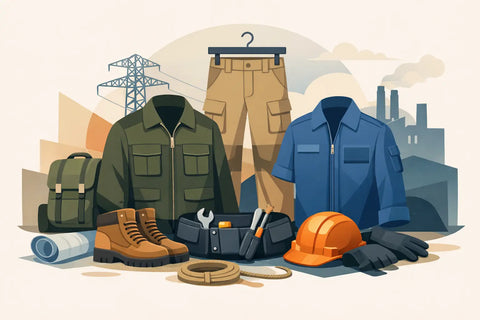
A jacket with real pocket depth changes how you move through a day. So do trousers cut to bend, sit, and carry weight without strain. That is the point of utility clothing at its best - not costume, not trend language, but garments shaped by use.
The term gets stretched too easily now. It can describe almost anything with a patch pocket or a washed canvas finish. But utility was never about surface cues alone. It came from need. Workwear, military issue, field dress, industrial uniforms - each solved specific problems through fabric, construction, and form. The best contemporary pieces still do the same. They simply do it with more considered proportion, better comfort, and a wider understanding of who wears them.
What utility clothing really means
Utility clothing begins with purpose. Every detail should justify itself. A pocket is placed where the hand naturally falls. A placket protects a closure from wear. A fuller leg allows movement. A dense twill resists abrasion and holds shape over time.
That does not mean every garment needs to look severe or technical. Some of the strongest utility pieces are quiet. A worker jacket in compact cotton drill. A photographer shirt with balanced pocketing. Balloon pants with volume that creates ease rather than excess. The visual language is restrained because the function is already built in.
This is where many modern interpretations miss. They borrow the signs of workwear without the discipline. Extra straps. Decorative seams. Pockets too small to hold anything useful. Fabrics chosen for appearance rather than wear. The result may read as "utility," but it does not perform like utility clothing.
Why utility clothing keeps returning
It returns because the need never left. Most wardrobes are overbuilt around occasion and underbuilt around life. People buy for a version of themselves that appears a few times a year, then neglect the garments they actually reach for every week.
Utility clothing answers a more practical question: what earns repeated wear? A good utility trouser can move between studio, commute, travel, and dinner. A structured overshirt can sit between shirt and jacket for most of the year. These are not one-use garments. They are systems pieces.
That is also why utility clothing appeals across gender lines. Functional shapes tend to be more adaptable. They leave room for the body rather than forcing the body to serve a narrow silhouette. A boxier jacket, a straighter shirt, a fuller trouser - these forms often work on more people because they begin from movement, not display.
The anatomy of good utility clothing
The fabric comes first. If the cloth fails, everything else follows. Good utility clothing usually depends on materials with enough density to hold structure, enough resilience to take wear, and enough character to age well. Cotton drill, ripstop, canvas, denim, herringbone twill, high-count poplin, and brushed moleskin each behave differently, but all have a reason to exist.
Weight matters, though not in a simplistic heavier-is-better way. Heavy canvas can be excellent in outerwear and punishing in a shirt. Lightweight poplin can be ideal in warm weather and too insubstantial for a hard-wearing trouser. It depends on the garment category, the climate, and how the piece is meant to function in a wardrobe.
Construction is next. Topstitching should reinforce stress points, not just decorate panels. Bar tacks should appear where strain is expected. Seams should feel clean and stable. Hardware should be chosen for longevity, but not so aggressively that it makes the garment stiff or noisy. Utility is often a matter of small decisions made well.
Then there is fit. This is where contemporary utility clothing has improved most. Vintage workwear can be beautiful, but not always comfortable by present standards. Modern pattern cutting allows for cleaner balance - higher arm mobility, better rise placement, a leg shape that moves without collapsing. The goal is not historical reproduction for its own sake. It is preserving the logic while refining the wear.
Utility clothing and silhouette
Silhouette is not separate from function. It is part of it. A cropped worker jacket pairs well with fuller trousers because it keeps the body proportionate and mobile. A relaxed shirt with a square hem layers more easily than a tightly fitted one. A balloon pant creates shape, but it also adds ease through the thigh and knee where movement happens.
That is why utility clothing often feels architectural. The lines are direct. Volume is controlled. Nothing relies on ornament to create interest. Shape carries the garment.
How to tell the difference between real utility and styled utility
The quickest test is simple: ask what the detail is doing.
If a pocket sits too low, too high, or too close to a seam to be useful, it is mostly visual. If a fabric wrinkles sharply, bags out quickly, or feels coated without reason, it may be serving image over wear. If a garment is overloaded with references - military here, hiking there, cargo elsewhere - the concept is likely stronger than the design.
Good utility clothing tends to be edited. It may borrow from several sources, but it resolves them into one coherent garment. Nothing feels pasted on. Nothing asks for attention it has not earned.
This restraint is what gives a piece longevity. Trend-driven utility usually peaks fast because it depends on immediate recognition. Better garments reveal themselves more slowly. You notice the pocket shape after months of use. You appreciate the cloth once it softens. You keep reaching for the same jacket because it continues to make sense.
Building a wardrobe with utility clothing
The strongest utility wardrobe is not large. It is interoperable. One jacket should work with several trousers. One shirt should move between solo wear and layering. Each piece should solve more than one need.
Start with outerwear because it defines the system. A worker jacket, chore coat, or compact overshirt gives structure without formality. Then build from trousers - ideally one straight or relaxed pair and one fuller silhouette for contrast. Shirts should sit between utility and ease: enough structure to stand alone, enough simplicity to layer.
Color matters here. Utility clothing is often strongest in grounded tones because they age well and combine easily. Olive, ecru, navy, black, iron gray, washed khaki, and deep indigo carry the heritage naturally. That does not mean color should be absent. It means color should be considered as part of longevity.
Utility clothing across seasons
Seasonless does not mean weatherless. It means garments are chosen to work across more of the year with small adjustments. A midweight cotton twill jacket can top a tee in spring, a shirt in fall, and a knit in winter. A poplin utility shirt can be worn open in heat and layered under outerwear when it cools.
This is where fabric selection matters more than trend timing. Buyers who understand clothing rarely ask whether a piece is "for this season." They ask whether it has range.
Why utility clothing matters now
There is a reason experienced buyers continue to return to these forms. Utility clothing offers clarity in a market crowded with novelty. It gives you garments that can absorb wear, adapt to different bodies, and stay relevant after the noise passes.
It also aligns with a better way of buying. Fewer pieces. Better cloth. Smarter construction. More repeat wear. The environmental argument is often stated too broadly, but one point remains true: clothing kept for years is fundamentally different from clothing bought for a moment.
That is where brands like WORKWARE sit with intention - not in nostalgia, and not in trend cycles, but in the space where heritage logic meets present-day use. Details with a past. Forms for now.
Utility clothing should not ask to be admired from a distance. It should invite wear. It should improve with friction, carry the marks of use, and become more specific to its owner over time. Buy the piece that keeps answering the same question, season after season: does this still make sense? If it does, keep it close.