
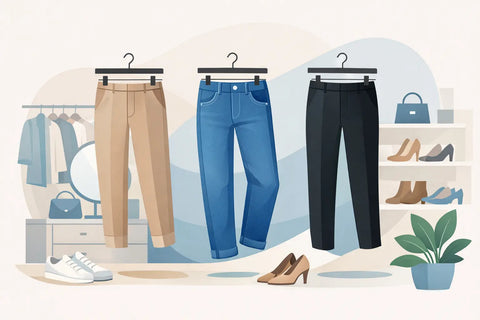
A versatile wardrobe usually fails in one place: the pants. Shirts can shift roles easily. Jackets can sharpen or relax a look in seconds. But trousers decide proportion, movement, and whether the whole system actually works. That is why the best pants for versatile wardrobes are not the loudest pair you own. They are the ones that hold their shape, work across shoes and outerwear, and keep earning their place.
For experienced dressers, versatility is not about owning fewer things for the sake of austerity. It is about clarity. A good pair of pants should move between work and weekend, between heat and cold, between structured dressing and something softer. The right pair does not need styling tricks. It already knows what it is.
What makes the best pants for versatile wardrobes
Versatility starts with silhouette. Not extreme. Not anonymous. A pant with a considered shape will stay useful longer than one built around a short-lived fit cycle. Straight legs, gentle tapers, relaxed utility cuts, and fuller volumes with control at the waist all tend to outlast trend-driven proportions. The detail that matters is balance. If the leg is wide, the rise and seat need discipline. If the cut is trim, it needs enough room to move.
Fabric is the second test. Pants take more abrasion than almost any other garment, so cloth matters more here than in a shirt. Midweight cotton twill, dense sateen, herringbone, ripstop, broken twill denim, and substantial canvas all age well when cut properly. They also transition across seasons better than fabrics that feel too thin, too precious, or too synthetic. A versatile pant should soften with wear, not collapse.
Then there is construction. Reinforced seams, clean waistband finishing, a strong fly, pocket bags that can handle daily use, and hardware that does not feel disposable - these are not romantic details. They are the reason a pair becomes a fixture. Longevity is practical.
Color matters, but less than most people think. The strongest foundation usually comes from dark navy, washed black, olive, stone, and muted khaki. These shades absorb repetition well. They work with leather, canvas, wool, jersey, and denim. Bright color can still belong in a wardrobe system, but it rarely serves as the central pair.
The five silhouettes worth building around
No single cut works for every body or every wardrobe. The best approach is to understand which silhouettes remain useful under pressure.
Straight-leg work pants
This is the quiet standard. A straight leg with a medium to high rise works with boots, sneakers, loafers, and simple leather shoes. It can take a chore jacket, an oxford shirt, a knit polo, or a plain tee without looking confused. In cotton twill or denim, it usually improves over time.
Its strength is neutrality, but not blandness. Straight-leg work pants carry structure without stiffness. For many wardrobes, this is the pair that gets worn three times a week without announcing itself.
Relaxed utility trousers
A utility trouser earns its place through pocket design, leg room, and fabric character. The best versions do not look costume-like. They reference military and industrial garments, but they are edited for daily use. That means pocket placement that stays clean, a rise that sits well, and a leg shape that feels intentional rather than oversized for effect.
These are especially strong for people who dress around outerwear. Worker jackets, field layers, overshirts, and heavier shirting all sit naturally with utility trousers. They also handle transitional weather better than finer tailoring fabrics.
Balloon or curved-leg pants
A fuller, slightly curved pant is not as niche as it seems. In a disciplined wardrobe, it can be one of the most useful shapes because it creates form without relying on decoration. The volume gives ease. The taper or curve keeps the silhouette resolved.
This shape works best when the fabric has body. Twill, chino cloth, and substantial denim can hold the line. Soft fabrics often make a curved leg feel too vague. For people who prefer simple tops and practical footwear, this cut can add depth without noise.
Tapered fatigue pants
Fatigue pants sit between military reference and everyday staple. The front patch pockets are part of their appeal, but the reason they endure is proportion. A good fatigue pant offers room at the top, a clean line through the leg, and enough taper to stay sharp with shorter jackets and knitwear.
They are often easier than chinos because they carry more character. At the same time, they are less formal than wool trousers and less casual than washed denim. That middle ground is where versatility lives.
Minimal pleated trousers
For wardrobes that lean more architectural than rugged, a restrained pleated trouser can do the same job as workwear pants, just through a different language. The key word is restrained. One pleat, a fuller top block, and a leg that falls cleanly can make these surprisingly flexible.
The trade-off is fabric sensitivity. If the cloth is too fine, the pant becomes occasion-specific. If it is cut in sturdy cotton, wool blend twill, or dense tropical wool, it can move across settings more easily. This is the dressier edge of versatility, not the universal answer.
Best pants for versatile wardrobes by fabric
Fabric changes the role of a pant more than naming does. Two pairs with the same pattern can live very different lives depending on the cloth.
Cotton twill is often the most reliable choice. It has enough structure for shape, enough breathability for long wear, and enough resilience for repetition. It also develops surface character instead of simply wearing out.
Denim brings a stronger visual identity. That can be useful or limiting, depending on how the rest of the wardrobe is built. Dark, clean denim with a measured silhouette is highly adaptable. Distressed washes and high-contrast fading are less so.
Ripstop and herringbone carry stronger workwear and military references. They can be excellent in wardrobes built around utility, knitwear, and simple leather goods. They may feel too specific if the rest of your clothing is very polished.
Wool and wool blends add refinement, but they ask more from the wearer. They are ideal if your daily uniform includes tailoring, fine knits, or clean leather shoes. Less ideal if you need something you can wear hard without thinking.
The best fabric is not the most luxurious one. It is the one that suits your actual week.
Fit is where versatility is won or lost
A versatile pant should not require perfect conditions. It should work with a tucked shirt, an untucked knit, a short jacket, and a longer coat. That range depends on fit.
Rise is often overlooked. A medium to high rise is generally more adaptable because it creates a cleaner relationship with tops and outerwear. Low rise can look sharp in narrow contexts, but it tends to reduce flexibility.
Hem width matters too. Too narrow and the pant becomes dependent on one kind of shoe. Too wide and it can start to pool awkwardly unless the rest of the silhouette is calibrated. A hem with enough presence to sit over multiple shoes is usually the safest choice.
Length should be intentional. Full break, slight break, cropped, or clean no-break can all work. What does not work is uncertainty. Good pants look considered even when worn casually.
How to choose fewer, better pairs
If you are building a wardrobe system, start with two pairs, not six. One should be a daily foundation - usually a straight or relaxed work pant in navy, olive, black, or khaki. The second should shift the silhouette or mood - perhaps a fuller balloon trouser, a fatigue pant, or a clean pleated option.
That pairing creates range without redundancy. It lets tops, jackets, and footwear do more. It also reveals what your wardrobe actually needs. Some people discover they never reach for denim once they have a strong twill trouser. Others realize a more generous leg unlocks the rest of their closet.
There is no reward for theoretical versatility. If a pair only works in carefully styled outfits, it is not truly versatile.
The details worth paying for
Look closely at the waistband, the pocket depth, the quality of the fabric edge, and whether the pant keeps its line after sitting and walking. These are small proofs of thought. A well-made garment does not ask for attention, but it gives confidence back to the wearer.
This is where brands rooted in utility and heritage often stand apart. They understand that a trouser is infrastructure. At WORKWARE, that idea sits at the center: forms that feel current because their logic is old and proven.
The best pants are rarely the pair you buy for one season. They are the pair that make the rest of the wardrobe simpler. Choose shape over novelty, fabric over finish tricks, and construction over noise. Then wear them hard enough to let time do its part.