
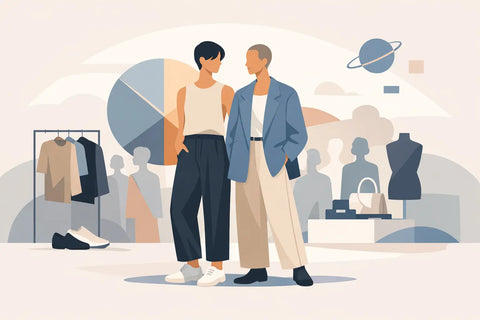
A wide leg trouser cut from dense cotton twill does not become more useful because it sits in the men’s section. A cropped worker jacket does not lose its clarity because a woman wears it. The future of genderless fashion starts there - not with slogans, but with the obvious fact that good garments already move across bodies, roles, and routines more easily than retail language suggests.
For years, much of the market treated genderless dressing as a visual statement. The result was often shallow: oversized hoodies, neutral palettes, familiar basics relabeled as progressive. That phase mattered because it opened the conversation. But it was only a beginning. What comes next is more precise, and more demanding. Better pattern cutting. Better grading. Better fabric choices. Better retail logic. Better clothes.
Why the future of genderless fashion is changing
The shift is not only cultural. It is technical.
Experienced buyers already know that many of the most enduring garments come from categories built around function rather than gender. Fatigue pants, chore coats, field shirts, coveralls, deck jackets, painter pants - these pieces were designed for movement, storage, weather, and wear. Their authority comes from use. That gives them a natural advantage in a gender-inclusive wardrobe.
As fashion moves away from trend acceleration, genderless design becomes less of a niche and more of a rational response. If a garment is seasonless, durable, and adaptable across different people, it simply earns more time in rotation. It also makes more sense economically. One piece can be styled formally or casually, worn close or oversized, shared within a household, and kept for years without feeling locked to a moment.
That does not mean every item should be unisex. It means the old binary system is a poor organizing principle for many of the clothes people actually live in.
Less category, more silhouette
The strongest genderless clothing will not come from removing identity. It will come from designing with silhouette first.
A balloon pant works because volume is placed with intent. A photographer shirt works because the pocketing, drape, and stance are considered as a whole. A utility skirt can feel grounded rather than decorative when the cloth has enough structure and the proportions are resolved. These are not compromises between menswear and womenswear. They are complete garments.
That distinction matters. When brands chase neutrality for its own sake, the result can feel anonymous. Flat shapes. Limp fabrics. No tension, no character. Real genderless design still needs point of view. It needs a shoulder line, a rise, a leg shape, a collar proportion, a fabric with memory. Minimal is not the same as vague.
This is where workwear and utility references continue to matter. They offer a disciplined vocabulary of forms that already prioritize use, durability, and clear construction. The past is useful here. Not for costume, but for proportion and purpose.
Fit will be the real test
The future of genderless fashion will be decided less by campaign imagery and more by fit systems.
This is where many brands still fall short. Calling something unisex often means shifting to a looser block and hoping that ease solves everything. Sometimes it does. In shirting, outerwear, and relaxed trousers, generous proportions can create flexibility across a wide range of bodies. But there are limits. Shoulder slope, chest shaping, hip distribution, rise depth, sleeve pitch - these details still affect how a garment hangs and moves.
The next wave of genderless apparel will need more thoughtful grading, not just larger or boxier shapes. Brands that understand pattern making will build collections around silhouette families rather than rigid gender categories. A jacket might come in one shape offered through a broader size architecture. A trouser might use adjustable tabs, deeper hems, or cleaner rise options. A shirt might be cut to work tucked or untucked, close to the body or intentionally off it.
This is slower work. It asks more from design teams, sampling, and product development. But it is also where credibility lives.
Fabric matters more than messaging
If the garment is meant to move across bodies and seasons, the cloth has to do real work.
Fabric determines whether genderless fashion feels substantial or superficial. Dense cotton poplin can hold a sharper line through repeated wear. Twill can give shape to volume. Denim can age into the body of the wearer while retaining structure. Wool blends can add drape without collapse. Ripstop can bring lightness with integrity. These choices affect not only comfort, but also how adaptable a piece becomes.
Soft, overly thin fabrics often fail in this category because they rely on the body underneath to create interest. Stronger materials create form of their own. They let a garment stand slightly away from the body, which is often what makes a unisex piece feel balanced rather than exposed.
This is also why longevity and genderless design belong in the same conversation. A garment built to last has a better chance of being re-worn, re-styled, and even passed between people. One garment. Different bodies. Different lives. That idea is not branding copy when the construction supports it.
Retail will need to catch up
The product can be ready before the system is.
Many customers already shop across traditional categories. They know their measurements. They read fabric compositions. They study fit notes. They ignore the sign over the rack if the piece is right. But most retail environments still force a binary path, online and in store.
That creates friction where there does not need to be any. The better approach is to organize around garment type, silhouette, fabrication, and fit guidance. Show the same trouser on different bodies. Give exact measurements. Explain rise, leg opening, and intended fit. Clarify whether the fabric will soften, shrink, or hold. This is not only more inclusive. It is more useful.
For design-literate customers, utility beats ideology every time. They do not need to be told what the garment represents. They need to know how it is cut and how it will wear.
The trade-offs are real
Not every consumer wants a genderless wardrobe. Not every garment benefits from a unisex approach. And not every brand should force it.
There will always be people who want body-specific shaping, traditional tailoring, or the cultural codes of menswear and womenswear. That is not a failure of progress. Dress is personal. Sometimes the right jacket is a straight, boxy worker coat. Sometimes the right jacket needs a closer waist and a different balance through the sleeve. It depends on the wearer and the purpose.
The point is not to erase distinction. The point is to make room for a design language that does not begin with old constraints.
That is why the most convincing brands in this space will resist grand claims. They will let the garments argue for themselves. Clear lines. Durable cloth. Practical details. Fit that respects variation. Styling that shows possibility without forcing a message.
What the future of genderless fashion will look like
It will likely be quieter than people expect.
Less performative casting around generic basics. More considered wardrobe systems built from shirts, outerwear, trousers, skirts, and knitwear that share a common logic. Less dependence on novelty. More attention to repeat wear. Less emphasis on whether a piece is for men or women. More attention to whether it deserves space in a closet at all.
The strongest version of this future is not abstract. It is very concrete. A dense overshirt that works over a tank in summer and under a coat in winter. A pair of utility trousers with enough room to move and enough shape to feel intentional. A jacket with practical pocketing, clean construction, and a proportion that reads clearly on different frames. This is where brands like WORKWARE already have an advantage: the foundation is not trend language, but garment logic.
Genderless fashion is growing up. It is moving away from the easy symbolism of sameness and toward something more rigorous - clothing that accommodates difference without making difference the whole story.
That is a better ambition. Not to make everyone dress alike, but to make fewer, better garments that can live longer, fit more intelligently, and mean more through wear.