
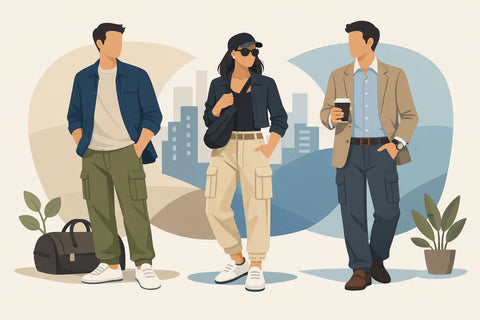
Utility trousers fail when the rest of the outfit tries too hard. The trouser already carries enough information - patch pockets, reinforced seams, a fuller leg, a denser cloth. If you are wondering how to style utility trousers, the answer usually starts by removing noise, not adding it.
They work best as a structural piece. Not a costume. Not a trend reference. A foundation with intent.
How to style utility trousers starts with silhouette
Before color, before footwear, before accessories, there is shape. Utility trousers often have more volume through the seat and leg than standard chinos or tailored pants. Some taper. Some fall straight. Some balloon slightly and sit away from the body. That shape decides what the rest of the outfit needs.
If the trouser is relaxed and rounded, keep the top cleaner. A fitted rib tee, a boxy but cropped shirt, or a compact knit gives the eye a clear stopping point. If both top and bottom are oversized without control, the look can lose its line. That may be right for some wardrobes, but it takes precision. Volume only looks easy when proportion is deliberate.
Rise matters too. A higher-rise utility trouser sits best with pieces that acknowledge the waist - tucked shirting, a shorter jacket, or a knit that ends above the hip. A lower rise reads more casual and often works better with untucked layers. The point is not to force a formula. It is to let the trouser's architecture set the terms.
Fabric sets the tone
Not all utility trousers behave the same way. A crisp cotton twill holds shape and feels more graphic. Washed herringbone softens and drapes closer to the body. Heavy canvas looks grounded and direct. Ripstop reads lighter, more technical, and a touch more casual.
This is where styling often goes wrong. People treat every utility pant as interchangeable. They are not. A dense, structured pair can sit under a tailored wool coat and still feel composed. A lighter pair may be better with jersey, poplin, or a casual overshirt. The cloth tells you how formal or raw the outfit can go.
Color has the same effect. Olive, stone, navy, and black are the easiest because they already belong to a workwear vocabulary. They absorb repeat wear well and build quietly into a wardrobe system. Brighter shades can work, but then the styling has to narrow. The more unusual the color, the less visual competition it needs.
Build around contrast, not novelty
The cleanest way to style utility trousers is through contrast. Pair functional trousers with refined pieces, or structured trousers with something softer. That tension keeps the outfit modern.
A compact merino crewneck with utility trousers feels sharper than a graphic sweatshirt. A crisp oxford or photographer shirt gives the pants a purpose beyond casual wear. Even a simple white T-shirt works, provided the fabric has enough weight and the fit is considered. Flimsy basics tend to make utility trousers look accidental.
Outerwear should follow the same principle. Short worker jackets, chore coats, and blousons are natural companions because they share the same language of function. But there is also a case for cleaner outer layers. A mac coat, a minimal zip jacket, or an unstructured wool overshirt can calm the trouser down.
It depends on what you want the outfit to say. More heritage references create a stronger workwear signal. Cleaner pairings shift the trouser into a broader daily uniform.
The easiest combinations
For everyday wear, a white or off-white tee, utility trousers, and leather shoes is hard to beat. It is direct. Nothing is wasted.
For a slightly sharper version, swap the tee for a striped knit or a washed cotton shirt. Add a short jacket with enough structure to hold its shape. The result feels dressed without becoming formal.
For colder months, a dense crewneck sweater over a T-shirt, with utility trousers and substantial boots, gives you depth without excess. Keep the palette close - olive with ecru, navy with charcoal, black with stone. Tonal dressing makes practical garments feel more intentional.
Footwear changes everything
The shoe decides whether the trouser reads workwear, city uniform, or weekend ease.
Leather derbies or plain-toe shoes sharpen utility trousers immediately. They are especially useful if the pants have a fuller leg, because the weight of the shoe balances the volume. Minimal sneakers make the outfit lighter and more contemporary, though the wrong pair can flatten the look. Avoid overly technical running shoes unless the trousers are cut from a lighter, sport-adjacent fabric.
Boots are the obvious option, but not always the best one. A service boot or side-zip boot gives gravity. A heavy lug sole can push the look too far into reenactment if the rest of the outfit already leans heritage. Sometimes a simple leather loafer or a clean canvas sneaker is the better decision.
Hem length matters here. Utility trousers should usually break lightly or sit just above the shoe with enough volume to show their shape. Too long and they puddle into disorder. Too short and the trouser loses substance.
How to style utility trousers for work
The word work means different things now. In most modern settings, utility trousers can replace chinos if the styling is controlled.
Start with darker tones or cleaner finishes. Navy, black, deep olive, or washed charcoal sit more easily with office-adjacent pieces. Pair them with a poplin shirt, fine gauge knit, or a structured overshirt. Add leather shoes rather than sneakers. Keep accessories spare.
The aim is not to disguise the utility trouser as tailoring. It is to use its function and durability inside a more polished system. When done well, it looks grounded and assured. When done poorly, it looks like a half-finished dress code.
If your workplace is more creative, you have more room. A fuller silhouette, softer fabric, and layered neutrals can feel entirely appropriate. The discipline remains the same - one strong trouser, one clean top layer, one considered shoe.
Styling across bodies
Utility trousers are one of the more democratic garments in a wardrobe. They are generous without being vague. They allow movement. They sit well on different frames. But styling still depends on where you want emphasis.
If you want length, keep the top closer to the body or shorter in proportion. If you want ease, let the shirt or jacket relax more, but keep an eye on sleeve length and shoulder width so the outfit still has edges. A belt can help define shape, but it is not always necessary. Often the better move is simply choosing the right rise and inseam.
This is where unisex dressing works well. The same utility trouser can read sharper, softer, broader, or more compact depending on the wearer and the styling around it. One garment. Different bodies. Different lives.
What not to add
Too many references at once. Cargo vest, heavy boot, logo cap, washed graphic tee - now the trouser is no longer doing the work. It is competing.
Overdesigned tops are another problem. Utility trousers already have pockets, seams, and shape. They do not need a shirt with excessive hardware or a jacket full of added detail. Let one garment carry the utility language.
The same restraint applies to accessories. A leather belt, a practical bag, a cap if needed. Enough to support the outfit, not narrate it.
Seasonless ways to wear them
Part of the value of utility trousers is range. In spring, wear them with a poplin shirt and canvas footwear. In summer, a dense jersey tee or sleeveless knit keeps them light without losing structure. In fall, add an overshirt or cropped jacket. In winter, heavier knits and boots make sense, especially if the fabric has enough weight to hold its own.
Seasonless dressing is less about one item working in every climate and more about a silhouette staying relevant across the year. Utility trousers do that well because they are practical, stable, and easy to layer around.
A good pair also improves with wear. Twill softens. Knees form slightly. The fabric records use without collapsing. That aging is part of the appeal. You are not preserving them in perfect condition. You are building familiarity.
WORKWARE approaches this well because the silhouette stays clear even as the garment settles over time. That is the difference between a piece made for a season and one made for a wardrobe.
The real rule
If you want to know how to style utility trousers, stop thinking in outfits and start thinking in systems. What shirt balances the volume. What shoe gives the trouser enough weight. What jacket keeps the line clean. Repeat those elements until they become instinct.
Utility trousers are not difficult. They just ask for discipline. Let them hold the structure, and let the rest of the wardrobe stay calm.