
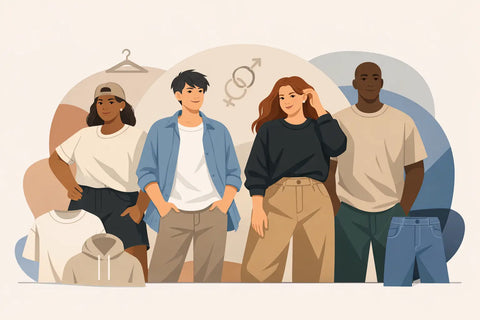
A worker jacket can look lean and sharp on one person, broad and architectural on another, and relaxed on someone else entirely. That is the point. Styling unisex pieces across body types is not about making every body fit one silhouette. It is about understanding how proportion, fabric, and construction shift from person to person - then using that shift with intention.
Unisex dressing works best when you stop asking whether a garment was designed for you and start asking what the garment is designed to do. A photographer shirt creates volume through the sleeve and shoulder. Balloon pants narrow at the ankle and widen through the leg. A utility trouser carries weight lower on the body than a tailored pant. These are structural facts, not gendered ones. Once you read the structure clearly, styling gets simpler.
Styling unisex pieces across body types starts with proportion
Most fit issues are proportion issues in disguise. People often assume a piece is wrong because it feels too boxy, too long, too wide, or too severe. Usually the garment is doing exactly what it was built to do. The question is whether the rest of the outfit supports it.
On shorter frames, oversized unisex pieces can feel heavier faster. That does not mean avoiding volume. It means placing it carefully. If you wear a full-cut worker jacket, keep the trouser cleaner through the hip or slightly cropped at the hem so the eye can register shape instead of only mass. A short, dense jacket paired with a full balloon pant can work, but only when the rise and hem create a clear line rather than a block.
On taller frames, the opposite problem appears. Some unisex garments that feel generous on the rack can read almost narrow once worn. Length becomes an advantage here. A longer overshirt, deeper cuff, or wider trouser break can preserve the intended silhouette. Without that, the piece can lose its authority and start looking merely undersized.
Broader shoulders change the way unisex tops hang. A straight-cut shirt may look more structured and less fluid. That can be useful. Crisp cotton poplin or dense twill will emphasize that architectural line, while a softer brushed fabric will release it. Narrower shoulders often benefit from garments with a dropped shoulder seam or chest pocket placement that adds visual width without looking styled for effect.
Curvier bodies tend to expose a common misconception in unisex dressing: that neutral design means erasing shape. It does not. A boxy shirt over a fuller bust or hip will create a different drape, sometimes with more front lift or side spread. That is not a flaw. Often the cleanest answer is to size for the part of the body that needs ease, then refine the line elsewhere through sleeve roll, open placket, half tuck, or a cropped outer layer.
Fit is not tightness
Experienced buyers already know this, but it matters here. A good fit in unisex clothing is not about contour. It is about movement, balance, and where the garment sits on the body.
Take utility trousers. On one body, the ideal fit may be high on the waist with a relaxed seat and a shortened hem. On another, the same trouser works better lower on the waist with more stack and a belt to hold the line. Neither is more correct. What matters is whether the rise, volume, and break feel intentional together.
This is why sizing up is not always the route to a better unisex look. More room can improve drape, but it can also distort key details. Cargo pocket placement can fall too low. Knee articulation can miss the knee. Shoulder seams can slide past the point where the garment looks designed rather than borrowed. Size down too far, and you lose the ease that gives these pieces their character.
The better approach is to identify the garment's anchor point. For shirts and jackets, it is usually the shoulder and chest. For pants, it is the rise and hip. If that anchor sits correctly, the rest can be styled.
Fabric decides how inclusive a silhouette really is
The same pattern in different cloths can behave like two different garments. This matters more than most size charts.
A rigid herringbone worker jacket holds shape away from the body. It creates presence. On straighter frames, that can build volume and edge. On fuller bodies, it can create a clean shell that skims rather than clings. But if the cloth is too heavy for the wearer's scale, it may feel imposing.
A softer cotton shirt jacket collapses more easily into the body. It is often easier across bust, shoulder, and hip because it drapes instead of projecting. The trade-off is that it shows more of what is underneath. If you want cleaner lines, the base layer matters more.
Denim sits somewhere in between, depending on weight and wash. A dense indigo denim trouser gives shape and memory. It softens with wear and becomes personal over time. That is one reason heritage workwear remains so adaptable across bodies - it records the wearer.
Use contrast, not correction
The old styling advice for different body types tends to be corrective. Minimize this. Lengthen that. Balance becomes code for concealment. Unisex dressing offers a better framework: contrast.
If the pant is rounded, keep the top flatter. If the jacket is cropped and square, let the trouser run longer. If the shirt is long and fluid, ground it with a denser bottom half. You are not trying to disguise the body. You are giving the garment system enough variation to read clearly.
This is especially useful for people with fuller hips or thighs. Wide pants often look better when they are truly wide, not cautiously relaxed. A half-measure can catch at the body and look accidental. Pair them with a shorter jacket or a shirt with a firm collar and the silhouette settles. Likewise, people with slimmer legs can use a fuller trouser to create depth, then keep the upper half compact so the outfit does not drift.
Styling unisex pieces across body types often comes down to one decision: where do you want the eye to rest first? On the shoulder line, the waist position, the hem, the volume of the leg? Once that is clear, the rest follows.
Small adjustments carry the look
The most effective styling moves are usually minor. Roll the sleeve once to expose the wrist and reduce visual weight. Leave the overshirt open to create a vertical break through the torso. Button only the top and bottom of a boxy shirt to control volume. Hem the pant to hit just above the shoe rather than pooling without purpose.
These are not tricks. They are ways of finishing a silhouette.
Belts matter more in unisex dressing than many people admit. They set waist position and alter how volume falls. A balloon pant worn high and belted reads differently from the same pant worn loose on the hip. Footwear does similar work. A substantial shoe can carry a wider hem. A slimmer shoe sharpens a broad pant but can also make it look larger by contrast. It depends on whether you want weight or precision.
Layering also changes how a garment relates to the body. A rib tank under an open shirt creates a vertical interior line. A cropped vest over a longer shirt shifts the center of gravity upward. A coat worn over a boxy jacket can either look disciplined or overloaded depending on cloth weight and collar scale. Workwear styling is less about piling on pieces than choosing which layer gets to define the shape.
When tailoring helps - and when it ruins the point
Some adjustments improve a unisex piece immediately. Hemming pants, shortening sleeves, or slightly tapering a leg opening can make a garment easier to wear without changing its character.
Others remove what made it good. Taking too much out of the body of a worker jacket can strip away its utility line. Narrowing the shoulder of a dropped-shoulder shirt can collapse the intended drape. Unisex garments often rely on a certain reserve of space. Once that reserve is gone, the piece loses its logic.
If you tailor, tailor for length and function first. Let width stay generous unless it actively interferes with movement or proportion.
A better way to build a unisex wardrobe
The strongest unisex wardrobes are not built around category labels. They are built around repeatable shapes. A cropped jacket that works with high-rise pants. A full trouser that pairs with close knits and boxy shirts. A long overshirt that can sit under outerwear or over a tank in warmer months. Form first. Then fabric. Then use.
That is why the best pieces tend to come from workwear language. They were designed around motion, wear, and utility before they were filtered through gendered styling rules. A well-cut fatigue pant, chore jacket, or utility shirt does not ask for a specific body. It asks for a wearer with intent.
At WORKWARE, that principle sits at the center: one garment, different bodies, different lives. Not because fit is identical, but because good construction leaves room for interpretation.
The useful question is never whether a unisex piece flatters everyone in the same way. It does not. The useful question is whether it gives different bodies enough structure, ease, and possibility to become personal. When it does, you keep wearing it. And that is usually the clearest sign you chose well.