
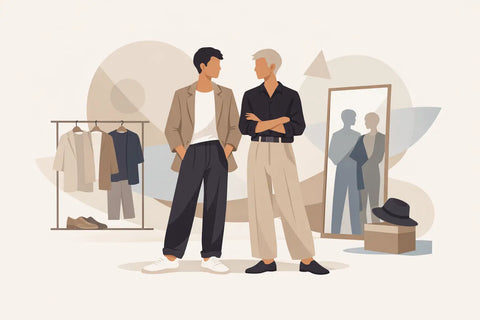
A shirt is not neutral because a label says so. It is neutral when the cut holds its shape across different bodies, when the fabric has enough character to stand on its own, and when the wearer does not need permission to make it work. That is the real guide to gender neutral dressing - less about category, more about form.
For experienced dressers, this is rarely a question of ideology alone. It is a question of construction. Why does one overshirt feel resolved on multiple frames while another reads borrowed or unfinished? Why do some trousers settle into daily use while others only work in a styled image? Gender-neutral dressing works best when the clothes are designed with proportion, utility, and longevity in mind.
What gender-neutral dressing actually means
At its best, gender-neutral dressing is not a novelty rack placed between menswear and womenswear. It is a clearer way of building a wardrobe. The focus shifts from prescribed categories to silhouette, movement, fabric weight, rise, shoulder line, and ease.
That does not mean every garment should look identical on every body. It means the design allows for variation without losing integrity. A worker jacket can sit square and cropped on one person, longer and more relaxed on another. A balloon pant can read sculptural on one frame and practical on the next. The garment keeps its intent.
This is where many brands get it wrong. They call something unisex when they really mean oversized. Oversizing can be useful, but it is not a complete answer. Without a considered shoulder, sleeve, rise, or leg shape, oversized clothing can feel vague rather than inclusive.
A guide to gender neutral dressing starts with silhouette
Silhouette does most of the work. Before color, before styling, before the language around a piece, the shape decides whether a garment has range.
Straight and slightly boxy tops tend to translate well because they avoid overcommitting to one body map. Think photographer shirts, chore coats, utility overshirts, and knitwear with structure rather than cling. They leave room around the torso, but still have enough line to feel intentional.
On the lower half, balance matters more than convention. A high rise can work across bodies because it establishes a clean line and allows the leg shape to fall properly. A fuller leg can be more adaptable than a narrow one, especially in substantial cotton twill, denim, or canvas. Taper can help, but too much taper often pushes a trouser back toward a coded fit.
If you are building from scratch, start with shapes that hold their own without heavy styling. A cropped jacket with a clean shoulder. A straight shirt with a slightly dropped armhole. A pleated trouser with room through the seat and thigh. A simple skirt or dress cut with the same logic as workwear - practical, durable, and easy to layer. Neutral dressing is often strongest when the garment already knows what it is.
Proportion is where the outfit settles
Good proportion is not about following rules. It is about visual tension. If the jacket is boxy, the pant can be fuller or cleaner depending on how much shape you want. If the trouser has volume, the top should offer enough structure to answer it.
This is why gender-neutral wardrobes often look better when they are built as systems. Not more clothes. Better relationships between clothes. One compact jacket over a longer shirt. One wide trouser with a close knit. One generous overshirt over a tank and straight pant. The point is clarity, not performance.
Fit matters more than size labels
Standard sizing is still one of the biggest obstacles in gender-neutral dressing. A medium in one line may assume shoulder width. In another, it may assume bust shaping or hip allowance. The label matters less than the measurements and the intended silhouette.
Start with the part of the garment that is least forgiving. For jackets and shirts, that is often the shoulder and upper sleeve. If the shoulder is too narrow, the garment rarely recovers. If it is slightly dropped by design, that can work. For trousers, pay attention to rise, hip, and top block before inseam. Hems can be altered. A strained rise usually cannot.
There is also a difference between fitted and resolved. Many people trying gender-neutral dressing for the first time assume they need to size up for ease. Sometimes that works. Sometimes it simply removes the line that made the garment good. A better approach is to buy the shape you want rather than the category you were assigned.
If a shirt is intended to sit away from the body, let it. If a coat is designed to layer, keep room for that use. If a trouser is cut with volume, do not size down until the shape disappears. Precision is not the same as tightness.
Fabric gives the garment authority
A practical guide to gender neutral dressing has to talk about fabric, because fabric often determines whether a piece feels deliberate or generic.
Substantial materials tend to perform better in gender-neutral wardrobes. Cotton drill, poplin, Japanese denim, canvas, brushed twill, ripstop, wool blends with body - these fabrics create shape. They hold a line across different frames and wear well over time. The garment does not rely on body contour to make sense.
That does not mean every piece should be rigid. Soft jersey, washed linen, and fluid shirting still have a place. But they usually work best when paired with something more grounded. A soft tee under a structured overshirt. A washed shirt with a firm trouser. Too much drape at once can make the outfit feel less neutral and more undefined.
Texture also helps. Faded duck canvas, slub cotton, dry denim, garment-dyed twill - these surfaces add depth without decoration. They allow simple outfits to feel complete.
Color is useful, but not the point
Many people reduce gender-neutral dressing to a palette of black, white, olive, and stone. Those shades work because they are stable and easy to combine, not because they are inherently neutral.
The better question is whether the color supports repeat wear. Navy work jacket, ecru trouser, washed gray tee, tobacco overshirt, muted stripe shirting, dark indigo denim - these are useful because they build continuity. They let silhouette and fabric lead.
There is room for stronger color, but it helps to choose shades with depth rather than novelty. Rust, deep green, mineral blue, saffron, faded red. Color should feel lived with, not seasonal.
Use workwear logic, not costume logic
Workwear remains one of the clearest references for gender-neutral dressing because it was built around function first. Pockets, reinforcement, freedom of movement, durable cloth, practical closure systems - these details age well and wear across categories.
The trade-off is that workwear can slip into costume if every piece is too literal. Head-to-toe heritage can feel rigid. Usually one or two grounded elements are enough. A worker jacket with clean trousers. Utility pants with a crisp shirt. A denim overshirt over a simple dress. The point is to borrow the logic, not perform a character.
This is part of why contemporary unisex brands with a workwear foundation often feel more credible. The garments are designed as tools for daily life. In that space, neutrality is not a slogan. It is built into the pattern, the cloth, and the way the piece moves between bodies.
How to build a gender-neutral wardrobe that lasts
Start with repetition. Identify the forms you return to naturally, then refine them. Most people need fewer categories and better versions: one hard-working jacket, two or three shirts with different weights, a trouser with enough room to move, denim that improves with wear, knitwear with structure, and a dress or skirt only if it fits the same logic of ease and durability.
Then wear the pieces across contexts. The best gender-neutral clothing does not ask for separate lives. It should work for a studio day, a flight, a dinner, a weekend, and the ordinary hours between them.
This is where brands such as WORKWARE have found a clear lane. Not by flattening difference, but by designing garments with enough intelligence to live on different bodies without losing form. One garment. Different bodies. Different lives.
A final test helps. Ask whether the piece will still make sense when the styling disappears. No stacked jewelry, no trend shoe, no perfect image. Just the garment, worn often. If it still feels precise, keep it close.