
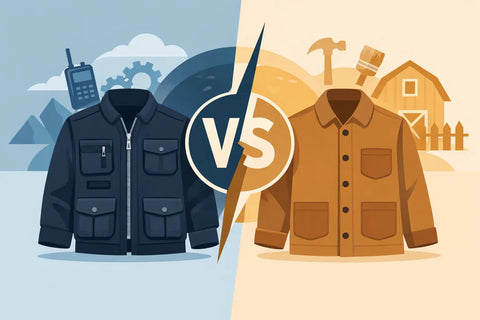
A jacket can carry its history quietly. The utility jacket vs chore coat question is less about choosing a label than choosing the kind of function you want close at hand: field-ready storage and protection, or a clean work layer built for repetition.
Both belong to the wider language of workwear. Both improve with wear. Both can anchor a wardrobe built around substantial cloth, useful pockets, and shapes that do not depend on a particular season. Yet their proportions, details, and original jobs are distinct enough to change how they live on the body.
Utility Jacket vs Chore Coat: The Core Difference
A utility jacket is a broad category. It usually takes its cues from military, field, safari, hunting, or technical garments, where equipment needed to remain accessible and the wearer needed protection from weather, brush, or movement. Expect multiple pockets, a more engineered front, and often a waistband or adjustable hem.
A chore coat is more specific. Its foundation is European and American manual labor: painters, mechanics, railway workers, farmers, and workshop hands. Traditionally cut from cotton drill, moleskin, canvas, or denim, it is a simple, hip-length coat with a straight body, a button front, and large patch pockets.
The distinction matters because each garment solves a different problem. A utility jacket organizes. A chore coat covers. One is often designed around carrying; the other around layering and working.
Neither is more authentic than the other. The better choice depends on the rest of your wardrobe, your climate, and whether you prefer visible function or quieter construction.
The Utility Jacket: Built Around Access
The utility jacket tends to look more complex because it is. Its recognizable features are chest bellows pockets, lower cargo pockets, flaps, storm closures, epaulets, drawcords, or adjustable cuffs. Not every version includes all of these details, but the underlying idea is consistent: the jacket is a portable system.
Classic field jackets make this especially clear. Their longer bodies and pocket layouts were designed for carrying maps, tools, rations, and personal effects without a bag. Contemporary versions can be cleaner, but a good one still retains purpose in its construction. Pocket placement should be useful, not decorative. Reinforcements should sit where strain occurs. Closures should make sense in changing weather.
This makes a utility jacket particularly useful when your day moves between transit, studio, travel, and outdoors. It can replace a small bag when needed, though fully loaded pockets will change the line of the garment. That is the trade-off. More function creates more visual activity and, often, more volume through the torso.
Fabric is usually chosen for resistance. Cotton ripstop, densely woven poplin, dry waxed cotton, nylon-cotton blends, and tightly woven canvas all suit the category. An unlined utility jacket works as a three-season shell. A lined version becomes more weather-specific and less adaptable indoors.
Fit and proportion
Utility jackets often have a shaped or adjustable waist. This can create definition, but it can also make sizing less forgiving if you want to layer thick knitwear underneath. Look at the armhole, shoulder width, and sleeve volume before focusing on the marked size.
A slightly relaxed fit is generally the most useful. It leaves room for a sweatshirt or overshirt without becoming a costume version of military surplus. If the jacket has a drawcord, use it sparingly. The strongest silhouette often comes from letting the fabric and proportion do the work.
The Chore Coat: A Uniform for Repetition
A chore coat has less to prove. Its form is direct: a collar, button front, three or four patch pockets, and a straight cut that falls around the hip or upper thigh. The front is open enough to work in, and the body is generous enough to layer without feeling oversized by default.
Its simplicity is its advantage. The patch pockets remain accessible, but they do not dominate the garment. The flat front makes it easy to wear over a T-shirt, a photographer shirt, knitwear, or a collared shirt. It can move through different settings without changing character.
The best chore coats reveal quality through restraint. Consider the density of the fabric, the depth and anchoring of the pockets, the shape of the collar, the strength of the buttonholes, and the finish of internal seams. These are quiet decisions. They determine whether a coat softens into a daily layer or loses structure after one season.
Traditional indigo denim and navy cotton drill are familiar for good reason. They age with clarity. Fading develops at cuffs, plackets, pocket edges, and points of movement. Undyed canvas, black twill, olive drill, and textured wool blends offer a different expression, but the principle remains: choose a fabric that will become more personal through use.
Fit and proportion
A chore coat should not fit like a blazer. It needs enough ease through the chest and back to reach, sit, and layer. The shoulder may be clean but should not feel restrictive. A slightly dropped shoulder can work well, especially in unisex proportions, provided the sleeve length remains considered.
Length is decisive. A shorter chore coat feels sharper and more casual, working well with high-rise trousers or fuller balloon pants. A longer version has more presence and layers comfortably over tailoring or heavier knits. If you want one coat for most of the year, choose a midweight fabric and a body that ends around the high hip to upper thigh.
Pockets, Closures, and What They Say
Comparing a utility jacket vs chore coat is often easiest at the front of the garment. Utility pockets usually have flaps, gussets, or expansion. They are made to secure and separate items. Chore-coat pockets are open patch pockets, made for quick access to a notebook, gloves, phone, or the small tools of ordinary work.
A utility jacket may use snaps, zippers, concealed plackets, or a combination of closures to manage wind and rain. A chore coat usually uses buttons. Buttons are slower, but they suit the garment's rhythm. They are easy to repair, easy to operate, and visually calm.
If you carry a camera, transit card, sketchbook, or small tools, a utility jacket can be genuinely practical. If your needs are lighter and you value a cleaner front, the chore coat is often enough. More pockets are only useful when they are used.
How Each One Works in a Wardrobe
The utility jacket is strongest when the rest of the outfit is simple. Pair its detail with straight denim, fatigue pants, or a plain jersey layer. Keep footwear grounded: leather shoes, canvas sneakers, or a substantial boot. The jacket already provides structure, so it rarely needs competing cargo pockets or heavy graphics below it.
The chore coat is more open-ended. It can be worn with denim and canvas trousers, but it also holds its own over pleated pants, a fine-gauge knit, or a crisp shirt. Its workwear roots keep polished pieces from becoming overly formal. Its clean shape gives relaxed pieces a little more intention.
For a gender-inclusive wardrobe, the chore coat is often the easier shared garment. Its straight body and minimal hardware adapt across different frames with less adjustment. A utility jacket can do the same, but its waist placement, chest-pocket position, and sleeve volume need more attention.
Color also changes the role. Navy, indigo, black, and washed olive stay close to workwear's original palette and integrate easily. Stone, ecru, or natural canvas make the garment more visible and show wear sooner. That is not a flaw. It is a decision about patina.
Which Jacket Should You Buy?
Choose a utility jacket if you need weather resistance, like an adjustable silhouette, and will use the extra storage. It suits travel, commuting, and days that begin in one place and end somewhere else.
Choose a chore coat if you want a dependable daily layer with a quieter outline. It is the better option for a compact wardrobe because it sits easily between casual and considered, work and weekend, warm months and colder layers.
There is also a case for owning both, but only when each has a distinct role. A lightweight field jacket in olive cotton and a midweight indigo chore coat will not compete. Two similar jackets with different pocket arrangements probably will.
Start with the garment you will reach for without planning around it. A good jacket should meet the day where it is, take on its marks, and remain useful long after the newness has gone.