
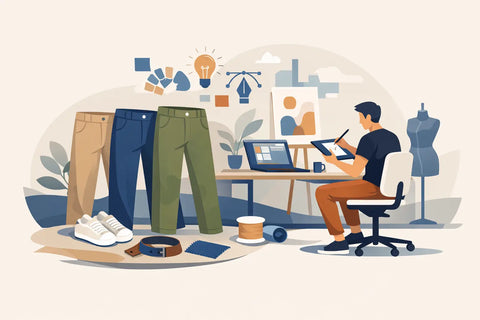
Creative work has a dress code, even when nobody names it. You need clothes that let you move between studio, office, site visit, opening, and late dinner without feeling overbuilt or underdressed. The best pants for creative work do exactly that. They carry utility without costume. They hold shape through a long day. They make room for tools, movement, and your own way of working.
That usually rules out two common failures. First, pants that look sharp on a hanger but collapse after three hours at a desk. Second, pants designed for pure function that read too literally, as if you borrowed from a job rather than built a wardrobe. For creative work, the line is finer. You want substance, not theater.
What makes the best pants for creative work
Start with fabric. If the cloth is wrong, nothing else saves it. Creative work tends to involve friction - sitting, reaching, carrying, walking, crouching, commuting. Lightweight fashion cloth often twists, bags, or shines out too quickly. On the other end, heavy canvas can feel rigid indoors and overdone in settings that call for some refinement.
The sweet spot is usually a mid- to heavy-weight fabric with visible integrity. Cotton twill, herringbone, brushed sateen, denim, and structured blends all work when the hand feels substantial rather than stiff. A good cloth should break in, not break down. It should take wear personally and improve from it.
Fit matters just as much, but not in the narrow sense of slim versus wide. The real question is whether the cut supports movement and proportion. Creative professionals often spend part of the day seated and part of it in motion. A trouser that binds at the hip, pulls at the knee, or collapses at the seat stops being useful fast. Volume can help, but only when it is intentional. Balloon shapes, relaxed straight legs, and full utility cuts work because they create space where the body actually needs it.
The rise is often overlooked. Mid and high rises tend to perform better over long hours because they sit more securely and create a cleaner line with tucked or untucked layers. Very low rises may look current for a season, but they rarely wear well across different postures, different bodies, and different contexts. Good work pants should feel settled.
Then there is pocket placement. In creative work, pockets are not decoration. They should hold a phone, notebook, tape measure, pen, or keys without distorting the whole garment. Side entry pockets are usually cleaner than patch pockets at the hip. Utility pockets can be useful, but they need restraint. Too many compartments and the pant starts to announce itself before you do.
The right silhouette depends on the kind of creative work
There is no single answer because creative work is not one environment. A furniture designer, art director, stylist, florist, architect, and photographer all use their clothing differently. Still, some silhouettes consistently hold up.
Utility trousers
This is the obvious category, but also the easiest to get wrong. The best utility trousers borrow from workwear without becoming reenactment. Look for articulated shape, reinforced seams, and durable fabric, but keep the hardware clean and the lines controlled. They should feel considered enough for a meeting and practical enough for production.
Utility trousers suit people who move a lot, carry tools, or work between clean and rough environments. They also layer well through seasons, which matters if you build a wardrobe as a system rather than a rotation of moods.
Balloon pants
A well-cut balloon pant can be one of the strongest options for creative work. The volume gives ease through the hip and thigh, while the taper keeps the silhouette deliberate. That balance matters. You get movement without sloppiness.
This shape works especially well for those who spend long hours seated, cycle or walk between appointments, or prefer garments that shift easily across bodies and styling modes. With a crisp shirt it feels architectural. With a jersey or overshirt it becomes quieter. Either way, it keeps its identity.
Straight-leg work pants
Straight-leg trousers are often the most versatile option if your work moves between formal and informal settings. They do not ask for much, which is exactly their strength. In sturdy twill or denim, they can read polished enough for client-facing work while still taking daily wear seriously.
The trade-off is that a straight leg relies more heavily on exact proportion. Too narrow and it feels timid. Too wide and it loses line. Hem, rise, and shoe pairing all matter more here.
Painter and fatigue styles
These can be excellent, but only if the fabric and finishing are right. Painter pants in soft drill or broken twill can feel relaxed and lived-in without looking careless. Fatigue trousers, especially with a fuller top block and clean taper, offer storage and ease with less visual noise than cargo pants.
The caution is obvious. If details are too literal - hammer loops, oversized pockets, high-contrast stitching - the pant can tip into costume. Unless your work genuinely calls for those features, restraint usually ages better.
Fabric is where longevity begins
Experienced buyers know that two pants with the same silhouette can behave completely differently in wear. Fabric weight, weave, finishing, and dye all change the life of a garment.
Cotton twill is one of the safest choices for creative work because it holds shape, softens well, and can move between casual and professional contexts. Herringbone adds a little more texture and depth without demanding attention. Denim works too, especially in rinsed or washed finishes that avoid stiffness, but it is often best when the cut is clean and the branding minimal.
Garment-dyed cloth has its own appeal. It gives depth and a worn-in quality early, which suits heritage-rooted wardrobes. The trade-off is that it may fade unevenly in high-friction areas. For many wearers, that is not a problem. It is the point.
Stretch fabric is where judgment matters. A little can improve comfort, especially for long commutes or physically active work. Too much, and the pant loses memory, starts to shine, or feels synthetic against the rest of a considered wardrobe. Natural structure usually ages better than engineered recovery.
Construction tells you whether the pant will last
Good pants for creative work are built for repetition. That means you want to look beyond silhouette and color into construction.
A stable waistband, clean seat, reinforced stress points, and durable pocket bags all matter. So do seam quality and stitch consistency. You should not need to inspect a garment with a magnifying glass, but you should be able to feel whether it was made with discipline. Loose pocket linings, twisting legs, and lightweight facings tend to show up early and worsen fast.
This is where workwear heritage still earns its place. Not because old garments should be copied exactly, but because the logic behind them remains sound. Utility came from use. When translated with restraint, it still works now. Details with a past. Forms for now.
Color is part of the function
For creative work, color should extend the wardrobe, not interrupt it. That usually means neutrals with depth: washed black, olive, stone, navy, ecru, deep brown, muted khaki. These shades absorb wear well and pair easily across shirts, knits, outerwear, and footwear.
Black is useful, but not always best. In some fabrics it can look flat or collect wear in an unflattering way. Olive and charcoal often age with more nuance. Ecru and natural canvas have presence too, though they ask more from the wearer. They mark easily. Some people prefer that honesty. Others do not want to think about every chair, stair, or subway seat.
The best pants for creative work are not trend pieces
Trend-driven pants usually fail in one of two ways. They either exaggerate volume without structure, or they flatten utility into a styling cue. Both date quickly. If you are buying for years rather than content cycles, the better approach is to choose shapes with enough character to feel distinct and enough restraint to stay wearable.
That is why refined workwear continues to hold attention. It has purpose built into the pattern. It does not need novelty to justify itself. One garment. Different bodies. Different lives.
When assessing a pair, ask a simple question: will these still make sense after a year of regular wear? Not just physically, but visually. If the answer depends on a current mood board, keep looking.
How to choose your pair
Think first about your actual day, not your idealized one. If you sit for ten hours, prioritize ease through the waist and thigh. If you move between studio and client meetings, look for a cleaner leg and more structured cloth. If you carry tools or devices, test the pockets with weight in them.
Then think in systems. The best pants for creative work should earn repeated wear with the shirts, jackets, and shoes you already trust. They should not require a special outfit to make sense. That is part of value. A good pant reduces decisions.
If you are between sizes or between fits, choose the option that leaves room for the garment to settle into your life. Slight ease usually wears better than forced precision. Especially with substantial fabrics, a little space can make the difference between a pant you admire and one you actually use.
WORKWARE has always understood this distinction. The right pant is not there to complete a look. It is there to support a life, then improve with it.
Buy for movement. Buy for repetition. Buy for the shape your days actually take. The right pair will stop asking for attention and start earning it.