
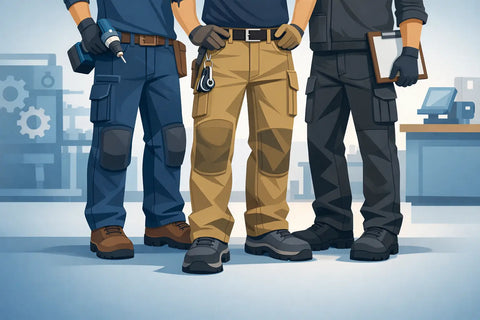
A shift on your feet changes the standard. The best pants for standing jobs should not merely look considered at 9 a.m. They need to hold their shape through hours of movement, bending, walking, lifting, and waiting - without pinching at the waist or leaving you overheated by late afternoon.
Standing work asks more from a garment than a seated office day. A good pair of pants becomes part of the support system: substantial enough to endure, flexible enough to move, and resolved enough to wear again tomorrow.
What Makes the Best Pants for Standing Jobs?
The answer depends on the work itself. A barista, gallery installer, nurse, retail associate, chef, and photographer may all spend a day standing, but their requirements are different. Heat, repeated crouching, access to tools, dress codes, and the surface underfoot all change the equation.
Still, the strongest pants share a few traits. They have a stable waistband, room through the seat and thigh, fabric with enough structure to resist collapse, and a leg shape that does not interfere with movement. Durability matters, but stiffness is not the same thing as durability.
A well-made work pant should feel dependable rather than restrictive. Look for purposeful construction: reinforced seams, secure pocket placement, a clean rise, and fabric that can take regular washing without becoming thin or distorted. These details are quiet. Over a long shift, they are felt.
The pants alone will not solve leg or back fatigue. Footwear, insoles, breaks, floor surface, and workload matter. But an awkward waistband or a narrow thigh can make an already demanding day unnecessarily harder.
Start With the Shape, Not the Label
Terms such as utility pant, carpenter pant, chino, and work trouser describe a lineage, not a guarantee of function. Fit tells you more. For standing work, the most useful shapes tend to sit at the natural waist or just below it, with ease through the hip and thigh before tapering, falling straight, or opening slightly at the hem.
Give the seat and thigh enough room
When you stand for hours, you are rarely still. You reach low shelves, climb stools, squat to pick something up, take long strides, and turn quickly. Pants that fit neatly while motionless can become restrictive the moment the day starts.
A relaxed straight leg or a softly ballooned silhouette gives the body space where it needs it. This does not mean buying oversized pants with a collapsing waist. The waist should stay secure without a belt pulled to its last notch, while the seat and upper leg should allow movement without pulling across the pockets.
Choose a rise that stays put
Low-rise pants can slide when you bend and create pressure at the hip crease during repeated movement. Very high rises may feel confining if the waistband is rigid or the torso is short. For most bodies and workplaces, a mid- to high-rise construction offers the most stable starting point.
Check the pants while sitting, squatting, and taking a full step. If the waistband rolls, the back pulls down, or the front presses into your abdomen, the fit is not right for a long standing shift. A dressing-room mirror cannot answer this on its own. Move before deciding.
Let the hem work with your shoes
The right length depends on your footwear. A full break can catch under a heavy shoe or collect dirt on a wet floor. A cropped hem can expose the ankle in cold workspaces and shift the visual balance of a wider trouser. A clean, slight break usually works well with service shoes, boots, sneakers, and clogs.
If you rotate between shoes, choose a length that accommodates the pair you wear most often at work. Pants are part of a system, not an isolated purchase.
Fabric Has to Earn Its Weight
Fabric determines how pants wear, wash, and recover. The heaviest cloth is not automatically the best choice. Dense canvas may be excellent for warehouse work or outdoor installation, yet too warm for a busy kitchen or crowded retail floor.
For most standing jobs, these four fabric families cover the ground:
- Cotton twill offers a balanced, familiar feel. It is durable, breathable, and often softens well with wear. Midweight twill is especially useful for indoor roles where you need structure without the density of canvas.
- Canvas and duck cotton bring greater abrasion resistance and a more defined silhouette. They suit physical work, tools, and frequent contact with rough surfaces, though they can feel stiff until broken in and may retain heat.
- Denim wears in beautifully and handles repeated use, particularly in a relaxed fit. Choose a weight that matches the season. Heavy raw denim has character but may not be the practical choice for a hot, high-movement job.
- Ripstop cotton or cotton blends are light, durable, and useful where mobility and quick drying matter. Their technical look is not for every workplace, but the fabric earns its place in active settings.
Natural fibers generally manage heat and daily wear well, but blends have their place. A modest synthetic content can improve abrasion resistance, recovery, and drying time. Read the composition as a practical specification, not a purity test.
Pockets Should Carry Their Weight
Pocket design is where work pants either become useful or become busy. Large patch pockets look convincing until they pull the garment out of shape when loaded. Small, shallow pockets may keep a clean line but fail to hold a phone, notebook, keys, or basic tools securely.
For customer-facing or creative work, deep front pockets and clean rear pockets are often enough. For studio, field, and trade work, utility pockets can earn their space when positioned so their contents do not swing against the leg or catch when you crouch.
Pay attention to the pocket opening. A phone pocket that is easy to reach while standing but secure when bending is worth more than a row of decorative compartments. The same goes for closures. Buttons and zippers should feel solid, but they should not add unnecessary bulk at the hip.
This is the difference between utility as styling and utility as design.
Construction Tells You What Will Happen Later
New pants can hide weak points. Look beyond the first impression. Strong seams at the inseam and rise, bar tacks at pocket corners, a properly attached waistband, and a cleanly finished fly all indicate a garment made for repetition.
Weight is useful, but construction is what directs that weight. A lighter twill with disciplined stitching may outlast a heavier pant made with poor seam tension. Likewise, a durable garment should be repairable. A simple shape, accessible hem, and standard hardware make future care easier.
At WORKWARE, heritage workwear is useful because its logic remains useful: room to move, cloth with substance, and details placed for a reason. The goal is not costume. It is a pant that belongs to the present and improves with use.
Build Around the Conditions of Your Shift
Indoor retail and hospitality often call for breathable twill, a refined relaxed fit, and a pocket layout that stays discreet. Physical production work may justify canvas, reinforced knees, and more generous utility storage. Healthcare and food service can favor washable fabrics, easy movement, and a cleaner surface that does not hold onto lint or spills.
Color also has a job. Dark navy, black, olive, and washed brown conceal marks and integrate easily with an existing wardrobe. Lighter shades feel right in warm weather or creative settings, but show wear sooner. Neither is better. Choose based on what the day leaves behind.
Buy for the conditions you actually work in, not an imagined version of workwear. If your shift is humid, do not choose heavy canvas for its appearance alone. If you carry tools every day, do not settle for a delicate trouser because it looks sharper at the start of the week.
A Better Test Before You Commit
Try pants on at the time of day when you are most likely to feel normal workday swelling, not only first thing in the morning. Wear the socks and shoes closest to your shift uniform. Walk, squat, reach overhead, sit briefly, then stand again.
Notice what happens after five minutes. Does the fabric bunch behind the knee? Do the pockets pull open? Does the waistband stay level? Does the hem catch? The best choice is usually the pair you stop thinking about while moving.
A standing job gives clothing an honest test. Choose pants with enough ease for the day, enough structure for the years ahead, and a fabric you will be glad to meet again after laundry day.