
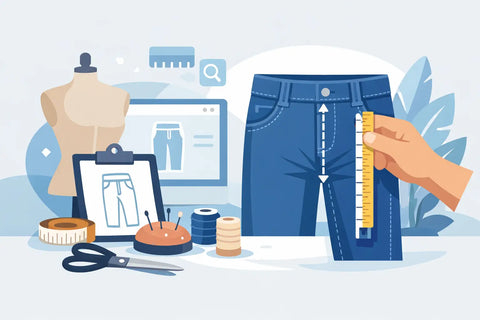
A trouser can have the right waist measurement and still feel completely wrong. Often, the missing number is rise. Knowing how to measure garment rise gives you a clearer read on where a pair of pants will sit, how the seat will move, and whether the silhouette has the proportion you want.
Rise is not a minor specification. In workwear, it shapes the whole garment: the line of a tucked-in shirt, the amount of room through the hip, the break at the leg, and the ease of sitting, cycling, or moving through a long day. It is construction made visible.
What garment rise actually measures
Garment rise is the distance from the crotch seam to the top edge of the waistband. It is measured in two directions: front rise and back rise.
Front rise runs from the crotch seam, up the front curve of the garment, to the top of the front waistband. It determines whether trousers sit low on the hip, near the natural waist, or somewhere between.
Back rise runs from that same crotch seam, up the back curve, to the top of the back waistband. A longer back rise generally gives more coverage and room through the seat. It also affects how well the waistband stays in place when you bend or sit.
These figures are related, but they are not interchangeable. Two pairs of pants can share a 12-inch front rise and feel different because one has a fuller back rise, a more curved seat seam, a wider leg, or a different waistband placement. Rise is one part of a system.
How to measure garment rise accurately
Use a flexible tape measure and a pair of trousers laid flat on a clean, level surface. Button or fasten the waistband, close the fly, and smooth the garment without stretching it. Do not pull the waistband taut. You are measuring the garment as it is made, not forcing it into a different shape.
Find the crotch point first. This is where the inseam seams meet the curved center seam between the legs. On some trousers, especially those with a reinforced gusset or a complex workwear construction, there may not be one obvious point. Use the lowest central point where the front and back rise seams join the inseams.
Measure the front rise
Place the end of the tape at the crotch point. Follow the curve of the front center seam, over the fly, until you reach the very top edge of the waistband. Keep the tape in contact with the fabric rather than measuring a straight diagonal line through the air.
Record the measurement to the nearest quarter inch. This is the front rise.
If the waistband is contoured or slopes downward at the front, measure to the actual top edge at the center front. That is where the garment will meet the body. Measuring to a side point or the top of a belt loop will give a misleading number.
Measure the back rise
Return the tape to the same crotch point. Follow the back center seam up to the top edge of the back waistband. Again, follow the seam's curve rather than taking a straight-line shortcut.
The back rise is usually longer than the front rise. That difference is intentional. The body needs more length over the seat than across the lower abdomen, particularly in pants designed for movement or a generous, relaxed fit.
On trousers with a center-back seam that is heavily curved, the tape may shift as you measure. Hold it lightly in place or use a second hand. Precision matters most when comparing one garment against another, so measure each pair in the same way.
Rise versus crotch depth
Rise and crotch depth are often used as though they mean the same thing. They do not.
Rise is a garment measurement taken along the seam. Crotch depth is a body measurement: the vertical distance from your natural waist, down between your legs, to the seat of a chair when seated. It can help explain why a certain rise feels comfortable or restrictive, but it is not a direct substitute for measuring trousers.
A high front rise does not automatically mean a high-waisted fit on every person. Torso length, hip shape, and where someone naturally wears their trousers all change the result. A 12-inch rise may sit at the natural waist on one body and below it on another.
This is especially useful when buying unisex trousers. A single pattern can create distinct waist placements across different bodies without being incorrectly sized. The measurement tells you the garment's construction. Your preferred wearing position determines the fit.
Read the number in context
For many contemporary trousers, a front rise under roughly 10 inches reads low. Around 10.5 to 12 inches often falls into a mid-rise range. Above 12 inches usually moves toward high rise, particularly in smaller sizes. These are useful reference points, not fixed rules.
Size changes matter. A graded trouser pattern typically adds rise as sizes increase, though not always by the same amount as the waist. Always check the rise listed for your specific size rather than assuming a measurement from a size small applies across the range.
The waistband also changes perception. A firm, structured waistband tends to hold its assigned position. An elastic waistband can settle differently depending on the body and what is carried in the pockets. A deep pleat, a dropped crotch, or a gusset can add ease without making the garment feel conventionally high-rise.
Fabric has a role, too. Rigid denim and densely woven cotton drill hold their shape and make rise more apparent. A soft twill may relax and settle. Neither is better. The question is whether you want the garment to maintain a defined silhouette or adapt through wear.
Compare it with trousers you already wear
The most reliable fit reference is a pair you reach for often. It may be an old fatigue pant, a straight-leg jean, or a wide trouser that has already earned its place in your wardrobe. Measure its front and back rise using the same method, then compare those figures with the garment you are considering.
Do not compare rise alone. Set the waist, hip, thigh, inseam, and leg opening beside it. A high-rise trouser with a generous thigh will wear differently from a high-rise trouser cut close through the leg. Likewise, a lower rise can work well when the seat is roomy and the waistband is intended to rest on the hip.
Pay attention to the difference between front and back rise. A modest front rise paired with a substantial back rise can be particularly effective in utility trousers. It keeps the front clean while preserving coverage and mobility at the back. That balance is one reason well-made workwear often feels better in motion than its measurements initially suggest.
Common measuring mistakes
The most common mistake is measuring from the inseam several inches below the actual crotch join. This adds length and makes the rise appear larger than it is. Another is using a ruler in a straight line rather than following the seam curve.
Do not measure an unfastened waistband if you can avoid it. The front edges may spread apart, shifting the top point. Avoid measuring a garment hanging on a hanger as well. Gravity can distort soft fabric and make a curved seam difficult to trace.
There is one useful exception: if a product measurement chart clearly states that rise is taken as a straight measurement, follow that brand's stated method when comparing within its range. Consistency is more useful than a universal technique. For comparing garments from different makers, measuring along the seam gives the fuller picture.
Choose the rise for the way you dress
A lower rise can suit shorter tops, untucked shirting, and a more relaxed hip placement. It can also feel less restrictive through the waist for some wearers. The trade-off is reduced coverage when sitting and a shorter visual leg line.
A higher rise works naturally with tucked shirts, cropped jackets, and fuller silhouettes. It can lengthen the leg and create a more stable feeling through the waist and seat. But high rise is not automatically formal, vintage, or flattering. Its success depends on proportion: leg shape, fabric weight, and where the wearer wants the waistband to land.
The right measurement is not the highest or the most familiar one. It is the rise that lets the garment do its job without asking for constant adjustment. Measure the pieces you wear hardest. Their numbers will tell you more than a label ever can.