
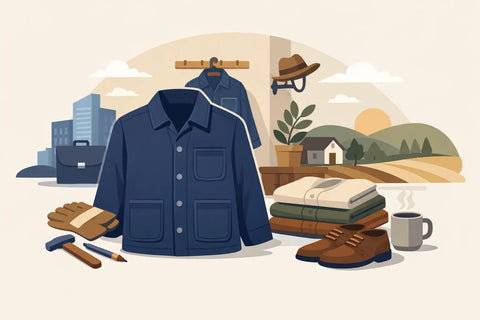
A chore jacket should not need an occasion. It belongs by the door, over a chair, or folded into a bag for the day ahead. Its value is not in a perfect first wear. It is in how naturally it becomes part of the work: carrying a notebook, taking a sudden rain shower, holding its shape through a long train ride, then returning home with a little more character than before.
The form began as practical clothing. French laborers wore simple cotton work coats, often called bleu de travail, for protection and ease of movement. The details were direct: a button front, a straight body, durable cloth, and pockets placed where hands could reach them. Nothing was decorative without a reason.
That clarity still matters. A well-made chore jacket is a useful layer, but it is also a wardrobe structure. It brings proportion to wide trousers, ease to tailored pants, and a sense of intention to a T-shirt and denim. One garment. Different bodies. Different lives.
What Defines a Chore Jacket
The best versions retain the original logic without becoming costume. They are not trying to imitate a workshop uniform from another era. They use workwear principles to answer present needs: utility, repetition, comfort, and durability.
A classic chore jacket usually has a boxy or gently relaxed cut, a collar that sits close to the neck, a button closure, and three or four patch pockets. The lower pockets are obvious. The chest pocket is often the detail that turns a plain layer into a working garment, giving the front a measured, architectural rhythm.
Length matters. Too short, and the jacket can feel like a casual overshirt. Too long, and it may lose the compact utility that defines the form. Most sit around the high hip to upper thigh, creating enough coverage for layering while keeping the silhouette clean.
Fit should leave room to move. That does not always mean oversized. A chore jacket needs space through the shoulder and body for a knit, a shirt, or another light layer underneath. But excessive volume can make dense workwear fabric feel heavy, particularly on smaller frames. The right fit is calm rather than restrictive: enough ease to work in, enough shape to wear anywhere.
Fabric Is the Real Decision
The silhouette is recognizable. Fabric determines how the jacket lives.
Cotton drill and twill are traditional choices for good reason. Their diagonal weave has structure, abrasion resistance, and a surface that softens with use. A midweight twill makes an effective year-round layer in mild climates. It wears comfortably indoors and works over a sweatshirt when the temperature drops.
Canvas is firmer and more protective. It holds a sharper outline and develops visible creases, fading, and wear at the seams. For some, that is the point. For others, especially those who want a jacket for daily city wear, a heavy canvas can feel too rigid or too warm. Weight is not automatically quality. The better choice depends on how often the garment will be worn and what it needs to do.
Herringbone twill brings a more textured finish, with a subtle zigzag weave that catches light differently than plain twill. It has a clear military and workwear history, yet it can feel refined when the cut is restrained. Cotton-linen cloth is lighter and more breathable, suited to warm weather, though it will not offer the same density or long-term abrasion resistance as a heavier drill.
Pay attention to the fabric before the first wash. Is it compact or loosely woven? Does it recover after being squeezed? Does the surface feel overly processed? Garments designed to last do not need to feel indestructible on day one. They need a fabric that can accept repeated wear without thinning, twisting, or losing its character.
Construction That Holds Up
A jacket intended for regular use should be built with the same restraint as its design. Clean topstitching reinforces stress points and gives the garment definition. Bar tacks at pocket corners prevent the places under most strain from giving way. A well-set collar holds its line without feeling stiff against the neck.
Buttons deserve attention. Large, securely sewn buttons are easier to handle and more in keeping with the garment's purpose than delicate fastenings. Corozo, horn, metal, and durable resin each age differently. The material matters less than whether it suits the fabric and can be repaired when needed.
Inside finishing tells its own story. Bound seams, flat-felled seams, or carefully overlocked construction can all be appropriate, depending on fabric weight and intended price. What matters is consistency. Loose thread ends, uneven pocket placement, and puckered seams are not signs of honest workwear. They are signs of hurried production.
How to Wear a Chore Jacket Without Overworking It
The chore jacket is strongest when it is not treated as a statement piece. Let its function do the visual work.
Over a white or washed cotton T-shirt, it gives denim a more resolved shape. With an Oxford shirt and wool trousers, it can replace a blazer when the setting calls for less formality but still benefits from structure. Over a fine gauge knit, the straight hem and patch pockets keep the look grounded.
For a fuller silhouette, pair it with balloon pants, fatigue trousers, or loose denim. The volume should feel balanced, not matched for its own sake. A boxy jacket over wide pants works when there is a visible difference in length or fabric weight. A cropped, lighter jacket can sharpen a roomier trouser. A longer, denser one can anchor it.
The same jacket also works with a skirt or dress because its lines are uncomplicated. A structured workwear layer against a softer fabric creates contrast without requiring a styled-out look. This is where unisex design earns its place. The garment does not need to be translated into a separate category to work across different bodies. It needs proportion, ease, and a clear purpose.
Color changes the role of the piece. Indigo and navy remain close to the original workwear language and fade with depth. Black is cleaner and more urban, though it may show wear differently over time. Ecru, natural cotton, and stone feel lighter but require more tolerance for marks. Olive and tobacco offer utility without becoming uniform-like.
There is no universal best color. Choose the one that connects to the rest of your wardrobe. A jacket worn twice a week in a color that works with your trousers, shoes, and shirts is more useful than a heritage-perfect shade that stays on the rail.
Care, Repair, and the Evidence of Use
A chore jacket is allowed to change. In fact, the best ones do. Twill softens at the elbows. Indigo opens at the seams. Canvas develops creases that reflect how you move. These are not defects to erase. They are evidence that the garment has become specific to its wearer.
Wash less when possible, but do not treat care as preservation theater. Air the jacket after wear. Spot clean when a full wash is unnecessary. When it needs washing, follow the care label, use a mild detergent, and avoid excessive heat. Turn darker fabrics inside out to limit surface fading. Reshape while damp and hang dry when the fabric allows.
Small repairs extend the useful life of the piece. A missing button, a loosened pocket corner, or a worn cuff does not require retirement. Repair is part of the original workwear contract. Clothes made for labor were expected to be maintained, not replaced at the first sign of use.
That expectation is worth carrying forward. Buying better is not only about choosing heavier cloth or heritage references. It is about selecting a form you will reach for often, caring for it without anxiety, and keeping it long enough for the materials to tell the truth.
A good chore jacket will never ask to be the center of the outfit. It will simply make getting dressed easier, season after season.