
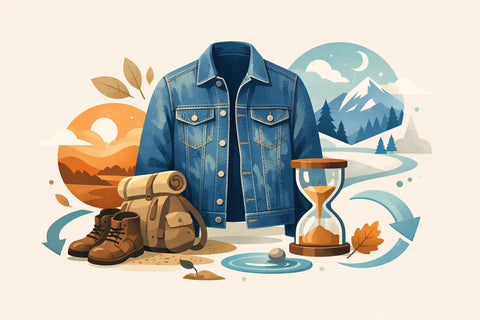
A jacket should not look finished when it leaves the store. It should look ready. Ready for train platforms, studio floors, weather, work, travel, and the gradual marks that make a garment personal. The future of durable clothing is less about making pieces indestructible than making them worth keeping once life has happened to them.
That distinction matters. A stiff fabric can survive years in a closet without becoming useful. A garment built only for visual impact can be technically well made and still lose its place after one season. Durability is material strength, certainly. It is also proportion, repairability, comfort, and the quiet confidence of a form that does not date itself.
The Future of Durable Clothing Is Not Just Tougher Fabric
The usual definition of durability begins with fabric weight: heavier canvas, denser twill, substantial denim, tightly woven poplin. These things matter. Fiber length, yarn twist, weave structure, abrasion resistance, and finishing all affect how a garment holds up. But fabric is only one part of the system.
A hard-wearing cloth can fail at a strained pocket corner, a narrow armhole, a weak zipper tape, or a seam that has not been reinforced where the body moves. A durable garment considers pressure points from the first pattern. It gives a trouser enough room through the seat and thigh. It uses seam allowances that can be repaired. It places pockets where they can be reached without pulling the whole garment out of shape.
This is where workwear remains instructive. Its original forms were developed around repeated use, not seasonal styling. Chore jackets allowed movement. Utility trousers carried tools. Photographer shirts organized the small objects needed through a day. Their details had a reason before they had an aesthetic.
That history should not become costume. A contemporary wardrobe needs the same logic, translated with restraint. The best utility garments retain their purpose while fitting different bodies, workplaces, and ways of moving through a city. Details with a past. Forms for now.
Weight has a trade-off
Heavier is not always better. A 14-ounce denim may be ideal for a structured pant that will soften over time, but excessive weight can limit comfort in humid weather or make a shirt sit awkwardly under a jacket. A lighter fabric can last just as well when its construction suits the garment and its intended use.
The useful question is not, “How heavy is it?” It is, “What is this fabric being asked to do?” A worker jacket needs body, abrasion resistance, and a finish that improves with wear. A daily shirt needs enough density to resist thinning at the elbows and collar, while remaining breathable. Durability begins with an honest match between material and function.
Construction Should Invite Repair
For too long, clothing has been designed as a closed object. When a button breaks, a hem drops, or a zipper fails, replacement is often easier than repair. That is not progress. It is a design decision disguised as convenience.
The next standard for durable clothing is serviceability. Buttons should be replaceable. Hardware should be chosen for availability as well as appearance. Seams should be accessible to a skilled tailor. A lining should not make a simple repair needlessly complicated. These choices rarely create the loudest product story, but they determine whether a garment returns to use.
Repair also changes how ownership feels. A visible mend, a replaced cuff, or a carefully patched knee does not reduce value. It records a relationship. The garment becomes more specific to its wearer, not less refined.
There is nuance here. Not every repair is practical, and not every damaged fabric can be restored. Some technical coatings degrade in ways that cannot be reversed. Some synthetic blends are difficult to mend cleanly. This is why the future is not simply about promising a lifetime. It is about designing for a long, useful life, then being clear about the limits of each material.
A durable wardrobe benefits from garments that can be altered, too. A generous hem allowance can extend a trouser. A straight, balanced silhouette can move between formal and informal settings. Adjustable waists, considered plackets, and unisex proportions allow one piece to work across changing bodies and changing routines. One garment. Different bodies. Different lives.
Timeless Form Is a Form of Durability
A garment can remain physically intact and still become obsolete. This is the waste that trend cycles normalize: clothing made to survive, then styled to expire.
Timelessness does not mean neutral, anonymous, or stripped of character. It means the design has enough internal logic to outlast a moment. A balloon pant works because its volume is balanced by a controlled ankle and a clear waist. A boxy worker jacket works because its shape layers easily and gives the body room. A well-cut overshirt earns repeat wear because it can shift between outer layer, middle layer, and shirt.
These forms are not immune to change. Fit preferences move. Lifestyles change. But garments with proportion, utility, and presence tend to adapt. They are not dependent on a single season's styling instructions.
For experienced buyers, this is often the real test before purchase: Can this piece enter the existing wardrobe without requiring a new identity around it? Can it work with worn denim, tailored trousers, a long skirt, or a pair of utility pants? Can it be worn hard without becoming visually exhausted?
The answers are often found in small decisions. A collar that sits correctly. A pocket scaled to the garment rather than added as decoration. A color that develops depth rather than merely fading. A silhouette that holds its line after repeated washing.
Better Materials Need Better Expectations
Natural fibers are often treated as the automatic answer to responsible clothing. They have real strengths: cotton can be repaired and softened, wool can recover from creasing, linen gains character with wear. Yet no fiber is inherently without cost. Cotton requires land and water. Wool requires careful animal and land management. Linen can crease sharply. Leather needs responsible sourcing and appropriate care.
Synthetic fibers have their place as well. They can add strength, stretch, weather resistance, and fast drying performance. The issue is not purity. It is whether a blend genuinely improves the garment's service life and whether its end-of-life limitations have been considered.
A small amount of nylon in a high-friction work pant may prevent premature wear. A stretch fiber in a garment intended for decades of use can be more complicated, since elastic components often fatigue before the main cloth. There is no single correct fabric. There is only appropriate material use, stated plainly.
The same applies to finish. A water-resistant treatment may be useful for an outer layer. It is unnecessary theater on a garment that will spend most of its life indoors. Durable clothing should avoid both false purity and unnecessary performance claims.
Ownership Is Part of the Design
A well-made garment still needs a wearer who understands its rhythm. Washing less often, spot cleaning when possible, closing zippers before laundering, drying knits flat, and storing pieces away from direct sun can change a garment's lifespan substantially. Care is not preciousness. It is basic maintenance, like oiling a tool or conditioning a pair of boots.
Brands have a role here. Care instructions should explain more than symbols. They should tell the wearer what to expect: whether indigo will transfer, whether canvas will relax, whether shrinkage is possible, whether a fabric will develop creases or patina. Clear expectations prevent disappointment and let aging become part of the appeal.
The strongest relationship between maker and wearer continues after checkout. It includes practical guidance, replacement parts where possible, repair support, and honest information about how a piece is meant to change. Buy better. Keep forever is not a promise that nothing will wear out. It is a commitment to choosing pieces whose wear is worth living with.
The future of durable clothing will be built in pattern rooms, mills, factories, repair shops, and closets. It will favor fewer decisions made with greater care. When considering the next garment, look beyond the first impression. Check the fabric, then the seams. Consider the silhouette, then the life you can realistically give it. The right piece will not ask to be protected from use. It will ask to be used well.