
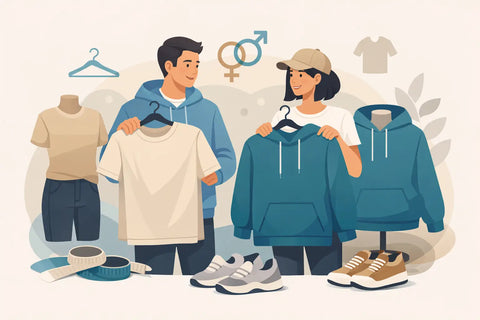
The mistake usually happens before the garment is even on the body. Someone sees “unisex,” assumes it means universally easy, and picks the size they always wear. That works sometimes. Often, it does not. If you want to know how to choose unisex sizing well, start by ignoring the letter on the tag and reading the garment the way a pattern cutter would - through shape, ease, and proportion.
Unisex sizing is not a neutral shortcut. It is a design decision. A worker jacket cut for movement will land differently than a straight camp shirt. Balloon pants with volume through the leg behave differently than a trim utility trouser. The point is not to erase body differences. The point is to build one garment that can live well on different bodies.
What unisex sizing actually means
Unisex does not mean identical fit for everyone. It means the garment has been designed with a broader fit logic than traditional menswear or womenswear. That logic usually starts with straighter lines, balanced proportions, and enough ease to allow different body shapes to wear the piece without distortion.
But there is no universal industry standard. One brand’s unisex medium can feel like a relaxed men’s medium. Another can feel closer to a women’s large with extra length. The term tells you the intention. It does not tell you the exact fit.
That is why experienced buyers treat unisex sizing as a measurement problem first, and a size-name problem second. Small, medium, and large are only useful once you know how the garment was drafted.
How to choose unisex sizing by measurement, not habit
Start with the garment you already own and wear often. Not the one that almost works. The one you reach for without thinking. Lay it flat and measure chest, shoulder, waist, rise, hip, inseam, and opening where relevant. Those numbers will tell you more than your usual size ever will.
When you compare those measurements to a size chart, focus on the dimensions that control fit most strongly for that garment type. For shirts and jackets, chest and shoulder usually matter first, then length and sleeve. For pants, waist and hip matter, but rise is often the deciding factor in whether a unisex trouser feels right or slightly off.
This is where many people size up too quickly. They want more room at the hip or chest, so they jump a full size, then end up with dropped shoulders, excess sleeve length, or a rise that sits too low. Sometimes the better move is to stay closer to your true measurement and choose a silhouette already built with volume.
A boxy overshirt and a straight utility shirt can have the same chest measurement and still wear differently. The pattern shape matters as much as the number.
The measurements worth caring about most
Chest width is not just about tightness. It affects drape. In a chore coat or worker jacket, a little extra chest room helps layering and movement. Too much, and the garment starts to collapse instead of hold its line.
Shoulder width is often the cleanest signal in unisex tops. If the shoulder extends too far, the whole garment can look borrowed rather than intentional. There are exceptions. Some oversized cuts are designed exactly for that effect. But if the garment is meant to feel precise, shoulder placement is usually where precision starts.
For pants, rise deserves more attention than it gets. A unisex pant with a longer front rise may sit well on one body and feel too low or too long on another. Waist can be altered with belts or tabs. Rise cannot. If you are choosing between sizes, check rise before assuming the larger size is safer.
Read the silhouette before you read the size chart
A good unisex garment begins with silhouette. The size chart tells you scale. The silhouette tells you behavior.
Straight-leg utility trousers are usually forgiving across body types because the line stays clean even with some variation in fit. Balloon pants are more specific. They depend on volume and taper. Too small, and the shape disappears. Too large, and the volume can start too high or finish too wide.
The same goes for tops. A photographer shirt with a generous body and simpler shoulder can accommodate range naturally. A cropped jacket with a firm shoulder and structured hem needs closer attention because proportion is doing more of the work.
If the garment is meant to sit away from the body, do not size down just to “define” shape. You may end up removing the exact quality that makes the piece work. On the other hand, if the design is clean and compact, sizing up for comfort can distort the line. Fit is not only about room. It is about preserving intent.
Fabric changes the answer
Fabric weight and finish can make the same measurements feel entirely different. A dry cotton poplin shirt with little give will read more exact than a brushed twill shirt in the same dimensions. A dense denim jacket may feel smaller at first wear, then relax into the body over time. A washed canvas trouser may already have some softness built in.
So when thinking about how to choose unisex sizing, ask not only how big the garment is, but how alive the fabric is. Does it hold shape? Does it drop? Will it break in? Will it shrink slightly after washing, or has it been pre-washed already?
This matters most in garments with structure. Utility wear often relies on fabric memory. You are not just fitting the body. You are fitting the material’s behavior around the body.
Fit intent matters more than gender category
Many shoppers still approach unisex sizing by translating from womenswear to menswear or the reverse. It is understandable, but not always useful. A better method is to define the fit you want in plain terms.
Do you want the shirt clean through the shoulder with room in the body? Do you want the jacket to layer over knitwear? Do you want the trouser to sit high and cropped, or lower and full-length? Those are fit intentions. They are more accurate than trying to decode what a men’s medium might mean on your frame.
This is especially true for people who wear across categories already. A person who regularly buys vintage military shirts, wide-leg tailoring, and classic denim often has a more developed eye than the size system assumes. Trust that eye. If you know you prefer a firm collar, a longer sleeve, or a fuller rise, let that guide the decision.
Unisex clothing works best when you stop asking, “Was this made for me?” and start asking, “Was this cut the way I want to wear it?”
Common sizing traps in unisex clothing
The first trap is using your standard size without checking the garment measurements. Familiar sizes create false confidence.
The second is choosing based only on body measurement, not finished garment measurement. Your body is one variable. Ease is the other. Without ease, you do not know how the piece is meant to function.
The third is treating all unisex garments the same. A relaxed jersey tee, a structured twill jacket, and a high-rise trouser should not be sized with the same logic.
The fourth is forgetting proportions after width. A garment can fit your torso and still feel wrong because the sleeve, body length, knee placement, or hem opening is off. Proportion is where a good fit becomes a convincing one.
A practical way to get it right
If you are between sizes, begin with the silhouette category. For a roomy overshirt, chore coat, or volume pant, the smaller of the two sizes often keeps the shape intentional while still giving enough ease. For a trim jacket, straight shirt, or cleaner trouser, the larger size may preserve movement better, especially if your measurements sit near the top of the smaller range.
Then check the fabric. If it is rigid and structured, leave some margin. If it is washed, soft, or naturally forgiving, you can size more precisely.
Finally, think about use. A garment worn mostly over a tank or tee can be closer. A jacket meant for layering needs air inside it. Workwear has always understood this. Function sets the fit.
At WORKWARE, unisex design is not treated as a compromise between categories. It is treated as a system - one garment, different bodies, different lives. That only works when the wearer meets the garment halfway, with attention.
The best size is rarely the one that flatters in theory. It is the one that lets the shape hold, the fabric move, and the piece stay in rotation for years. Buy better. Keep forever.