
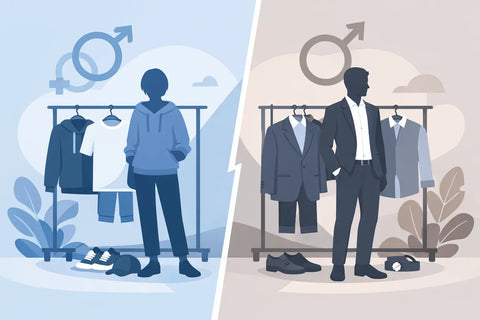
A jacket can share the same drill cloth, bar tacks, and patch pockets, yet feel entirely different on the body depending on whether it was built as menswear or built without a fixed gender frame. That is the real question inside unisex clothing vs menswear. Not ideology. Pattern, proportion, and how a garment lives across different bodies over time.
For anyone building a wardrobe with intent, the distinction matters. Not because one category is better, but because each starts from a different design assumption. Menswear usually begins with a male-coded fit block and a long-established set of proportions. Unisex clothing begins with shared wear in mind. The best versions are not vague. They are precise in a different way.
Unisex clothing vs menswear starts at the pattern
Most menswear is drafted from a men's base block. That affects shoulder width, sleeve pitch, rise, seat shape, and overall balance. Even when the styling is minimal, the underlying architecture is specific. A men's oxford shirt may look clean and universal on a hanger, but it often assumes a straighter torso, a certain neck-to-shoulder relationship, and a hem length intended for male-coded styling.
Unisex clothing does not simply remove labels. At its best, it reworks the pattern so the garment can hold shape across a broader range of bodies. That may mean a dropped shoulder instead of a sharp shoulder point, a roomier sleeve that layers well without collapsing, or a straighter side seam that does not force the waist. In pants, it can mean a rise and hip balance designed for movement rather than a narrow idea of where the garment should sit.
This is where many brands miss the mark. Some call a men's fit unisex and stop there. The result is familiar: a shirt that fits one wearer with ease and another with excess in the wrong places. Real unisex design asks more of the pattern maker.
Menswear often protects tradition
That is not a flaw. In many categories, menswear's strength is its discipline. The formulas are proven. A well-cut chore jacket, fatigue pant, or straight-leg jean in the menswear tradition carries decades of refinement. If you know your fit and prefer that structure, menswear can be exacting in the best sense.
It also preserves a language of dress. The stance of a collar, the pitch of a sleeve, the depth of a front placket - these details have continuity. For buyers who appreciate heritage garments, that continuity is part of the appeal.
Unisex clothing often protects flexibility
Unisex design tends to favor adaptability over rigidity. It leaves more room for personal styling, body variation, and shared use. One garment. Different bodies. Different lives.
That can make unisex clothing especially strong in workwear-rooted pieces. Utility trousers, worker jackets, photographer shirts, and balloon pants already come from functional origins. They were never about decoration first. When reworked carefully, they carry well across gender lines because the core logic is practical: movement, storage, durability, ease.
Fit is where the difference becomes visible
If you are deciding between unisex clothing vs menswear, ignore the category name for a moment and look at four things: shoulder, chest, rise, and length. Those points tell you more than the label.
In tops and jackets, menswear usually has a more defined shoulder line and a torso shaped around male-coded proportions. That can create a clean, familiar silhouette, especially if you want the jacket to sit close to the frame. Unisex jackets often relax that precision slightly. The shoulder may drop. The body may be boxier. The result is not necessarily oversized, just less prescriptive.
In pants, the difference gets sharper. Menswear often assumes a certain waist-to-hip relationship and may feel restrictive or awkward on some bodies even when the waist technically fits. Unisex pants that are well designed tend to account for broader variation through rise, volume, and placement of ease. A balloon pant is a good example. Its shape is not neutral by accident. It uses volume as a fit strategy.
Length matters too. Menswear shirts and outerwear are often cut longer based on conventional styling and body assumptions. Unisex garments may shorten or rebalance length so they work tucked, untucked, layered, or worn by people of different heights without looking incidental.
Where unisex clothing wins
Unisex clothing is strongest when you want a wardrobe that behaves like a system rather than a set of categories. Shared outerwear. Trousers that move between work and weekend. Shirts that layer over a tee, under a coat, or over a dress without strain. The value is not just inclusivity. It is efficiency.
There is also a practical advantage for experienced buyers: unisex pieces often allow more control over silhouette. You can size for shape rather than for gendered expectation. Want a closer line through the torso? Size down. Want volume for layering? Size up. The garment still reads intentional.
This is particularly true in heritage-informed clothing. Workwear has always had a blunt honesty to it. Good canvas, dense twill, ring-spun denim, reinforced seams. These materials and constructions tend to tolerate variation well. They gain character with wear. They do not rely on a narrow fit to justify their presence.
For brands like WORKWARE, that is the point. Details with a past. Forms for now.
Where menswear still makes sense
There are times when menswear is simply the better tool. Tailored trousers, suiting, shirting with a sharp collar stance, and jackets meant to follow the shoulder closely can benefit from the specificity of menswear drafting. If you know you prefer a traditional masculine line, unisex alternatives may feel too open-ended.
Menswear can also be more predictable if you have bought within that system for years. You know your measurements. You know how a size 32 trouser or a medium overshirt tends to behave. That consistency has value, especially online.
And some garments should remain specific. Not every product category improves when generalized. Precision is part of good design. Sometimes shared wear is the right answer. Sometimes dedicated patterning is.
The common mistake: confusing oversized with unisex
Oversized menswear is not automatically unisex. It may look relaxed on one body and simply too large on another. Scale alone does not solve fit. A genuinely unisex garment considers where volume sits, how it falls, and how the proportions resolve once worn.
That is why the best unisex clothing often feels subtly architectural. The sleeve is wider but still balanced. The hem is straighter but not dead. The rise is fuller but controlled. Nothing is accidental. Minimal does not mean generic.
When evaluating a piece, look beyond marketing language. Check the shoulder line. Check whether the armhole allows movement. Check where the side seam falls. Check whether the front and back lengths are working with the body or against it. Construction reveals intent.
How to choose between unisex clothing and menswear
Start with how you want the garment to function, not how you want it labeled. If you need structure, a traditional line, or category-specific fit, menswear may serve you better. If you want versatility, layering ease, and a silhouette that can move across settings and bodies, unisex clothing is often the stronger choice.
Then consider fabric. Heavier, more substantial fabrics often support unisex design well because they hold form without clinging to body-specific contours. Twill, drill, canvas, ripstop, and sturdy poplin tend to create shape through construction rather than through the body underneath. Lightweight fabrics can work too, but they expose fit decisions more quickly.
Finally, think about longevity. Will this garment still make sense in five years? Can it be styled in more than one register? Can someone else in your household wear it just as well? The difference between a good purchase and a forgettable one often lives there.
Unisex clothing vs menswear is really a question of intent
Both categories can produce excellent clothing. Both can produce lazy clothing too. The useful distinction is not cultural shorthand. It is whether the garment was designed with enough clarity to do what it claims.
Menswear, at its best, offers tradition, rigor, and a specific line. Unisex clothing, at its best, offers flexibility, utility, and room for real life. Neither should be treated as a compromise. The standard should stay the same: fabric with integrity, construction that holds, and proportion that feels resolved.
Buy the piece that understands its own purpose. If it fits your life, the label matters less with every wear.