
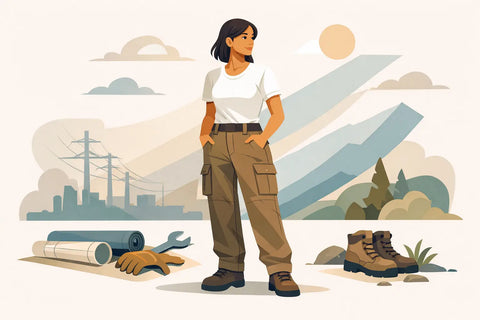
A good pair of utility trousers for women does more than reference workwear. It earns space in rotation through shape, fabric, and use. The difference is easy to spot. One pair reads as costume. Another becomes the piece you reach for three days a week because it holds form, carries what you need, and improves with wear.
That distinction matters more now than trend relevance. Many women are not looking for novelty. They are building wardrobes that work under repetition - for the studio, the office, travel, weekends, and every unplanned shift between them. Utility trousers belong in that system when the design is disciplined enough.
What utility trousers for women should actually do
Utility is often reduced to surface details - a few patch pockets, a visible seam, a washed fabric. That misses the point. True utility starts with function and then resolves into proportion. The trousers should move cleanly, sit well on the body, and support repeated wear without feeling blunt or overbuilt.
The best pairs are grounded in workwear logic. Pockets are placed where the hand naturally falls. The rise is balanced, not extreme. The leg shape has intent, whether straight, gently tapered, or slightly ballooned. Fabric carries enough weight to create structure, but not so much that the trousers become stiff or seasonal.
This is where many fashion versions fall short. They borrow the language of utility without keeping the discipline. Excess trim, decorative straps, or oversized cargo compartments can date a garment quickly. Cleaner construction tends to last longer, visually and physically.
Fabric first
If you know clothing, you know the fabric usually decides the life of the garment. With utility trousers, that is especially true.
Cotton twill remains the clearest choice. It has history, abrasion resistance, and a dry hand that softens over time. A dense twill gives utility trousers their shape and slight authority. It also wears in rather than wearing out. High-twist cotton can feel crisper and more refined, while brushed twill offers a softer surface but may lose some edge.
Canvas is another strong option, though it depends on weight. Too heavy, and the trousers can feel rigid for daily use. Too light, and they lose the point of utility. Herringbone twill brings subtle texture and heritage depth, often with a more relaxed drape than plain canvas.
Blends have their place, but they change the character. A small amount of elastane may improve comfort, especially if the cut is close through the hip or thigh. The trade-off is longevity. Stretch fibers can fatigue before the cotton does. If durability is the priority, a well-cut 100 percent cotton fabric often ages better.
Washed finishes matter too. Garment washing can reduce stiffness and give the trousers an easier hand from day one. The risk is overprocessing. If the fabric looks too distressed at purchase, there may be less beauty left for time to add.
Fit is structure, not trend
The right fit in utility trousers for women is not about following whatever silhouette is currently loudest. It is about balance.
A mid to high rise usually makes the most sense because it anchors the trousers and lets the leg shape read clearly. Lower rises can work, but they often make utility details feel less grounded. Through the hip and seat, there should be enough room to move without creating drag lines or excess volume. Utility trousers should feel composed, not squeezed on.
Leg shape changes the mood. A straight leg is the most versatile and usually the easiest to integrate into an existing wardrobe. A taper brings a more compact, architectural line, especially good with cropped jackets or oversized shirting. A wider or balloon leg can be excellent if the fabric has enough body to hold the silhouette. Without that structure, volume can collapse and lose precision.
Length deserves more attention than it gets. Full length with a slight break gives weight and practicality. Cropped lengths can sharpen the line, but they are more dependent on footwear and season. If you want one pair to do the most work, full length usually wins.
The details worth paying for
Construction is where the quiet value sits. Better utility trousers often look simple at first. Then you notice the decisions.
Topstitching should be clean and consistent, not merely visible. Bar tacks at points of strain are a small sign of seriousness. Pocket bags should feel substantial. Belt loops should be secure and proportionate. A good waistband lies flat and stays that way over time.
Pocket design matters more than count. Two well-placed front pockets and a useful back pocket may outperform a trouser covered in cargo compartments. Side patch pockets can work beautifully, but only when scaled to the garment and body. Too large, and they dominate. Too small, and they become decoration.
Hardware should support the garment, not call attention to itself. Durable buttons, solid zippers, and rivets where needed are enough. Utility is not theater.
How to wear them without losing the point
The strength of utility trousers is that they do not need much around them. In fact, they usually work best when the rest of the outfit stays equally resolved.
For everyday wear, pair them with a crisp shirt, rib tank, or substantial tee. Let proportion do the work. A wider trouser likes a shorter or cleaner top layer. A straighter trouser can take more volume above - a worker jacket, an oversized oxford, a knit with a dry hand.
Footwear shifts the reading. A leather derby, loafer, or simple boot keeps the line grounded. Minimal sneakers make sense when the trousers are sharp enough in fabric and cut. Delicate shoes can work, but it depends on the trouser. A heavy canvas cargo with a barely-there sandal may feel unresolved. A refined twill utility pant with a clean flat can be exact.
This is also where color earns its keep. Olive, ecru, navy, black, and washed khaki tend to hold longest in a wardrobe system because they pair widely and age well. Brighter shades can be compelling, but they usually narrow the range of use.
When women borrow from menswear, and when they should not
Many of the best utility trousers for women are informed by menswear or are fully unisex. That is often a strength. Workwear historically prioritized durability, movement, and direct construction. Those values translate well across bodies.
But copying menswear patterns without adjustment is not always enough. Depending on body shape, the rise, hip allowance, and pocket placement may need refinement to sit properly. Some women prefer a straighter unisex fit with more room and less contour. Others want the same utility language with a better relationship to the waist and seat. Neither approach is more correct. The better choice is the one that keeps the garment functional on your body, not just on a hanger.
This is part of why experienced buyers look beyond labels like womenswear or menswear. They look at measurements, fabric behavior, and silhouette. One garment. Different bodies. Different lives.
What to avoid
If a pair looks convincing online but feels thin, overdesigned, or strangely precious in person, trust that instinct. Utility trousers should not require delicate treatment. Nor should they rely on exaggerated details to explain themselves.
Be cautious with paper-thin fabrics marketed as utility, heavily tapered cuts that restrict movement, or pockets placed purely for effect. Also question anything that feels too tied to a single season's styling language. The best pairs do not need a trend cycle to justify their shape.
Price alone is not proof either. A higher price can reflect better cloth and construction, but sometimes it reflects marketing and nothing more. Read the garment closely.
Why they stay relevant
Utility trousers last because they answer a real need. They offer structure without stiffness, practicality without compromise, and presence without noise. That combination is rare.
They also age well because wear improves them. Twill softens. Edges become more personal. The silhouette settles into your habits. A good pair does not just survive repetition. It becomes more itself through it.
That is the quiet promise of well-made clothing, and it is why brands like WORKWARE return to these forms season after season. Not to refresh them into novelty, but to refine what already works.
If you are choosing utility trousers, choose the pair that still makes sense after the styling falls away. The one with the right weight, the right rise, the right pocket, the right line. Buy better. Keep forever.