
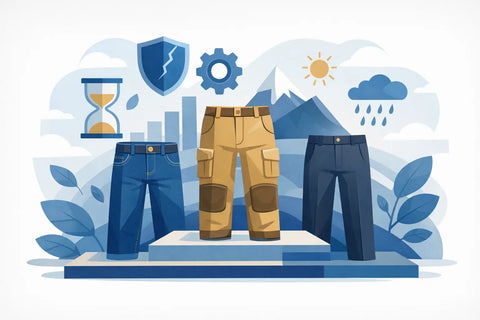
A pair of pants usually tells the truth before the label does. Knees go shiny. Seat seams strain. Pocket bags tear. The fabric twists after a few washes, and suddenly the garment that looked right in the fitting room feels temporary. If you're asking what pants last the longest, the answer is less about category and more about build.
Longevity lives in the relationship between cloth, construction, fit, and use. A well-made pant can age into itself. A poorly made one starts collapsing almost immediately, even if the fabric feels substantial at first touch. The difference is rarely one dramatic feature. It is a system.
What pants last the longest in real wear?
In most wardrobes, the pants with the longest life are sturdy cotton trousers, dense denim, canvas work pants, and tightly woven twills with enough structure to resist abrasion. Not delicate, not overfinished, not designed around novelty. The longest-lasting pairs tend to come from workwear and military lineage for a reason - those categories were built around repeated wear, repair, and movement.
That does not mean every heavy pant is durable. Weight helps, but weight alone can be misleading. Some low-grade heavy fabrics feel impressive on the hanger and then break down at stress points because the yarn quality is poor or the finishing is too aggressive. Good cloth holds together at the fiber level. It recovers after wear. It softens without thinning too quickly.
The strongest candidates are usually midweight to heavyweight fabrics in the 8 to 14 ounce range for everyday trousers, and often higher for denim or true utility pants. Cotton drill, herringbone twill, ripstop, duck canvas, and tightly woven denim have all earned their place over time. Wool can also last remarkably well in tailored trousers, but only when the fabric is dense, the cut is not overstrained, and the wearer is not treating dress pants like field gear.
Fabric matters first
If durability is the brief, start with fiber and weave.
Cotton twill remains one of the most dependable choices. The diagonal weave resists wear well, drapes cleanly, and works across seasons. It is less rigid than canvas, usually more comfortable out of the gate, and easier to live with long term. Utility trousers and fatigue pants often rely on twill because it balances structure and movement.
Canvas and duck cloth are tougher still. They resist abrasion, hold shape, and tend to improve with use. The trade-off is stiffness. Some wearers want that firmness. Others find it restrictive, especially in a narrow cut. A canvas pant cut too slim often wears out faster than it should because the fabric cannot move the way the body does.
Denim is the obvious reference point, but not all denim earns its reputation. Durable denim is tightly woven, made from quality yarns, and cut with enough room to reduce constant stress at the seat, thighs, and knees. Raw and rinsed denims often outlast heavily distressed pairs because they have not been artificially weakened before you even put them on.
Ripstop deserves mention too. It was engineered to limit tearing, and in the right trouser it performs well. But it is not invincible. Lightweight ripstop can still abrade quickly if used hard. It works best when the fabric is substantial enough to match the intended use.
Synthetic blends complicate the picture. A small amount of nylon can improve abrasion resistance. A touch of elastane can improve comfort. Too much stretch, though, often shortens a pant's life. Stretch fibers fatigue. Knees bag out. Recovery fades. The cloth loses its discipline. For long-term wear, less stretch is usually better.
Construction decides whether the fabric gets a fair chance
Even the right cloth can fail if the pant is poorly built.
Look closely at the seams. High-stress areas should be clean and stable, with no loose tension or skipped stitches. Flat-felled seams, bar tacks at pocket openings, reinforced belt loops, and secure fly construction all matter more than decorative details. A pant meant to last is usually quiet in its design and serious in its engineering.
Pocket bags are one of the first places weak pants reveal themselves. Thin, loosely woven pocketing tears quickly, especially if you carry keys, a phone, or a wallet in the same places every day. Durable trousers use sturdy pocket bags and attach them cleanly so strain is distributed rather than concentrated.
Hardware matters too, but not in a flashy way. A reliable zipper, well-set rivets where appropriate, and buttons sewn on with enough substance to survive repeated use are basic requirements. None of this is glamorous. That is the point.
There is also such a thing as overbuilding. Triple stitching everywhere may look convincing, but if the fabric is soft or the pattern is unbalanced, the extra thread does not solve the core problem. Durable design is precise, not performative.
Fit changes lifespan more than most people think
The wrong fit can ruin good pants.
A pair worn too tight through the seat and thigh will fail early, no matter how strong the fabric appears. Constant tension at the crotch seam, stress across the back rise, and friction at the inner thigh create predictable damage. This is one reason roomier heritage cuts often age better than aggressively slim ones. They allow the cloth to move.
That does not mean baggy is always better. Excess fabric can create its own abrasion points, especially at the hem and inner leg. The best fit for longevity is balanced - enough ease to walk, sit, cycle, and climb stairs without forcing the seams, but not so much volume that the pant drags or folds into itself.
Rise also matters. A rise that fits the body properly reduces strain across the top block. If the rise is too short, the pant is always fighting the wearer. Over time, the garment loses.
The pants that often fail first
If the goal is a long horizon, some categories are simply less reliable.
Very lightweight chinos can look clean but wear out quickly with daily use. Overwashed fabrics often feel soft because they have already surrendered part of their structure. Fashion denim with heavy distressing, sanding, or stretch usually peaks early. So do trousers built around surface appeal - coated finishes, novelty blends, exaggerated tapers, fragile trims.
This is the trade-off many brands avoid stating clearly: softness, drape, and immediate comfort can come at the expense of lifespan. Sometimes that trade is worth it. Not every pant needs to survive a decade. But if durability is your first filter, choose substance over instant ease.
What to inspect before you buy
A durable pant usually signals itself in the hand. The fabric should feel alive, not spongy. Seams should lie flat. The waistband should feel stable. Pocket openings should not warp when you tug them lightly.
Turn the pant inside out if you can. You will learn more there than from any marketing copy. Check seam finishing, pocketing, reinforcement, and fabric consistency. Look at stress points. Think about how you actually wear pants - at a desk, on a bike, on set, in a workshop, in transit. The longest-lasting pair is the one built for your use, not for an abstract ideal of toughness.
This is where experienced buyers tend to make better decisions. They do not ask only whether a pant is heavy. They ask whether the pattern supports movement, whether the cloth will break in well, whether the construction justifies the price, whether the silhouette will still make sense five years from now.
Care is part of the answer to what pants last the longest
The best-made pants can still be shortened by poor care.
Washing less helps, but only when balanced with hygiene and fabric type. Spot clean when possible. Wash cold. Use mild detergent. Skip excessive heat. High dryer temperatures are particularly hard on cotton fibers, stretch blends, and seam integrity. Air drying preserves more life.
Rotation matters just as much. Wearing the same pair day after day without rest concentrates stress and moisture in the same places. Two or three reliable pairs will outlast a single overworked favorite.
Repair should also be part of the plan. A loose hem, thinning knee, or early seam issue is not the end of a garment. It is often the moment that decides whether the pant lasts one year or many. Workwear has always understood this. Longevity is not just about resisting wear. It is about remaining worth repairing.
The short answer
If you want pants that last, look for dense natural fabrics, workwear-derived construction, balanced fit, and minimal stretch. Choose twill, canvas, or well-made denim over flimsy blends and overprocessed finishes. Inspect the inside. Buy for movement. Care for them with some restraint.
At WORKWARE, that logic is simple: buy better, keep forever. The longest-lasting pants are rarely the loudest pair in the room. They are the ones that keep earning their place, season after season, until they feel less like a purchase and more like part of the architecture of how you dress.