
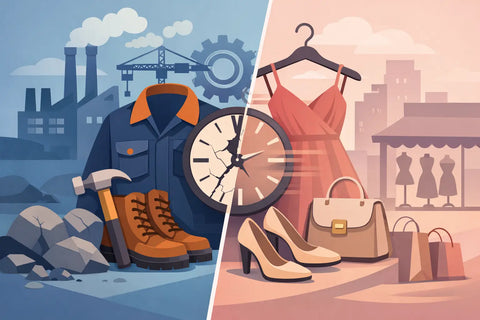
A jacket tells on itself after a season. The collar edge softens or collapses. The pocket bags hold or they fray. The fabric either gains character or gives up. That is where workwear vs fast fashion becomes clear - not on a trend report, but in daily wear.
For anyone who buys with intent, this is not just a question of price. It is a question of construction, use, and time. Fast fashion is built for immediate relevance. Workwear, at its best, is built for repeated use, repair, and long-term place in a wardrobe. They may sometimes borrow the same visual language - chore coats, carpenter pants, utility shirts - but they are not made with the same logic.
Workwear vs fast fashion starts with purpose
Workwear comes from function. Its original forms were shaped by labor, movement, weather, and repetition. A worker jacket needed room through the body. Utility trousers needed durable cloth and practical pockets. A photographer shirt or chore coat was not designed to be novel. It was designed to work.
That origin still matters. Even in a contemporary wardrobe, good workwear carries traces of utility - reinforced seams, generous cuts, fabrics with weight, and details that earn their place. The appeal is not nostalgia alone. It is clarity. Every element has a reason.
Fast fashion starts elsewhere. Its primary job is speed. It reacts to images, runway cues, social feeds, and micro-trends, then compresses them into quick product cycles. The goal is not long wear. The goal is fast adoption. That changes every decision downstream, from fabric selection to pattern cutting to finishing.
This is why two garments can look similar online and perform completely differently in life. A boxy canvas jacket and a trend-led imitation may share a silhouette in a product photo. Wear them for a year and the difference becomes structural.
Fabric tells the truth
Most experienced buyers start here. Fabric is where intention becomes tangible.
Workwear fabrics are usually chosen for endurance and character. Dense cotton twill, herringbone, canvas, ripstop, and substantial denim all wear in rather than simply wear out. They crease with memory. They soften without losing identity. The surface records use. That aging process is part of the value.
Fast fashion fabrics are often chosen for speed, low cost, and visual approximation. A cloth may be finished to look crisp at first but lack the density to keep its shape. Blends can pill early. Lightweight weaves can torque, bag out, or thin quickly at stress points. None of this is accidental. If the garment only needs to survive a season of relevance, longevity is wasted expense.
There is nuance here. Not every heavier fabric is automatically better, and not every affordable garment is disposable. But the general rule holds. When a brand invests in cloth with substance, it usually signals a wider commitment to wear life.
The best fabrics also improve the relationship between garment and body. They drape with intention. They hold a silhouette. They become more personal over time. That is difficult to fake.
Construction is the real separator
If fabric is the first signal, construction is the deeper one.
Workwear has always relied on practical construction - seams placed to reduce strain, bar tacks where tension gathers, pocketing that can handle use, closures that feel secure, hems that do not distort after washing. These are quiet decisions, but they define how a piece lives.
Fast fashion often reproduces the appearance of these details without the function behind them. A pocket may be too shallow to use. Topstitching may be decorative rather than reinforcing. An oversized fit may mimic utility wear visually while being cut from fabric too thin to support that shape. It reads right for a moment. It does not behave right for long.
This is where experienced shoppers become exacting. They notice whether the collar stand sits cleanly, whether the armhole allows movement, whether the waistband twists after laundering. These are not minor issues. They determine whether a garment becomes habitual or forgotten.
Good workwear feels resolved. It does not ask for attention. It earns trust through repeat wear.
The price question is less simple than it looks
Fast fashion wins the first transaction. That is obvious. The ticket price is lower, and the perceived risk is small.
But wardrobe value is not measured at checkout. It is measured across cost per wear, replacement frequency, and how much of your closet remains usable after a year. A cheaper garment that loses shape, breaks down, or stops feeling relevant after a handful of wears is not necessarily economical. It is just inexpensive at the point of purchase.
Workwear usually asks for more upfront because more has gone into it - better fabric, better trims, better make. The return is slower and more durable. A well-cut worker jacket can move across years, climates, and contexts. Utility trousers can be worn hard, styled differently, repaired if needed, and still remain current because they were never chasing a moment in the first place.
Of course, not everyone needs every garment to last a decade. Some categories are more disposable by nature, and budgets are real. But for the backbone of a wardrobe - outerwear, trousers, shirts, denim - longevity changes the math.
Style longevity matters as much as physical longevity
A garment can stay intact and still become obsolete. This is where workwear holds a different kind of advantage.
Because its shapes come from function, they tend to resist trend fatigue. A chore jacket is still a chore jacket. Balloon pants, when cut with balance, still make sense years later because volume is serving movement and proportion, not spectacle. A utility shirt remains useful because its design language is grounded, not seasonal.
Fast fashion depends on acceleration. It needs one look to replace another. That cycle creates visual exhaustion. Pieces bought for novelty often feel stale before they are physically worn through.
This is why so many intentional dressers move toward wardrobe systems. They are not trying to own less for its own sake. They want fewer decisions, stronger silhouettes, and garments that can cross professional, casual, and creative settings without strain. Workwear fits that system naturally.
It also works across bodies. Many classic utility forms are generous, adaptable, and less rigidly gendered. That flexibility is part of their endurance. One garment. Different bodies. Different lives.
Workwear vs fast fashion in daily use
The sharpest difference shows up after the purchase.
Fast fashion often performs well in the first hour. It photographs cleanly. It gives immediate variety. But repeated wear exposes compromise. Knees bag out. Ribbing warps. Synthetic-heavy fabrics hold odor or lose structure. A shape that looked directional on a hanger becomes awkward in motion.
Good workwear gets better in use. It learns the wearer. Sleeves crease where you move. Denim fades according to habit. The jacket begins to sit with ease rather than stiffness. Even signs of wear can improve the piece because the garment was designed with aging in mind.
That does not mean every workwear-inspired product deserves the label. Plenty of brands borrow heritage cues while producing trend merchandise. Real utility is not costume. You can usually tell by handling the piece or reading its details carefully. Weight, stitching, cut, finishing, and consistency all reveal whether the garment was designed as a long-term object or a short-term image.
What to look for if you are choosing better
The shift away from fast fashion does not require purity. It requires attention.
Start with the garments you wear most. Jackets, overshirts, trousers, denim, and shirts tend to carry the most weight in a wardrobe. Look for fabrics with enough substance to hold shape. Check seam finishing and stress points. Read the cut honestly. Does it allow movement, layering, and repeat wear, or is it only making a visual reference?
Pay attention to whether the design has a stable center. Useful pockets, balanced proportions, clean closures, and durable fabric are better signs than trend language. The best pieces do not need to announce themselves loudly. They simply continue to work.
It also helps to buy with a longer horizon. Choose silhouettes you can imagine wearing often, not just admiring briefly. If a garment only makes sense with one mood, one season, or one wave of attention, it may not belong in a lasting wardrobe.
Brands built around this mindset tend to show the same discipline in every category. They refine rather than flood. They return to proven forms. WORKWARE approaches clothing this way - details with a past, forms for now.
The point is not to reject fashion entirely. Style still matters. So does pleasure. But there is a difference between clothing that rewards a closer look and clothing that depends on a quick glance.
Workwear vs fast fashion is really a question of what you want your wardrobe to do. If you want constant replacement, speed will serve you. If you want garments that hold their line, age with dignity, and stay useful long after the season changes, choose pieces with purpose. Buy better. Keep forever.