
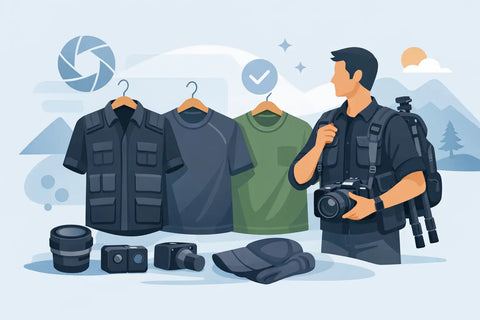
A good shirt tells on itself within minutes. The collar either sits clean or collapses. The cloth either carries structure or gives up at the elbow. Pockets either earn their place or become decoration. That is what makes a photographer shirt review worth doing properly. This is not a shirt category built on novelty. It lives or dies by proportion, fabric, and use.
The photographer shirt comes from a practical lineage. Not formal shirting. Not military issue in the strict sense. Something closer to fieldwear refined for everyday life. Its appeal is obvious to anyone who builds a wardrobe as a system rather than a mood board. It offers storage without excess, shape without stiffness, and a kind of ease that still looks considered.
That said, not every version deserves the name. Many brands borrow the silhouette, add oversized pockets, and stop there. The result often looks right on a hanger and feels vague in wear. A proper photographer shirt should do more. It should hold shape through the day, layer without bulk, and age in a way that improves the garment rather than exposing weak construction.
What a photographer shirt should do
At its best, this is one of the most useful pieces in a wardrobe. It sits between shirt and light overshirt, which means it can move across seasons with very little effort. Worn open over a tee, it reads relaxed. Buttoned to the neck with fuller trousers, it becomes sharper. Under a coat, it adds function without the visual weight of a jacket.
The key is balance. A photographer shirt should never feel overbuilt like outerwear, but it also should not behave like a dress shirt with extra pockets attached. The cloth needs enough body to define the silhouette. The cut needs enough room to layer. And the details need to be placed with restraint.
This is where many reviews stay too shallow. They focus on whether the shirt is comfortable or stylish. Those things matter, but they are the baseline. A stronger review asks harder questions. Does the pocket placement distort the front when loaded? Does the placket sit flat after repeated washing? Do the sleeves still drape well once the fabric softens? These are the things you notice after real wear.
Photographer shirt review: fabric first
Fabric decides almost everything. Before fit, before styling, before brand language. In a photographer shirt, the wrong fabric exposes the design immediately.
A light poplin can make the garment feel too insubstantial, especially when paired with patch pockets or utility seaming. The shirt may look crisp at first, but the architecture disappears as soon as it moves. On the other end, a cloth that is too heavy can push the piece into jacket territory. Then it loses range. It becomes something you wear a few months a year instead of a reliable layer across most of the calendar.
The sweet spot is usually a medium-weight cotton with visible character - compact twill, dense plain weave, brushed cotton, or a washed canvas-lite fabric with enough give to break in well. You want substance, not stiffness. The shirt should hold a line at the shoulder and pocket edge, while still softening with wear.
Natural aging matters here. A photographer shirt should look better after twenty wears than after one. Slight abrasion at seams, a softer hand, a collar that settles into the neck - these are good signs. Shiny surface wear, twisting side seams, or a bubbled placket are not.
Fit decides whether it stays in rotation
Most people are drawn to this category because it promises ease. That does not mean fit is forgiving by default. It means the cut has to be deliberate.
A strong photographer shirt usually carries a relaxed body, slightly dropped shoulder, and enough sleeve volume to move without strain. But "relaxed" is often misunderstood. Too narrow and the shirt loses its utility character. Too wide and it starts drifting into costume. The best versions create space without vagueness.
Length is especially important. If it is too short, the pockets and proportions can feel abrupt, almost boxy in a way that limits styling. Too long, and it starts competing with chore coats and overshirts. Ideally, it should work both tucked and untucked, though many buyers will prefer it untucked for the cleaner read.
This is also one of the few silhouettes that works well across different bodies when the grading is done carefully. That matters. A photographer shirt should not depend on one gendered idea of fit. The category is at its best when it offers room, function, and shape without forcing the garment into a narrow body standard.
Details separate the real thing from the reference
Pockets are the obvious marker, but they are not the whole story. In fact, oversized pockets can be the fastest way to cheapen the design if they are used too aggressively. A good photographer shirt uses utility with control.
Pocket depth should be practical, but not so heavy that the front panels pull. Stitching should be clean and confident. Buttons should feel appropriate to the fabric weight. Collar shape should support the garment's in-between nature - not too formal, not too soft. Side gussets, bar tacks at stress points, and well-finished interior seams all matter more than decorative contrast stitching or exaggerated flaps.
This is a category where restraint reads as expertise. Heritage references are strongest when they are absorbed into the garment rather than announced. You should feel the logic of the piece before you notice the design cues.
How it performs in real wear
A useful photographer shirt earns its place by adapting. That is the real test.
In spring and early fall, it should work as a top layer over a tee or tank. In colder months, it should slip under a coat without bunching at the sleeves or collar. Indoors, it should still read complete when worn on its own. That range is why people keep reaching for this silhouette.
The best versions also handle repetition well. You can wear them several times a week without feeling overstyled or underdressed. They pair naturally with denim, fatigues, pleated trousers, and fuller skirts. They work with sneakers, leather shoes, and boots. The form is simple enough to absorb into different wardrobes, but distinct enough to add shape and intention.
There are trade-offs. More structure usually means a slower break-in. Softer fabrics feel easier on day one but may lose edge sooner. Extra pockets can be genuinely useful for some wearers and irrelevant for others. If you carry very little, you may care more about line than storage. If you move through the day without a bag, those pockets start to matter.
Photographer shirt review: what to check before buying
If you are considering one, look closely at the points that affect long wear. Fabric weight should match how you actually dress, not an ideal version of your wardrobe. If you live in warm climates or layer lightly, choose a medium cloth with breathability. If you want it to replace a light jacket, lean denser.
Check the shoulder width and body volume against your usual habits. Do you button shirts fully, wear them open, or use them as a middle layer? The right fit depends on that. A cleaner fit may suit someone who wants a sharper daily shirt. A roomier cut makes more sense if layering is the priority.
Also pay attention to the wash treatment. Some garments arrive heavily softened and stay stable. Others are washed for effect and continue to collapse over time. There is no universal right answer, but there is a right answer for how you want the shirt to age.
For buyers who value longevity, this is where brands either show discipline or reveal shortcuts. A photographer shirt should feel designed from the inside out. Fabric, cut, and utility need to agree with each other. When they do, the garment becomes quietly indispensable. That has long been the appeal of pieces made with workwear logic and modern restraint, including those from WORKWARE.
Is it worth it?
Yes, when the garment is honest. Not because the category is fashionable, but because it solves real wardrobe problems with very little noise. It gives you a shirt that can behave like light outerwear, utility that does not overwhelm, and a silhouette with enough character to stand on its own.
No, if the piece relies on styling to justify weak construction or vague proportions. In that case, you are buying an idea rather than a garment.
A strong photographer shirt does not need much from the wearer. It asks only to be worn hard, washed without fuss, and judged over time. That is usually where the best clothes prove themselves. Buy the one that still makes sense after the first excitement wears off.