
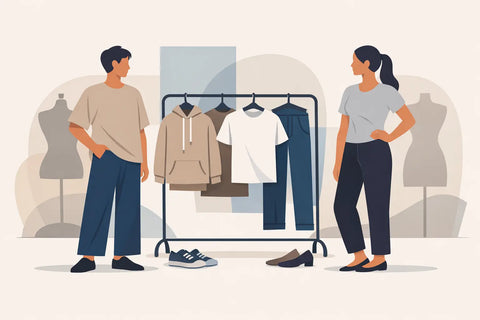
A worker jacket can sit square on one person, cropped on another, and still feel exactly right. That is the useful answer to the question, are unisex clothes flattering? They can be, decisively. But flattery does not come from a gender label or from hiding the body under extra fabric. It comes from form: where a garment holds structure, where it releases, and how it moves with the wearer.
Unisex clothing asks a better question than whether a piece is made for men or women. Does the proportion make sense? Does the fabric carry its own shape? Is there enough room to live in it, without losing intention? When those details are resolved, one garment can meet many bodies without becoming anonymous.
Are Unisex Clothes Flattering on Every Body?
Not automatically. No cut is universally perfect, and “one size fits all” is usually a shortcut rather than a design principle. A well-made unisex garment is not a conventional menswear pattern scaled down, nor a womenswear piece stripped of shaping. It is built around a considered, shared silhouette.
That silhouette may have a dropped shoulder, a straight torso, a high rise, a cropped length, or a fuller leg. Each choice creates a relationship with the body. The result may emphasize the shoulders, lengthen the leg, frame the waist, or create a deliberate volume around the hip. None of these effects belong to one gender. They belong to proportion.
Flattering also does not need to mean narrowing, smoothing, or making the body conform to a familiar ideal. A balloon pant can be flattering because its volume is controlled: full through the thigh, tapered toward the ankle, and anchored by a defined waistband. A photographer shirt can be flattering because the collar, pocket placement, and cloth give a relaxed body a clear line. The garment reads as intentional, not merely oversized.
For some wearers, a close fit feels most assured. For others, room is the point. The better measure is whether the piece creates presence without asking the wearer to disappear.
The Three Elements That Make a Shared Fit Work
Proportion gives volume a purpose
The difference between generous and shapeless is usually proportion. A wide trouser needs a hem that resolves the width. A boxy jacket needs a length that does not overwhelm the frame. A roomy shirt benefits from a collar, placket, or cuff that introduces definition.
This is why measurements matter more than category labels. Compare shoulder width, chest, body length, rise, inseam, thigh, and hem opening with garments you already wear well. These numbers tell you where the piece will sit and how it will behave. “Unisex” tells you only that the garment was designed to be shared.
A useful starting point is to choose one area for ease and one area for structure. If the trousers have a full leg, consider a shirt with a cleaner shoulder. If the jacket is boxy and short, let the pants carry a straighter line. This is not a rulebook. It is a way to give an outfit a center.
Fabric determines the outline
A silhouette begins on the pattern table, but fabric finishes it. Substantial cotton twill holds a worker jacket away from the body and keeps its architecture through the day. Dense denim develops shape with wear. A lighter poplin falls closer, making the same broad cut read softer and more fluid.
This is where inexpensive unisex clothing often falls short. Thin cloth can collapse at the shoulder, pull across the chest, or cling where the cut was meant to stand clear. The pattern may be sound, yet the fabric does not have enough weight or recovery to support it.
Look for cloth with a reason to exist. A utility trouser benefits from a durable weave and a measured amount of body. A work shirt needs enough density to layer cleanly. A relaxed dress needs drape, but also enough structure to maintain its line. Fabric is not a finishing detail. It is the silhouette’s working material.
Construction creates clarity
Details guide the eye. A firm collar frames the face. A set of pleats shapes movement. Deep pockets add utility, but they also affect balance. A waistband, yoke, cuff, or reinforced seam can introduce quiet definition without turning a shared garment into a heavily tailored one.
Consider the worker jacket. Its straight body is often what makes it versatile, but its utility comes from the construction around that simplicity: a stable collar, a substantial front closure, pocket placement, and sleeves that allow movement. These details make the jacket feel composed on different frames.
Good construction also makes fit more forgiving over time. A garment with room at the armhole, durable seams, and fabric that softens rather than distorts can become more personal with wear. The goal is not a static, showroom-perfect fit. It is a piece that holds its character through real use.
How to Find Your Best Unisex Silhouette
Start with the garments you reach for repeatedly. Ignore the label. Notice what they have in common. Perhaps you prefer a high rise because it gives the torso a clean break. Perhaps a cropped jacket works because it keeps a wider pant in proportion. Perhaps you always roll your sleeves because showing the wrist gives a work shirt more shape.
Then choose a starting silhouette, not a prescribed size. If you are new to broader, shared cuts, a straight utility trouser or a boxy overshirt is often easier than moving directly to extreme volume. Both offer ease while retaining familiar lines. If you already wear relaxed clothing, try a fuller trouser with a tapered hem or a long, straight dress layered over pants. Volume becomes more convincing when it is deliberate from head to toe.
Sizing up is not always the answer. A larger size may add length in the sleeve and body when what you actually need is room through the chest or hip. Sizing down can remove needed ease and make the garment pull in motion. Use the product measurements, then decide what kind of fit you want: close, regular, relaxed, or oversized. Those are different outcomes, not steps on the same scale.
Try the piece in motion. Sit down. Reach forward. Put your hands in the pockets. See where the shoulder seam lands and whether the rise allows you to move without constant adjustment. A flattering garment should feel as considered in use as it does in the mirror.
Styling Is Part of the Fit
Unisex clothing gives the wearer more control, but that freedom benefits from a little editing. If a piece is oversized, show a point of structure somewhere else: an exposed ankle, a defined waist, a turned cuff, a tucked hem, or a more compact layer beneath. These small decisions change the whole read of the garment.
Color can do similar work. A single tone from jacket to trouser creates a long, continuous line. Contrast at the shirt or footwear breaks the silhouette into sections. Neither is better. The first feels calm and architectural; the second brings more emphasis to proportion.
Accessories should earn their place. A belt can define a high-rise pant. A cap, scarf, or substantial shoe can balance a fuller outer layer. The point is not to decorate a simple outfit into submission. It is to make the shape feel complete.
Beyond “Flattering”
The language of flattery can be useful when it means balance, comfort, and self-recognition. It becomes less useful when it assumes every garment must minimize, lengthen, or correct. Clothing can frame the body without ranking it.
The strongest unisex pieces do not promise to look identical on everyone. They offer a stable form, then allow different bodies and different lives to give that form its character. A jacket becomes sharper on one wearer and easier on another. A pair of trousers sits high, low, cropped, or pooled, each version revealing a different proportion.
Choose the cut that lets you stand differently. Keep the piece that works hard, softens well, and still feels like yours after the first impression has passed. One garment. Different bodies. Different lives.