
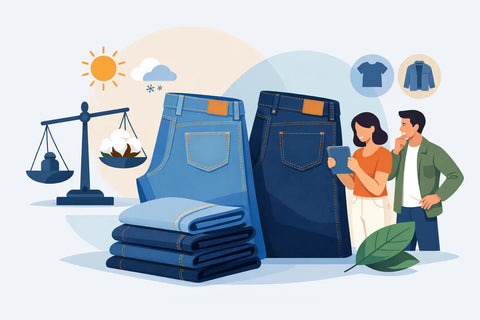
A pair of jeans can look right on the hanger and still feel wrong by noon. Usually, the issue is not the cut. It is the cloth. Knowing how to choose denim weight gives you a clearer read on how a garment will move, layer, age, and earn its place in regular rotation.
Denim weight is measured in ounces per square yard. That number is useful, but it is not the entire specification. Yarn thickness, weave density, finishing, stretch content, and garment construction all influence the final feel. Two 13-ounce denims can wear very differently.
For a wardrobe built around repeated use, weight should follow purpose. Choose the cloth before you choose the mythology.
How to Choose Denim Weight by Use
Start with the conditions the garment needs to meet. A light denim shirt and a heavy five-pocket jean may share an indigo cast, but they serve different systems of dress.
Lightweight denim generally sits below 10 ounces. It is pliable from the start, easier to layer, and suited to warm weather or indoor wear. In shirts, overshirts, dresses, and relaxed trousers, it offers the familiar character of denim without the bulk. It also drapes more readily, which matters in wider silhouettes or pieces designed to move around the body.
The trade-off is structure. Lightweight denim will not hold a sharp, architectural form in the same way as a dense workwear cloth. It can show abrasion sooner at high-friction points, particularly in fitted pants. That is not a flaw. It is simply the right fabric for a different job.
Midweight denim, usually around 11 to 13 ounces, is the most adaptable range. It has enough substance for jeans, chore jackets, utility trousers, and overshirts, while remaining comfortable through much of the year. For many wardrobes, this is the working center: substantial, but not punishing; durable, but still easy to wear on an ordinary day.
Heavyweight denim begins around 14 ounces and commonly reaches 16 ounces. It brings definition to a silhouette. Pleats stay pronounced. Wide legs hold their volume. A worker jacket feels protective rather than decorative. This is the range to consider when you want denim with presence, especially for cooler conditions, hard use, or garments that benefit from a more sculptural line.
Above 17 ounces, denim becomes a specialist choice. It can be deeply rewarding for those who want a slow break-in and visible wear over time, but it is not automatically better. Very heavy denim can restrict movement, retain heat, and make layering difficult. If a garment spends most of its life hanging because the cloth feels like a commitment, its weight is working against you.
Weight Is Only One Part of the Fabric
Ounce weight tells you the mass of the cloth, not its complete character. Look at how the denim is built.
A loosely woven 12-ounce denim may feel softer and more breathable than a tightly woven version at the same listed weight. A compact weave can make fabric feel firmer, smoother, and more resistant to wind. Open, irregular textures often feel more relaxed and show more surface variation. Neither is inherently superior. The choice depends on whether you want clean utility or a more lived-in finish.
The yarn also changes the experience. Ring-spun yarns often bring a softer hand and more nuanced fading. Slub yarns create visible variation, with highs and lows that become more pronounced as the garment wears. Rope-dyed indigo can produce strong contrast over time, while sulfur-dyed black or colored denim may fade in a quieter, more even way.
Finishing matters just as much. Raw or rigid denim has little to no pre-washing, so it feels firmer and may shrink or change shape depending on whether it has been sanforized. Rinsed denim has been washed once to remove some stiffness and stabilize much of the shrinkage. Stonewashed or enzyme-washed denim will arrive softer, often with a more settled color and a less demanding break-in.
Do not treat rigid as more authentic or washed as less worthy. Rigid denim is a material choice. So is a soft rinse. The best one is the one you will wear often enough to understand.
Match Denim Weight to the Silhouette
Weight and pattern should work together. A straight five-pocket jean can carry a broad range of denim weights because its shape is familiar and supported by its seams. A balloon pant, with more volume through the leg, reads differently in 9 ounces than it does in 15.
In lighter denim, a full leg falls closer to the body and gathers with movement. The result can feel casual, soft, and generous. In heavier denim, that same leg creates clearer space around the body. The shape becomes more deliberate. Neither effect is better, but they are not interchangeable.
For fitted or tapered pants, heavier denim can add durability but may create tension at the thigh, knee, and seat. Consider how you sit, cycle, commute, and work. A dense 15-ounce fabric in a close fit can feel far more restrictive than its number suggests. A roomier cut gives heavy denim the space it needs to move.
Jackets benefit from a similar calculation. A 12-ounce denim worker jacket can function as an overshirt for much of the year. At 14 or 15 ounces, it becomes a true outer layer with a firmer collar, stronger pocket shape, and more visual weight. If you expect to wear it beneath a coat, midweight cloth is usually the more practical choice.
Consider Climate, Layering, and Daily Friction
Temperature is obvious, but daily friction is often overlooked. Warm climates and long commutes favor lighter or midweight denim, especially in dark colors that absorb heat. Cold, dry weather makes heavyweight denim easier to live in. Humidity changes the equation again: a heavy, rigid jean can feel significantly warmer than its ounce weight implies.
Layering should guide the decision as well. If denim is your outermost layer, a heavier fabric can provide the necessary structure and protection. If it will sit under a chore coat, wool jacket, or overcoat, excess bulk at the waist, cuffs, and armholes quickly becomes inconvenient.
Think beyond the first wear. Heavy denim softens at stress points, but it does not become lightweight. Lightweight denim may relax and fade more quickly, but it remains useful when the weather turns. A wardrobe with one dependable midweight jean, one lighter denim shirt, and one more substantial jacket often covers more ground than several versions of the same heavy pant.
Stretch Changes the Equation
A small amount of elastane can make a dense denim feel immediately forgiving. That can be useful in close-fitting jeans or garments built for frequent movement. It may also reduce the need to size up in a rigid-feeling fabric.
But stretch denim has a different aging pattern. Over time, it can bag out at the knees or seat, particularly when the fabric is light and the fit is tight. Recovery depends on the quality of the yarn, fabric construction, and care. For a relaxed or straight silhouette, 100% cotton denim often develops a more stable, individual shape with wear.
If longevity is the priority, do not assume stretch is a shortcut to comfort. A well-cut, midweight cotton denim with adequate ease can be more comfortable over years of wear than a tight stretch jean that loses its form after a season.
Read the Garment, Not Just the Number
When shopping online, use the listed ounce weight as a starting point, then read the complete fabric description. Look for cotton content, stretch percentage, wash treatment, whether the fabric is sanforized, and notes on intended fit. Product images can help reveal whether the cloth stands away from the body or falls softly, but they cannot replace the specification.
Construction offers clues, too. Reinforced pockets, felled seams, bar tacks, substantial belt loops, and a properly finished waistband indicate that the garment has been designed to meet the demands its fabric suggests. Heavy cloth with weak construction is still a compromise. So is excellent construction in a fabric unsuited to the garment's use.
The right denim weight is not a badge of toughness. It is a decision about proportion, climate, movement, and time. Choose a fabric that supports the life you actually lead, then wear it long enough for the details to become your own.