
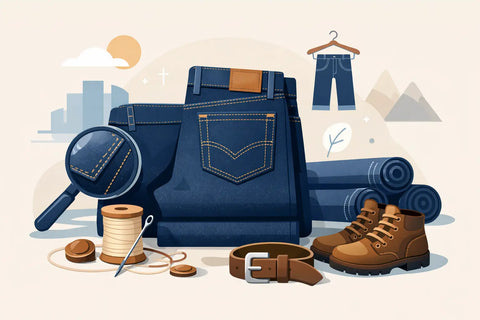
Raw denim asks for patience, but not ceremony. A good pair should work from the first wear: substantial at the knee, considered at the rise, and honest about how it will change. This guide to buying raw denim is for choosing a pair you will keep in rotation, rather than preserve for a future version of yourself.
A Guide to Buying Raw Denim: Know What Raw Means
Raw denim is denim that has not been washed after dyeing and sewing. The indigo remains concentrated on the yarn surface, the fabric feels firmer, and the garment has not been softened or artificially aged in a factory. Its eventual wear marks come from movement: a wallet pocket, a bike seat, folded knees, a cuff turned up through rain.
That does not mean every raw pair behaves the same way. Raw describes the finish, not the entire fabric. A pair can be raw and sanforized, meaning the cloth has been mechanically pre-shrunk. It can also be raw and unsanforized, often called shrink-to-fit, with more meaningful shrinkage after its first wash or soak. Both have a place. The difference is how much control you want before the jeans become part of your daily uniform.
Sanforized raw denim is the more straightforward choice. Expect only modest shrinkage, usually enough to make sizing manageable if you follow the garment measurements. Unsanforized denim carries more variation. It rewards a considered fit plan, but it can also offer a more distinctive texture and a closer relationship to the fabric from the beginning.
Raw denim does not need to be precious. It is workwear at its core. Wear it, repair it when necessary, and let the cloth record its use.
Start With Fabric Weight and Character
Fabric weight changes the entire experience. It affects drape, durability, warmth, break-in time, and the way a silhouette holds its line. Weight is usually measured in ounces per square yard.
Denim around 11 to 13 ounces is a versatile middle ground. It is substantial enough for regular wear while remaining comfortable indoors and across longer seasons. This is often the right starting point for a first pair, especially if you live in a warmer climate or prefer a softer, more relaxed shape.
At 14 to 16 ounces, denim begins to feel more structured. It will hold the volume of a balloon pant, a wide straight leg, or a generous utility trouser with real presence. It takes longer to soften, but the result is often more architectural: cleaner folds, deeper creases, and a fabric that settles rather than collapses.
Heavier denim, from 17 ounces upward, is a specific commitment. It can be satisfying in cold weather and exceptionally durable, yet it is not automatically better. A rigid, heavyweight pair may be excessive for daily commuting, travel, or a wardrobe built around light layering. Buy for the life you lead, not for a number on a spec sheet.
Look beyond weight, too. A slubby fabric has irregular yarns and visible texture. Nep denim shows small flecks within the weave. A cleaner, flatter weave will fade with quieter precision. Neither is superior. One is expressive; the other is restrained. Choose the surface you will still want to see after several years of wear.
Selvedge Is a Detail, Not a Verdict
Selvedge denim is woven on narrower shuttle looms, producing a finished edge along the outseam. It is a useful sign of traditional production methods and can be a beautiful construction detail when a cuff reveals it. But selvedge alone does not guarantee better cotton, better sewing, or a better fit.
A well-made non-selvedge jean can outwear a poorly designed selvedge pair. Prioritize the fabric hand, the cut, and the construction before the colored line at the edge.
Fit Is the Decision That Matters Most
Indigo will fade. Stiffness will ease. A compromised fit rarely improves enough to justify the purchase.
Start with the rise. The rise determines where the waistband sits and how the leg hangs from the body. A higher rise often creates a longer, more balanced line and gives room through the seat and upper thigh. A mid-rise can feel familiar and easy, particularly in a straight cut. The right choice depends on proportion, not gender labels. One garment can sit differently across different bodies and still feel entirely intentional.
Then consider the leg shape. A slim taper emphasizes the lower leg and works best when the thigh is not under pressure. A straight leg is enduring, practical, and easy to style with boots, sneakers, or a simple leather shoe. Wide and curved silhouettes bring volume and movement, especially when the fabric has enough weight to hold its form.
Do not judge fit standing still. Sit down. Take a full step. Put your hands in the pockets. Check whether the crotch pulls, whether the waistband stays in place, and whether the back rise gives you enough coverage when you bend. A little initial firmness is expected with raw denim. Numbness, sharp tension, or a waistband that needs constant adjustment is not a break-in issue.
Length deserves equal attention. Raw denim can be worn with a clean break, a single cuff, or a full stack, but each creates a different visual rhythm. If you plan to cuff selvedge denim, allow enough inseam for it. If you prefer a cropped, wide leg, make sure the hem lands deliberately rather than appearing undersized.
Read the Construction Before the Branding
The best details are usually quiet. Inspect the stitching at the inseam, outseam, belt loops, and pocket corners. Dense, even stitching helps, though an attractive stitch count means little if the garment is strained by the wrong fit. Look for bartacks or rivets at stress points, well-attached belt loops, and pocket bags that do not feel insubstantial against the denim.
A button fly is traditional, durable, and easy to repair. A zipper fly is faster in daily use and can suit a cleaner, more minimal front. This is preference, not a hierarchy. The same applies to contrast stitching, leather patches, exposed selvedge, and branded hardware. They should support the garment's purpose, not become its purpose.
Pay attention to the waistband. On a good pair, it should feel stable without digging in, with enough height to sit cleanly against the body. A chain-stitched hem can create the familiar roping effect after washing, but it is an added detail, not a reason to ignore the overall make.
Size for the Denim You Are Actually Buying
Never buy raw denim from a tagged size alone. Measure a pair of pants you wear often and compare the results to the garment measurements. Lay your reference pair flat, buttoned, and unstretched. Measure the waistband, front rise, thigh, knee, leg opening, and inseam. Those numbers describe the fit more clearly than a waist label ever will.
For sanforized denim, choose a waistband that is comfortably close without requiring force to close. Denim often relaxes with wear, especially through the waist and seat, then tightens slightly after washing. If it starts painfully tight, it may relax, but it will not transform into a different pattern.
For unsanforized denim, account for shrinkage before committing. Check the maker's guidance on whether to size up, soak first, or wear before washing. The answer varies by fabric, cut, and intended result. A traditional shrink-to-fit approach can be rewarding, but only if you are willing to accept some uncertainty.
If you are between sizes, consider where you need room. Size for the hip and thigh first, then use a belt if the waist is marginally generous. Taking in a waistband is usually simpler than creating room where the fabric cannot give it.
Wear, Wash, Repair
The first months establish the denim's character. Wear the pair consistently enough for it to learn your movement, but do not force a rigid schedule. You do not need to avoid washing for an arbitrary number of months. Washing less often can preserve contrast, while washing sooner creates a softer, more even fade and keeps the garment feeling clean. Both are valid outcomes.
When the jeans need washing, turn them inside out, use cold water and mild detergent, and avoid aggressive drying if you want to limit shrinkage. Air dry, reshape the seams while damp, and expect the fabric to feel firm again for a day or two. That firmness is temporary.
Repair before failure. Reinforce thinning pockets, crotch wear, and broken belt loops early. Visible mending suits raw denim because the cloth already carries evidence of use. A repair is not a compromise. It is part of the garment's record.
The right pair will not stay dark, crisp, or untouched. It will become more specific with time: shaped by the route to work, the tools you carry, and the way you move through a day. Buy better. Keep forever.