
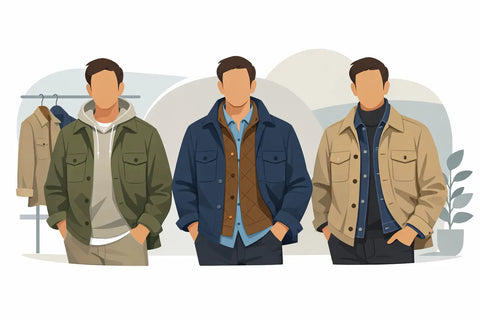
A chore jacket fails when it is treated like a blazer or a coat. It is neither. The shape is boxier, the cloth usually firmer, and the point is utility. If you are thinking about how to layer chore jackets, start there. The best combinations respect the jacket’s structure instead of fighting it.
A good chore jacket is one of the few garments that can move across seasons without feeling forced. It can sit over a T-shirt in spring, a button-up in early fall, or a knit when the temperature drops. That range is why it earns space in a tight wardrobe. But range only matters if the layers beneath and around it are chosen with restraint.
How to layer chore jackets starts with weight
Most layering problems are not styling problems. They are weight problems.
A chore jacket has presence. Even in a lighter cotton twill or washed canvas, it carries more body than an overshirt. That means the layer under it needs enough structure to hold its own, but not so much bulk that the jacket starts to pull at the chest or collapse at the sleeves. A crisp jersey tee, an oxford shirt, a chambray shirt, a fine merino knit, or a compact sweatshirt all work because they stay clean under pressure.
A heavy hoodie can work, but only if the jacket was cut generously to begin with. Otherwise the hood bunches at the neck, the body balloons, and the line is lost. This is where experienced buyers already know the answer: read the jacket as a shell with purpose, not as a container for anything thick enough to fit.
Fabric also matters beyond thickness. Dry cotton over dry cotton can feel right, especially when the tones are close and the finishes differ slightly. Brushed fleece under a stiff duck canvas jacket creates more contrast. Sometimes that contrast is useful. Sometimes it makes the jacket feel too top-heavy. It depends on whether you want clarity or softness.
Start with the closest layer
The base layer sets the temperature and the tone.
For warm weather or heated interiors, a plain T-shirt keeps the chore jacket sharp. A substantial tee is better than a thin one. Lightweight jersey can look incidental under a jacket with strong patch pockets and visible topstitching. A denser cotton tee gives the outfit enough foundation without asking for attention.
For transitional weather, a button-up shirt is the most reliable option. Oxford cloth, chambray, poplin, and brushed cotton all bring something different. Oxford adds body and makes the jacket feel a little more architectural. Chambray leans into workwear heritage without becoming costume. Poplin is cleaner and slightly more urban. Brushed cotton softens the whole system.
If you want a knit, keep the gauge in mind. Fine merino or a compact cotton crewneck layers easily. A shaggy wool sweater under a rigid chore jacket can work, but only when the fit has enough ease through the armhole and chest. If the jacket is already trim, a bulky knit will always win the argument.
The middle layer is where proportion can break
If you wear a middle layer under a chore jacket, it needs to justify its space.
A lightweight sweatshirt is often the best choice because it creates depth without too much visual interference. Crewneck, clean hem, no oversized graphics. The jacket already has functional detailing. It does not need competition.
A hoodie is more divisive. It can make a chore jacket feel younger and less formal, which may be exactly the point. But the hood adds bulk at the back neck and changes the collar line. On a jacket with a neat, flat collar, that shift can feel clumsy. On a more relaxed cut, it can look intentional. The difference is often one inch of ease and the weight of the hood fabric.
Vests are underrated here. A thin quilted liner, wool vest, or even a zip-front utility vest under a chore jacket adds warmth while keeping the sleeves clean. This matters if you dislike the compressed feeling that comes from stacking too many long sleeves together. It is a practical move, especially for commuting.
Outer layering works, but only with enough contrast
Yes, you can layer over a chore jacket. No, it does not always look good.
The easiest version is a roomy overcoat or mac. The coat needs enough length and enough volume to let the chore jacket sit naturally underneath. When it works, you get a clean line at the collar and cuffs, with the jacket functioning almost like a structured mid-layer. Wool coats, waxed coats, and rain shells can all do the job.
What usually fails is trying to force a chore jacket under another short jacket. Two cropped layers compete at the same hem and create unnecessary thickness through the shoulders. If you want a jacket-over-jacket combination, use different lengths or clearly different functions. A chore jacket under a long trench makes sense. A chore jacket under a denim trucker usually does not.
This is one reason the chore jacket remains useful in seasonless wardrobes. It can be the outermost layer for much of the year, then become a practical interior layer once winter requires something longer and warmer.
How to layer chore jackets with the right silhouette
Fit is not only about size. It is about sequence.
A chore jacket generally works best when each layer beneath is slightly closer to the body than the one above it. That sounds obvious, but many outfits ignore it. A loose tee under an oversized oxford under a boxy jacket can start to feel accidental unless the proportions are controlled elsewhere.
The cleanest route is to let the jacket be the widest point on top, then choose pants that either echo that volume or counterbalance it. Straight-leg fatigue pants, relaxed chinos, balloon pants, and full-cut denim all make sense with a boxy chore jacket because they create continuity. Slim pants can work, but they sharpen the contrast and can make the upper half feel heavier than intended.
Sleeve length is another detail that matters more than people think. If the shirt cuff disappears entirely and the jacket sleeve swallows the hand, the outfit can feel unfinished. A slight shirt cuff or knit cuff showing gives the jacket more dimension. Small detail, large effect.
Color should feel built, not styled
The chore jacket does not need dramatic contrast to look considered.
Tonal dressing tends to suit this silhouette best. Navy over faded blue. Olive over ecru. Tobacco over off-white. Charcoal over washed black. These combinations let fabric and shape carry the look. They also age well. A wardrobe built on near-neutrals gives a chore jacket more room to repeat without feeling repetitive.
Higher contrast can be useful when you want to sharpen the outline. An ecru tee under an indigo jacket is classic for a reason. A striped shirt can also work, particularly if the stripe is restrained and the rest of the outfit stays quiet. But if the jacket already has strong texture, pronounced fading, or oversized patch pockets, keeping the underlayers calm usually leads to a better result.
Texture is often more interesting than color anyway. Cotton twill over jersey. Moleskin over oxford. Canvas over merino. You notice it more slowly, and that is usually a good sign.
Season by season, the logic changes slightly
In spring, keep things light and dry. A tee or poplin shirt under the jacket is often enough, especially if the fabric has some density. This is where chore jackets are at their most useful - enough coverage, not too much insulation.
In summer, layering is less about warmth and more about function. A lightweight chore jacket can replace a cardigan in air-conditioned interiors or late evenings. Keep the base simple and breathable. The jacket should feel easy to take off and carry.
In fall, this silhouette comes into full focus. Chambray, oxford, merino, and sweatshirts all start to make sense. You can build real depth without losing mobility. This is also the season when earth tones and washed blues tend to look most natural.
In winter, the chore jacket becomes either an insulating middle layer or a short outer layer for milder days. If you are wearing it under a coat, choose compact layers beneath it so the whole system still moves. If you are wearing it on its own, a knit and scarf may be enough depending on climate.
A few mistakes are worth avoiding
The first is overfilling the jacket. If it strains at the placket, pulls at the biceps, or lifts awkwardly when you move, the layering has gone too far. Utility garments should still function.
The second is leaning too hard into costume. Workwear references are strong, which is exactly why they need editing. If every layer signals heritage at once - chore jacket, chambray shirt, raw denim, heavy boots, bandana - the outfit can feel studied instead of lived in. One or two references are enough.
The third is ignoring cloth finish. A pristine, flat chore jacket layered over heavily distressed basics can feel disconnected. The opposite is true too. Washed fabrics generally sit better with other washed fabrics. Clean fabrics prefer clean company.
At WORKWARE, this is the point of a lasting wardrobe system. One garment. Different bodies. Different lives. The jacket should adapt without losing itself.
The best way to layer a chore jacket is not to ask how much you can fit under it. Ask what the jacket needs to stay clear. Once the shape, weight, and texture are in balance, the rest usually follows.