
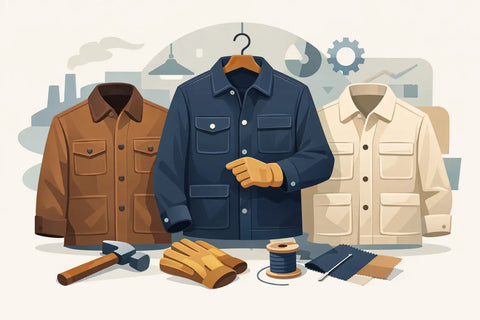
A good worker jacket review starts where most product pages stop - with what happens after the first month. Not how it looks under studio light, but how the cloth breaks in, whether the pockets earn their place, and if the cut still feels right after constant wear. This is the difference between a jacket you rotate for a season and one that becomes part of your wardrobe’s structure.
What a worker jacket is really judged on
The worker jacket has never depended on novelty. Its appeal is in proportion, utility, and restraint. The best versions keep that balance intact. They carry enough room for movement, enough structure to sit cleanly over a shirt or knit, and enough durability to improve with age rather than collapse under it.
That makes this category harder to judge than it looks. A worker jacket can photograph well and still fail in use. The collar can be too soft and lose shape. The fabric can feel substantial in hand but go limp after a few wears. A cropped body can look sharp on a hanger yet become limiting once layering starts. In this space, details are not decoration. They determine whether the jacket works.
Worker jacket review: fabric first
If there is one place to be strict, it is fabric. The worker jacket lives or dies by the cloth. A proper one should feel grounded from the start, but not armored. You want density, surface character, and enough flexibility for daily wear.
Cotton drill and canvas remain the clearest choices. Drill gives a smoother face and often a cleaner drape. Canvas brings a drier hand and a more obvious sense of utility. Neither is automatically better. It depends on how you wear the jacket. If you want something sharper that can move between work and dinner, drill often carries that dual purpose better. If you want more visible wear patterns and a tougher, more utilitarian finish, canvas has the edge.
Twill sits somewhere between the two and often reads more refined. Herringbone twill, when done well, adds texture without noise. It is a heritage fabric, but it does not need to feel costume-like. The right weight and wash keep it current.
Weight matters as much as fiber. Too light, and the jacket loses authority. Too heavy, and it becomes a specialist piece, useful only in a narrow slice of weather. For most wardrobes, the sweet spot is midweight fabric that can sit over a tee in spring and under a coat in winter. That is where real value sits - not in a dramatic first impression, but in a longer wearing window.
Construction tells you what the jacket will become
Experienced buyers already know this: construction is future tense. It tells you what the garment will look like after fifty wears, not just five.
Start with the seams. Clean topstitching is more than visual order. It stabilizes stress points and keeps the jacket reading crisp over time. Look at pocket attachment, cuff finishing, and side seam consistency. Uneven stitching on a workwear-derived garment is more than cosmetic. It suggests a lack of discipline where discipline should be fundamental.
Bartacks and reinforced pocket corners are worth noticing. So are sturdy buttons, especially corozo or metal with secure attachment. Cheap hardware ages badly. It chips, loosens, or simply feels wrong against a fabric that is meant to last. A worker jacket should never feel like the trim was chosen as an afterthought.
Then there is collar construction. This is one of the most overlooked points in any worker jacket review. A collar that is too flimsy can make the whole jacket look tired, even when the fabric is strong. A collar with enough body frames the neckline and keeps the silhouette intact, whether worn open or buttoned high.
Fit is not about trend. It is about function.
The current market swings between cropped and oversized, but the worker jacket is better read through function than fashion. A useful fit allows layering without bulk and shape without stiffness.
The shoulder should have enough room to move naturally, especially if the jacket is cut for a unisex wardrobe. Too narrow, and it becomes restrictive fast. Too wide, and the body can lose line unless the fabric has enough structure to hold it. The body length should work with the rest of the wardrobe. Slightly boxy is often ideal because it leaves space for different proportions and different styling habits. It also keeps the garment honest to its origins.
Sleeve shape matters more than many buyers admit. A sleeve that tapers too hard can make layering awkward. A straight or gently shaped sleeve tends to wear better across seasons. Cuffs should close cleanly, but not pinch. These are small distinctions. They change the daily experience.
For gender-inclusive dressing, the best worker jackets avoid over-correcting. They do not rely on exaggerated volume to signal neutrality. They let proportion and fabric do the work. One garment. Different bodies. Different lives.
Pockets, access, and actual use
Workwear references are easy to borrow. Utility is harder to execute. The pockets on a worker jacket should feel considered, not symbolic.
Patch pockets are the standard for a reason. They are practical, visually balanced, and part of the jacket’s language. But scale matters. If chest pockets sit too high, they become awkward. If hip pockets are too shallow, they stop being useful. A good pocket should hold weight without dragging the front out of shape.
Internal pockets are where modern needs enter the picture. They are not required, but when included well, they extend the jacket’s range. A phone pocket that distorts the line of the body is not an upgrade. A discreet inner pocket that preserves the exterior is.
This is where many contemporary interpretations get it wrong. They add features instead of refining them. More compartments, more zips, more visible utility. Usually less is stronger. The worker jacket works because its design is already resolved.
How it wears in matters more than how it starts
A jacket in this category should improve with use. That does not mean it needs to become dramatically faded or distressed. It means the fabric should soften without thinning, the seams should settle without twisting, and the shape should become more personal without losing clarity.
This is why washed finishes can be divisive. A light wash can take the stiffness out of a dense fabric and make the jacket easier from day one. But heavy pre-aging often shortens the pleasure of ownership. If all the character is built in at purchase, there is less room for the garment to record your wear. For buyers who keep clothes for years, that matters.
The best aging is gradual. Elbows develop ease. Cuffs gain softness. The front placket sits more naturally. Nothing feels forced. This is the quiet reward of a well-made worker jacket: it becomes more itself over time.
Where the real trade-offs are
No worker jacket does everything. If the fabric is especially dense, the break-in period may be longer. If the cut is generous enough for layering, it may feel larger than expected over a fine shirt. If the jacket is lined, it may be more comfortable in cool weather but less versatile indoors or across warmer months.
Price also deserves a clear-eyed reading. A higher price does not guarantee substance. Sometimes it buys branding, novelty finishing, or fashion positioning. But going too cheap usually shows up quickly in fabric quality, stitching discipline, and hardware. In this category, value comes from repeat wear. A jacket that costs more and works three days a week for years is often the better buy.
That is where brands with a real workwear vocabulary tend to separate themselves from trend labels. The difference is visible in pattern balance, fabric selection, and restraint. WORKWARE, for example, understands that utility pieces need clarity more than decoration. The silhouette does the speaking.
Who a worker jacket is best for
This is not a garment for one type of wardrobe. It works for people who dress with intent and need range. Over a tee and denim, it reads direct. Over a button shirt and pleated trouser, it sharpens. Over a knit with loose pants, it becomes architectural.
What it asks in return is consistency. The worker jacket rewards repetition. If you are building a wardrobe around pieces that can shift across settings and seasons, it earns its place quickly. If you prefer statement garments with a shorter arc, it may feel too restrained.
That is the point, really. The worker jacket is not designed to spike attention. It is designed to hold up - materially, visually, and over time. The best ones do not announce themselves on day one. They become indispensable by year three.
If you are weighing your next purchase, look past styling and first impressions. Read the cloth. Read the seams. Read the proportions. Buy the jacket that still makes sense after the trend cycle moves on.