
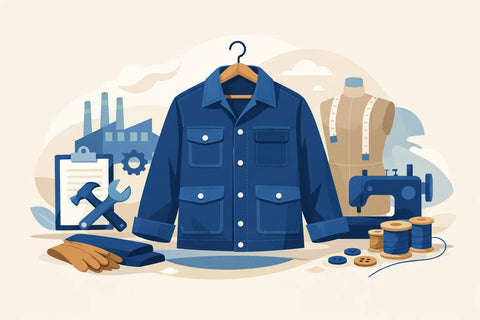
A worker jacket tells you what it is the moment you hold it. The cloth has weight. The pockets sit where hands actually reach. The shape leaves room to move. If you are asking what is a worker jacket, the short answer is simple: it is a practical layer derived from labor uniforms, built for utility, durability, and repeated wear.
The better answer is in the details. A true worker jacket is not just any chore coat, overshirt, or casual jacket with patch pockets added for effect. It comes from a specific lineage of garments made for factory floors, workshops, farms, rail yards, and ateliers. Its appeal now is not nostalgia alone. It is clarity of purpose.
What is a worker jacket in practical terms?
At its core, a worker jacket is a midweight outer layer designed to be worn over a shirt or knit and under heavier outerwear when needed. It usually has a straight or slightly boxy silhouette, a clean front opening with buttons, and practical pockets placed on the chest or lower front. The cut prioritizes movement over sharp tailoring.
That balance matters. A worker jacket should feel structured enough to define a silhouette, but not so rigid that it behaves like formalwear. It sits in the space between a blazer and a chore coat, often borrowing from both while remaining more grounded than either.
The reason the form has lasted is straightforward. It solves real wardrobe problems. It layers well. It works across seasons. It can be worn hard without looking tired too quickly. Few garments move as easily between studio, office, travel, and daily life.
Where the worker jacket comes from
The worker jacket belongs to the larger history of workwear. Across Europe, the United States, and parts of Asia, labor garments developed around task, climate, and available fabric. French chore coats, American railroad jackets, British utility uniforms, and workshop overshirts all share common logic: durability, accessibility, and enough ease for physical work.
The worker jacket is a refined descendant of that logic. In some versions, it resembles the French bleu de travail with its simple front and patch pockets. In others, it leans more industrial or military, with stronger structure, denser fabric, or reinforced seams. The common thread is function first.
That heritage still shapes how the garment should be read now. Not as costume. Not as trend. As a proven form adapted to modern use.
The details that define a worker jacket
A worker jacket is usually recognizable by construction more than decoration. Patch pockets are common because they are efficient to make, easy to access, and visually honest. A button front is more typical than a zipper, partly for repairability and partly because it keeps the garment quieter in appearance.
Collars tend to be simple and utilitarian - a point collar, work collar, or slightly softened spread. The length often lands at the hip or just below, allowing the jacket to function as a standalone layer without feeling oversized like a coat.
Fabric does much of the work. Cotton twill, canvas, herringbone, moleskin, drill, and denim are all natural fits. Some versions use washed fabrics for softness from the start. Others are left more rigid so they break in over time. Both approaches are valid. It depends on whether you want immediate ease or a garment that records wear more slowly and more distinctly.
The best examples avoid unnecessary complexity. They may include bartacks, reinforced pocket corners, triple-needle stitching, or durable buttons, but rarely for show. Each detail should justify itself.
Fit matters more than labels
This is where many modern interpretations drift. A jacket can be called a worker jacket and still miss the point if the fit is too slim, too cropped, or too styled to function.
A good worker jacket has enough room through the shoulders and body to layer without strain. Sleeves should allow movement, not pull at the elbow the moment you reach forward. The hem should feel balanced with the rest of the wardrobe - long enough to anchor wider trousers, clean enough to sit over denim, fatigue pants, or tailored wool.
That does not mean there is one correct fit. Some prefer a more compact silhouette that reads crisp and architectural. Others want a fuller shape with dropped shoulders and easier volume. The right choice depends on body type, layering habits, and the rest of the wardrobe system. What matters is that the jacket still feels useful, not decorative.
Worker jacket vs chore coat
The terms are often used interchangeably, and the overlap is real. A chore coat is one of the clearest historical references for the modern worker jacket. Both typically feature durable fabric, straightforward construction, and patch pockets.
Still, there can be subtle differences. A chore coat often leans more traditional and work-specific, sometimes with a longer body and a looser fit intended for wear over other garments. A worker jacket can be slightly more distilled - shorter, cleaner, and easier to integrate into everyday dressing without losing its workwear backbone.
In other words, every chore coat sits close to the worker jacket category, but not every worker jacket needs to look strictly like a vintage chore coat.
Why the worker jacket still works now
The modern wardrobe has too many garments built around occasion and not enough built around repetition. That is exactly where the worker jacket earns its place.
It gives structure without formality. It has more presence than a shirt, but less ceremony than tailoring. You can wear it with a T-shirt and denim, over a fine knit with pleated trousers, or layered under a heavier coat in colder weather. It does not ask for a special context.
That flexibility is not accidental. Workwear survives because its forms are efficient. A worker jacket carries that same efficiency into contemporary dressing. One garment. Different bodies. Different lives.
There is also the matter of aging. Better worker jackets tend to improve with use. Twill softens. Canvas develops shape. Indigo and garment-dyed finishes take on wear patterns that belong to the wearer, not the rack. Fast fashion imitates this visually. A well-made worker jacket earns it over time.
How to recognize a good worker jacket
Experienced buyers usually start with fabric and construction. If the cloth feels thin in a way that suggests fragility rather than intention, that is a warning. If the jacket copies workwear codes but skips reinforcement at stress points, the form is only surface deep.
Look at the seam work. Check whether the pockets are proportioned for use, not just symmetry. Notice the button attachment, the collar shape, the sleeve pitch, and whether the jacket hangs cleanly when unbuttoned. A worker jacket should feel resolved from every angle.
Then consider versatility. Some jackets are technically workwear-inspired but so stylized that they become narrow in use. Extreme distressing, oversized branding, or exaggerated proportions can limit longevity. There is nothing inherently wrong with a more directional piece, but it serves a different purpose. If you want a jacket to become part of daily rotation for years, restraint usually wins.
Fabric choice changes the character
A cotton twill worker jacket often feels like the most balanced option - durable, breathable, and easy across climates. Canvas has more grit and structure, which some prefer for outerwear use. Moleskin offers softness and density, making it especially good in cooler months. Denim brings a sharper sense of patina and contrast wear.
There is no universal best fabric. Climate, use, and personal preference all matter. If you run warm or need a jacket for indoor-outdoor transitions, a lighter twill may outperform a dense canvas. If you want more protection and shape, the heavier cloth can be worth the extra break-in time.
How to wear a worker jacket well
The easiest way is also the most effective: treat it as a foundational layer, not a statement piece. Let the cut and material do the talking.
With denim or fatigue pants, the look stays close to the garment's roots. With wool trousers or a crisp poplin shirt, the worker jacket introduces utility without becoming rugged for its own sake. Over a hoodie, it reads casual. Over a fine gauge knit, it becomes more composed. The garment adapts because the design is clear.
Fit balance matters here too. If the jacket is boxy, it often pairs best with trousers that have some volume or visual weight. If it is more compact, straighter denim or cleaner tailoring can sharpen it. There is room for contrast, but proportion should always be considered.
For unisex dressing, the worker jacket remains especially strong. Its geometry is inclusive by nature. Rather than forcing a body into a trend-specific silhouette, it offers shape through structure and ease. That is part of why brands like WORKWARE return to it season after season. The form has range.
So, what is a worker jacket really?
It is a garment with a job to do, even when the job is simply making a wardrobe more useful. It carries the discipline of workwear into everyday life through fabric, pocket placement, movement, and durability. The best ones feel direct, not nostalgic. They respect the past without getting stuck there.
If you are building a wardrobe for repetition rather than novelty, a worker jacket is one of the clearest places to start. Choose one with honest fabric, enough room to live in, and construction that will hold up to years instead of seasons. Then wear it often enough for the answer to become visible in the cloth.