
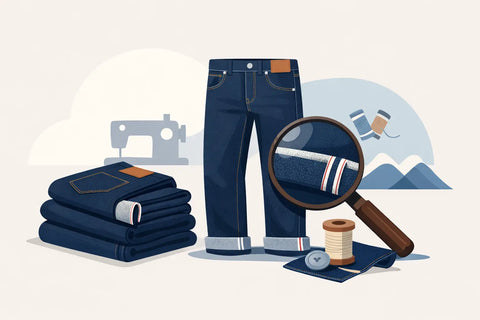
A good pair of jeans tells the truth quickly. Not in the first five minutes, when the fabric still feels stiff and the rise is unfamiliar, but after a month of wear, when the seat starts to settle, the twill begins to open, and the compromises reveal themselves. That is where a selvedge denim review guide matters - not as shorthand for hype, but as a way to judge what will actually earn a place in a long-term wardrobe.
Selvedge denim is often treated as a category on its own, as if the finished edge guarantees quality. It does not. Selvedge refers to the self-finished edge of the fabric, woven on shuttle looms to create a clean outseam ID. It says something about how the cloth was made. It does not, by itself, tell you whether the denim has character, whether the cut works across years of wear, or whether the construction respects the fabric.
For experienced buyers, that distinction matters. A jean can be woven on narrow shuttle looms and still feel overly processed, unbalanced in fit, or inflated in price. Another can look plain on the hanger and become essential through proportion, fabric response, and clean build. The review process has to be tighter than marketing language.
What a selvedge denim review guide should actually assess
Start with the fabric. This is the point. Weight matters, but not in the simplistic way it is often sold. Heavy denim is not automatically better. A 14-ounce fabric with a dry hand, visible vertical texture, and stable recovery may wear with more grace than a 21-ounce denim chosen mainly for bragging rights. The question is not how punishing the break-in feels. The question is whether the cloth has depth, resilience, and a convincing relationship to the garment built from it.
Look at the yarn character. Is the face flat and uniform, or does it carry irregularity from slub, nep, or uneven tension? Neither is inherently superior. A cleaner denim can be useful if the intention is sharpness and daily utility. A more irregular fabric may produce richer fades and a stronger sense of movement. What matters is whether the texture feels deliberate rather than gimmicked.
Then consider dye. Most selvedge jeans are indigo rope-dyed, which leaves the yarn core lighter and allows wear patterns to emerge over time. But not all indigo behaves the same way. Some fabrics crock heavily at first and settle into clear contrast. Others hold color longer and fade with less drama. If you want hard, high-contrast fades, that is one route. If you prefer a slower, quieter aging process, that is another. Neither is wrong. It depends on how you wear your clothes and what kind of patina you value.
Construction comes next, and this is where many pairs lose credibility. Chain-stitched hems, tucked belt loops, hidden rivets, and raised belt loops are often used as signals of seriousness. They can be useful details, but they are not enough. More important is balance. Does the waistband sit cleanly without twisting? Do the side seams track straight after repeated wear? Is the pocket placement proportionate to the block? Are stress points reinforced where the garment actually needs support, not just where heritage codes suggest they should be?
A strong pair of selvedge jeans feels coherent. The fabric, fit, and build all point in the same direction.
Fit is where good denim becomes wearable
A review that ignores fit is only half a review. Selvedge denim has long been framed through old-school masculine archetypes - slim taper, straight leg, lowish rise, raw finish, hard break-in. That language misses how people actually dress now. The best jeans today work as part of a wardrobe system. They sit with chore coats, oversized shirts, compact knits, technical outerwear, and flat shoes. They need to move across different bodies and different proportions.
Rise is the first thing to judge. Too low, and even a beautiful fabric becomes tiring. Too high, and the jean can tip into costume if the rest of the cut is not resolved. Mid to high rises often age better because they anchor the silhouette and allow the denim to mold without constantly pulling at the hip.
Leg shape matters just as much. A narrow hem can feel clean at first but date quickly if the thigh and knee are too restrictive. A straighter cut usually offers more longevity. A fuller top block with a gentle taper can work especially well for buyers who want room without excess volume. There is no universal best fit. There is only proportion that remains convincing after repeated wear.
Sanforized versus unsanforized fabric also affects fit in real terms. Sanforized denim has been pre-shrunk for predictability. Unsanforized denim can offer a more animated hand and old-loom character, but it asks more from the wearer. You need to account for shrinkage, settling, and a longer fitting process. For many people, sanforized selvedge is simply more useful. Precision has its own value.
Raw, rinsed, and washed
Raw denim keeps the fabric close to its original state. It shows more of the break-in process and usually gives the strongest personal wear pattern. It can also feel stubborn, bleed onto lighter garments, and require patience some wearers no longer find romantic.
Rinsed selvedge softens the start without erasing the fabric character. Often, this is the most balanced option. You lose some of the severe first-month contrast, but you gain ease, faster integration into daily wear, and a truer sense of final fit.
Heavily washed selvedge can work when the wash respects the cloth. When overdone, it often feels like the worst of both worlds - a premium fabric flattened by effects that substitute surface drama for long-term depth.
How to read quality beyond the selvedge line
The outseam ID is easy to photograph. It is not the whole garment. A more useful review looks inside and around it.
Check pocket bags. Thin, papery cotton fails early and undermines the whole build. Look at bartacks and rivet placement. If they are careless, daily use will expose it. Pay attention to fly construction, waistband facing, and seam tension. Good denim should feel calm under pressure. No bubbling, no torque that seems excessive, no sense that the factory rushed through a difficult fabric.
Hardware should suit the weight of the jean. Buttons that are too light feel off immediately. Leather patches are similar. Thick vegetable-tanned patches may look appealing when new, but they can become rigid, curl awkwardly, or stain. A simple patch, well applied, often ages better than a performative one.
Country of manufacture can be useful context, but it should not end the conversation. Japanese mills remain central to selvedge culture for good reason - consistency, texture development, dye work, loom expertise. But great jeans are not validated by geography alone. Mill, maker, pattern, and finishing all matter. A mediocre cut in an excellent fabric is still mediocre.
Value, fading, and the long view
Price in selvedge denim is rarely just about materials. You are paying for fabric width inefficiency, specialized production, lower output, and often more exacting construction. That can justify a higher price. It does not excuse one.
The better question is cost across years. Will the jean become better with wear, or merely softer? Will the knees bag out without recovery? Will the seat polish attractively, or just go shiny? Will the silhouette remain useful once the initial stiffness is gone?
This is where fading culture can distort judgment. Sharp honeycombs and wallet outlines are satisfying, but they are not the only measure of success. Some of the best selvedge denim ages with restraint - less contrast, more depth, a surface that records use without turning into performance. For many wardrobes, that quieter result is more desirable.
A review should also account for maintenance reality. If a pair demands so much ritual that you avoid wearing it, the romance has outrun the garment. Wash frequency depends on fabric, climate, and use. There is no virtue in forcing dirt and stress into the fibers for the sake of internet-approved fade timelines. Denim is workwear at its root. It should be lived in.
Who selvedge is for, and when it is not
Selvedge denim makes sense if you notice fabric behavior, care about line and proportion, and want jeans that improve through repetition. It also makes sense if you prefer garments with a traceable logic - woven a certain way, cut a certain way, built to hold use.
It may not be the right choice if you want immediate softness, high stretch, or a disposable price point. It may also be unnecessary if the rest of your wardrobe leans formal and your denim gets limited wear. Selvedge is not a moral category. It is a construction choice with aesthetic and practical consequences.
At its best, it offers clarity. Good cloth. Honest wear. Structure that relaxes without falling apart. Brands like WORKWARE understand that appeal because the value is not novelty. It is continuity.
The right pair will not ask for attention every time you put it on. That is the test. It earns repetition, carries use well, and gets more specific to you over time. Buy the denim that still makes sense after the first excitement is gone.