
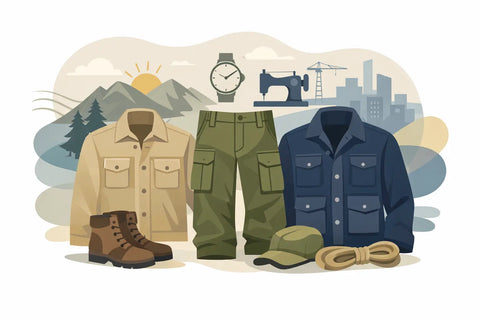
A jacket with real pocket placement does not need to announce itself. Neither do trousers cut with enough room to move, a dense cotton shirt, or denim that becomes more personal after a hundred wears. Are utility clothes timeless? They can be. But utility alone is not a guarantee. A garment lasts when its function, material, and proportion remain useful long after the season that made it popular has passed.
Workwear has always carried this test. It was designed around repetition: work, wash, repair, return. That practical origin gives utility clothing a stronger foundation than most trend-led categories. Yet the details still matter. Some pieces become permanent. Others only borrow the language of permanence.
Are Utility Clothes Timeless by Design?
The enduring appeal of utility clothing is simple: it answers ordinary needs without treating them as an aesthetic problem. Pockets hold what they should. A roomy sleeve allows movement. A hard-wearing cloth takes friction, weather, and repeated laundering without losing its character.
This is why classic worker jackets, fatigue pants, overshirts, and photographer shirts remain relevant across decades. Their forms were established by use, not by a runway cycle. They are recognizable, but not locked to one moment. The best versions retain that logic even when they are refined for contemporary life.
Timelessness is not the same as historical accuracy. A faithful reproduction can feel like costume if its fit belongs only to the archive. Equally, a modern interpretation can lose its point if every pocket, seam, and strap is added for visual effect. The balance is in preserving the reason for the garment while adjusting its form for how people live now.
A worker jacket, for example, need not be worn to a factory to make sense. Its short, practical length works over knitwear and tailoring. Its patch pockets give the front structure. Its durable cloth makes it a reliable outer layer from early fall through spring. Function becomes versatility.
What Makes Utility Clothing Last
Timeless utility clothes are built from decisions that hold up under close inspection. The first is fabric. A substantial cotton twill, canvas, ripstop, herringbone, or well-made denim has enough body to maintain shape while developing wear honestly. These materials do not need to stay pristine. They are allowed to soften, fade, crease, and record use.
The second is construction. Reinforced stress points, considered seam finishes, durable buttons, and a collar that keeps its line all affect how long a garment remains wearable. These are quiet details, but they determine whether a piece becomes a favorite or a replacement purchase.
The third is proportion. Utility clothes tend to work best when they give the body room without becoming shapeless. A slightly cropped jacket can create balance over full trousers. A straight or gently tapered leg offers movement while remaining adaptable to different footwear. Balloon pants can feel distinctly modern, but their volume needs control through a clean waist, measured rise, and a deliberate taper.
Color also matters. Deep indigo, washed black, olive, natural ecru, navy, charcoal, and tobacco endure because they work as part of a wardrobe system. They can be repeated without looking repetitive. This does not mean every lasting garment must be neutral. It means the color should support the material and silhouette rather than carry the entire design.
The Difference Between Utility and Costume
Utility references are easy to borrow. Cargo pockets, contrast stitching, oversized labels, and exaggerated straps can create an immediate workwear signal. They can also date a garment quickly when there is no practical reason for them.
A useful question is whether a detail earns its place. Does the pocket sit where a hand or object can actually reach it? Does the closure make the garment easier to wear? Does the fabric suit the weight and purpose of the piece? When the answer is no, utility becomes decoration.
This does not mean clothing must be severe. A generous pocket can be expressive. A curved seam can alter how a jacket sits on the body. A drawstring hem can shift the silhouette. The point is restraint. Good utility design has enough detail to be specific, and no more than it needs.
The same principle applies to distressing. Natural fading and repaired wear can make a garment more compelling over time. Manufactured damage may look right for a season, but it often leaves little room for the owner to create a relationship with the piece. Clothes with longevity should have somewhere to go.
Timeless Does Not Mean Formal or Minimal
There is a common mistake in treating timeless dress as a uniform of plain basics. Utility clothing offers a broader idea. A garment can have volume, texture, visible stitching, or a distinctive pocket arrangement and still remain useful for years. What matters is whether the identity comes from construction rather than novelty.
This makes utility wear especially suited to unisex wardrobes. A well-proportioned overshirt, chore coat, or full-cut trouser does not rely on narrow ideas of who should wear it. The garment adapts through styling, scale, and personal preference. One piece can look structured on one body, relaxed on another, and equally considered on both.
There is a trade-off. More generous shapes can require more attention to balance. If both jacket and trouser are oversized, a shorter layer, a tucked shirt, or a cleaner shoe can give the outfit definition. If the trouser is full, a fitted knit or compact tee creates contrast. Timeless clothing is not clothing that styles itself in every combination. It is clothing with enough range to reward repeated wear.
How to Choose Utility Pieces You Will Keep
Start with the role the garment will play. A worker jacket should function as an everyday layer, not compete with a heavy winter coat. Utility trousers should be comfortable for a full day, not only striking in a mirror. A shirt should work open, buttoned, and under a jacket if it is meant to earn regular rotation.
Then look at the fabric in your hand. Is it substantial enough for the silhouette? Does it have a surface that will improve with wear? Lightweight fabric is not automatically lesser, especially in warm climates, but it should be intentional. A summer poplin utility shirt needs breathability and a clean drape. A cold-weather twill trouser needs density without unnecessary stiffness.
Fit deserves patience. Check the shoulder line on jackets and shirts, the rise and seat on trousers, and the relationship between hem length and the shoes you wear most. Do not buy a piece only for the version of you who will style it perfectly once. Buy it for the days when getting dressed needs to be simple.
Care is part of the design, too. Wash less when the garment does not need it. Fasten closures before laundering. Air dry heavier cottons where possible. Repair a loose button before it becomes a missing one. These small habits preserve the structure and allow the fabric to age on its own terms.
A Garment Should Earn Its History
The strongest utility clothes become better through evidence. A softened elbow, a faded fold at the cuff, a patch made after years of wear - these are not flaws in a well-made garment. They are proof that it stayed in use.
Choose the jacket that works with your existing trousers. Choose the pants you can sit, walk, travel, and work in. Choose the fabric that feels right before it has been broken in. Then give it the time that good clothing requires. Details with a past are most convincing when they become part of yours.