
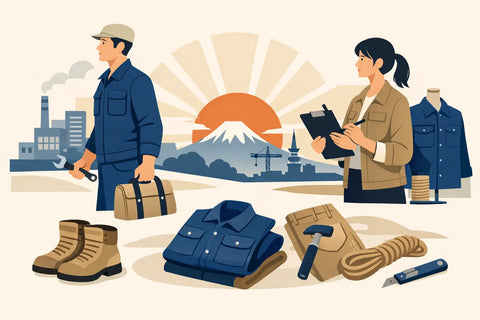
A pocket placed for use. A fabric chosen to take abrasion. A full-cut trouser that moves before it makes a statement. Japanese workwear has become shorthand for this kind of considered clothing: familiar utility forms, remade with exceptional attention to proportion, texture, and finish.
Its appeal is not novelty. It is restraint. The best pieces feel useful on the first wear and more personal after the hundredth.
Japanese Workwear Is a Design Language
Japanese workwear is not one uniform tradition. It draws from American railroad clothing, French chore coats, military uniforms, fishing garments, factory staples, and Japanese craft practices. Over decades, Japanese makers studied these references closely, then altered the equation. The work jacket became more balanced through the shoulder. The fatigue pant gained volume and a cleaner taper. Heavy cotton took on irregular texture and character.
The result is clothing that respects the source without becoming costume. A worker jacket can retain its patch pockets and durable cloth while sitting easily over a fine knit or worn with a clean shirt. A pair of utility trousers can carry the ease of a vintage field pant without the stiffness of reenactment.
That distinction matters. Heritage alone does not make a garment worth keeping. Form has to work in the present.
Why the Fabrics Feel Different
Fabric is often the first reason people return to Japanese workwear. Many of its most recognizable textiles have depth before they have color: slubbed cotton, dense twill, brushed moleskin, herringbone, sashiko-inspired weaves, and indigo-dyed denim that changes with wear.
These materials are not always soft at first. A substantial cotton drill may need time to relax. Rigid denim may crease sharply before it conforms. This is part of the exchange. The garment asks for wear, then records it.
Texture Is Function, Not Decoration
Texture can make a simple shape feel complete, but it also has a practical role. Dense twill resists friction. Herringbone spreads strain across its weave. Ripstop limits the spread of tears. A well-made brushed cotton brings warmth without the bulk of a heavy outer layer.
The trade-off is care. Indigo can transfer when new. Natural fibers can shrink if washed carelessly. Heavier cloth takes longer to dry and may feel too warm in high summer. These are not flaws, but they should guide the purchase. Buy a fabric for the climate and the life it will actually meet.
A good workwear wardrobe does not require every garment to be heavy. A lightweight poplin photographer shirt, an airy cotton overshirt, or a dry tropical-weave pant can carry the same utility-minded approach in warmer months.
Proportion Makes the Garment Current
The strongest Japanese workwear silhouettes often begin with room. Not excess, but deliberate volume. A dropped shoulder allows a jacket to layer without pulling. A wider thigh lets a trouser move naturally. A cropped body changes the balance of a boxy overshirt and keeps it from feeling oversized for its own sake.
This is why fit cannot be reduced to a size label. Workwear was built around movement, and contemporary interpretations should preserve that quality. Look at the full garment: shoulder width, sleeve shape, rise, thigh, hem, and the relationship between top and bottom.
A balloon pant, for example, needs shape rather than just width. Its volume should sit through the leg, then resolve at the ankle. Paired with a shorter worker jacket or a tucked-in shirt, it creates a clear line. Paired with a long, loose top of equal volume, it can feel unstructured. Neither approach is wrong, but the effect is different.
One Garment, Different Bodies
Unisex workwear works best when it is designed as a system of proportion, not a compromise between conventional menswear and womenswear. The same utility trouser may sit at the waist on one person and lower on another. A boxy jacket may read sharp over a dress, relaxed with denim, or architectural over wide pants.
Measurements matter more than category. Compare the garment to something you already wear well, especially across the shoulders and through the rise. If you are between sizes, decide what you need from the piece. Size down for a closer line. Keep the room if layering and movement are the priority.
At WORKWARE, this principle informs garments intended to move between bodies, seasons, and routines. One garment. Different bodies. Different lives.
Construction Is Where Longevity Begins
Workwear language is easy to copy. Durable construction is harder.
Look beyond the obvious details. Bar tacks at pocket corners help manage strain. Felled or flat seams reduce bulk and hold up well through repeated washing. Reinforced belt loops, substantial buttons, clean binding, and a properly set collar all affect how a garment lives over time. None needs to be theatrical. The best construction is usually quiet.
Pockets deserve particular attention. Useful pockets should be placed where a hand naturally falls and sized for what you carry. Too shallow, and they are decorative. Too large or too low, and they pull the line of the garment out of balance. The same applies to tool loops, pen slots, and adjusters. A detail should earn its place.
There is also a limit to utility. More compartments do not automatically create a better garment. If a jacket only works when filled with objects, it may be overdesigned. A well-proportioned chore coat with three strong patch pockets often does more than a technical shell covered in hardware.
How to Build a Wearable Workwear Rotation
Start with the garment that solves the most problems. For many wardrobes, that is a midweight worker jacket in cotton twill or canvas. It works as an outer layer in mild weather, an indoor layer in colder months, and an alternative to a blazer when the setting allows for texture.
Then consider trousers. Choose a fatigue pant, utility trouser, or balloon silhouette with enough room to sit, walk, cycle, and travel comfortably. Olive, navy, black, and washed khaki are useful foundations because they accept repeat wear and pair easily with denim, knitwear, and shirting.
A photographer shirt or overshirt adds range. Worn open, it functions as a light jacket. Buttoned up, it gives structure to relaxed pants. Over time, these pieces make more sense together because they share a material logic: natural fabrics, useful pockets, room to move, and shapes that do not depend on a single season.
Avoid buying an entire look at once. A uniform assembled too quickly can look fixed. Let one piece enter the wardrobe, then see what it changes. The right jacket may reveal that your existing jeans need a wider hem. The right pants may make a familiar white shirt feel more intentional.
Wear It Hard, Care for It Well
Workwear is built for repetition, not neglect. Brush off dirt before it settles into the cloth. Wash less when a garment is not truly soiled, especially denim and indigo pieces. When washing is needed, turn garments inside out, use cool water, and avoid aggressive drying that can shrink cotton or fatigue fibers.
Small repairs belong to the life of these clothes. Reinforce a loose button before it disappears. Mend a worn pocket edge. Patch a knee with a fabric that adds another layer of history. A repair does not diminish the garment. It proves that the garment was worth repairing.
Japanese workwear offers a useful standard: clothing should have enough purpose to be worn often, enough character to improve with time, and enough clarity to outlast the moment that brought you to it. Choose the piece you will reach for on an ordinary Tuesday. That is where its value becomes visible.