
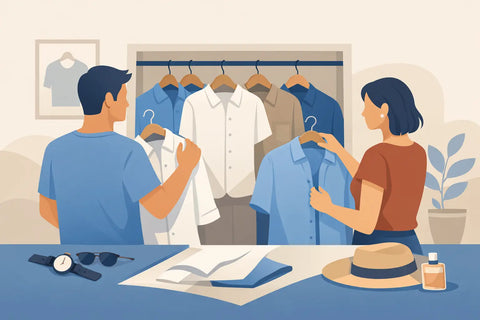
A shirt gets tested differently when it belongs to more than one person. It is pulled into weekday rotation, borrowed at short notice, washed often, and expected to sit right on different frames without losing its character. That is why the best shirts for shared wardrobes are not simply oversized or labeled unisex. They are built with balance.
A shared wardrobe asks more from a garment. It needs enough structure to hold shape, enough ease to move across bodies, and enough restraint in design to keep working no matter who wears it. Good shirts can do that quietly. Great ones make it feel obvious.
What makes the best shirts for shared wardrobes
The first requirement is silhouette. Shared wear works best when a shirt is neither aggressively fitted nor excessively oversized. A dropped shoulder can help, but too much volume can overwhelm one wearer and flatten another. A cleaner line, slightly boxy through the body with room at the sleeve and chest, tends to travel better.
Length matters just as much. A shirt that is too long can feel like a tunic on one person and standard on another. Too short, and it loses flexibility for layering or tucking. The most reliable proportion sits in the middle - enough coverage to wear open over a tee, enough control to wear buttoned on its own.
Collar shape is another quiet decision. A compact point collar or workwear collar usually outperforms a large spread or soft camp shape in shared wardrobes. It frames the face without pushing the garment into a specific mood. The same is true of pockets. One chest pocket, or two balanced utility pockets, adds function without making the shirt feel too decorative or too formal.
Then there is fabric. Shared pieces live hard lives. Crisp but brittle cloth will show stress quickly. Lightweight shirting may drape well, but it often loses authority after repeated use. Midweight cotton poplin, Oxford, chambray, herringbone, brushed cotton twill, and compact linen blends tend to hold up better. They soften with wear, but they do not collapse.
Fit across different bodies
A truly shared shirt should not rely on one body type to look right. That rules out many shirts marketed as universal. In practice, the shirts that work across men, women, and non-binary dressers usually share a few traits: a straight or gently shaped body, generous armholes, sleeves with enough width to roll cleanly, and a back yoke or pleat that creates movement.
The shoulder is where many shirts fail. A perfectly tailored shoulder can look sharp on one person and restrictive on another. A slightly relaxed shoulder gives more room for variation. Not sloppy. Not exaggerated. Just enough tolerance to make the shirt usable rather than precious.
Cuffs are often overlooked. Adjustable cuffs extend the life of a shared fit because they change how the sleeve lands and how the shirt layers under jackets. The same goes for plackets and button spacing. A well-built front can sit flat on different chests without gaping or pulling. Construction decides wearability long before styling does.
The best fabric choices for shared wardrobes
If one shirt is going to serve multiple people, fabric should do more than feel nice on day one. It needs memory, endurance, and a good aging pattern.
Oxford cloth remains one of the strongest options. It has body, subtle texture, and enough ease to dress up or down. It resists looking flimsy, which matters when the fit shifts from wearer to wearer. A white or pale blue Oxford is useful, but a washed ecru, charcoal, or faded stripe often integrates more naturally into a shared system because it hides wear and pairs broadly.
Chambray is another strong candidate, especially in midweight form. It carries workwear roots without becoming costume. It layers easily and improves with age. The slight visual texture also helps the shirt hold interest without needing graphic details.
Cotton twill and herringbone sit a little deeper in the utility lane. They are ideal if the wardrobe leans seasonless and practical. These fabrics tend to have enough density to work as an overshirt in mild weather and as a standard shirt under outerwear when it gets colder. That range is useful when one garment has to stretch across different routines.
Linen can work, but only with care. Pure lightweight linen tends to crease hard and change character quickly depending on who wears it and how. A heavier linen or linen-cotton blend is more dependable for sharing. It keeps the dry hand and breathability of linen while holding shape better.
Shirts that earn their place
The best shared shirts are usually the least theatrical. They do not depend on novelty proportions, oversized branding, exaggerated distressing, or seasonal colors that date quickly. They earn their place through repeat use.
Work shirts are especially strong here. Their origins are practical, and that practicality still reads. Two patch pockets, reinforced seams, and sturdy cloth create a shirt that can be worn open like light outerwear or buttoned as a base layer. It works for a studio day, a commute, or a dinner that does not require costume.
Photographer-style shirts also make sense in shared wardrobes. Their appeal is not trend but utility - clean fronts, useful pockets, enough structure to stand alone. They carry intent without looking overdesigned.
Classic button-downs have a place too, though the softer they are, the more carefully they need to be chosen. A button-down collar can skew more traditionally masculine on some bodies, more borrowed and relaxed on others. That tension can be a strength if the proportions stay clean.
Color, pattern, and staying power
Shared wardrobes benefit from restraint. This does not mean everything must be white, black, and navy, but it does mean a shirt should be easy to absorb into different ways of dressing.
Off-white, stone, faded olive, ink, washed black, and muted blue tend to wear well across people and seasons. These shades take on age gracefully. They also work with denim, utility trousers, tailored wool, and skirts without demanding too much from the rest of the outfit.
Stripes can be excellent, especially ticking stripes or narrow banker stripes with some fade. Large graphics and loud checks are more divisive. If one person loves them and the other avoids them, the shirt stops being shared and starts becoming claimed.
The same principle applies to hardware. Tonal buttons, matte snaps, and understated stitching generally give a shirt longer range. Contrast details can be compelling, but they reduce neutrality. In a shared wardrobe, neutrality is not blandness. It is capacity.
Why construction matters more than branding
Experienced buyers know the difference immediately. Flat felled seams, dense stitching, clean bar tacks, stable interlining, and a fabric with real weight will outlast any logo story. This matters even more in shared wardrobes because repeated wear reveals weak points faster.
Look closely at stress areas: side seams, cuff edges, pocket corners, and collar stands. These are the first places a frequently borrowed shirt begins to speak. A well-made one softens there. A poorly made one breaks there.
This is where heritage-informed design still earns respect. Workwear was never about decoration first. It was about use, repair, and endurance. Those values translate cleanly into contemporary unisex dressing. One garment. Different bodies. Different lives.
Buying fewer, choosing better
The temptation with shared wardrobes is to buy broadly and hope overlap happens. It rarely does. Better to choose fewer shirts with a clear role: one crisp option, one textured work shirt, one lighter shirt for heat, one darker overshirt-weight piece. Not a collection of near misses.
Try to assess a shirt in motion, not on a hanger. Can it be worn tucked and untucked? Open and closed? Sleeves down and rolled? Does it look deliberate on a smaller frame and grounded on a larger one? Those are better questions than whether it sits inside a trend cycle.
A strong shirt should also survive different styling instincts. One wearer may pair it with pleated trousers and loafers. Another may throw it over denim and heavy shoes. If the shirt still reads as itself, it is doing its job.
For brands built around utility, longevity, and gender-inclusive form, this category is not an afterthought. It is the center. WORKWARE understands that well. The point is not to make a shirt for everyone. The point is to make one worth reaching for, again and again, by more than one person.
The best shared shirt is the one that keeps its shape, gains character, and never needs explanation. Buy the piece that can live a long life in circulation. The rest is noise.