
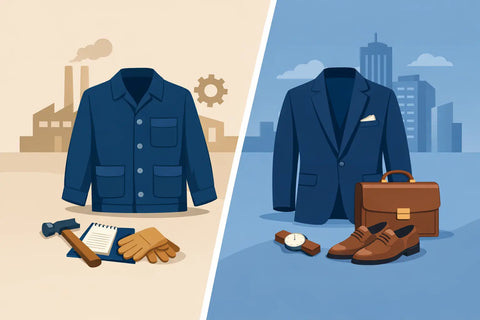
You can spot the difference before you touch the cloth. In a chore jacket vs blazer comparison, one piece is built to carry use. The other is built to hold shape. Both can look refined. They just arrive there by different routes.
That distinction matters more now than it did a decade ago. Dress codes have loosened, tailoring has softened, and workwear has moved from niche reference to daily uniform. As those lines blur, people end up wearing blazers like overshirts and chore jackets like tailored outerwear. Sometimes it works. Sometimes the garment is being asked to do the wrong job.
Chore jacket vs blazer: the real difference
A chore jacket begins with labor. Traditionally French in origin, it was designed as practical outerwear for makers, tradespeople, and shop workers. The shape is direct - straight body, simple collar, patch pockets, room to layer. Nothing ornamental. Its logic is use.
A blazer begins with tailoring. Even in its most relaxed form, it carries the language of a tailored jacket: shaped front, set shoulders, lapels, cleaner drape, and a more deliberate relationship to the body. It may be casual, but it still comes from the world of dress.
So the real comparison is not casual versus formal. It is utility versus tailoring. A chore jacket organizes movement and wear. A blazer organizes line and presentation.
That is why the two feel different even when they share the same color, similar weight, or a similarly minimal finish. The intention is built into the pattern.
Structure decides everything
The fastest way to understand these garments is through construction.
A chore jacket is usually cut with ease through the chest and body. The shoulder is often natural or only lightly defined. Patch pockets sit on the outside because access matters. Buttons are straightforward. Fabrics tend to be workwear-adjacent: cotton twill, moleskin, canvas, herringbone, washed denim, dense poplin. The jacket is expected to crease, soften, and carry marks of wear without losing character.
A blazer depends more on internal architecture. Even an unstructured blazer still has a tailored front, a roll line, and some degree of shaping. Welt or flap pockets keep the surface cleaner. Fabrics can range from hopsack wool to cotton twill to linen, but they are chosen for drape as much as durability. A blazer is less about storage and more about proportion.
This changes how each piece ages. A good chore jacket gets better as the fabric breaks in and the edges soften. A good blazer can age beautifully too, but only if the cloth and make are good enough to keep their balance over time. Once a blazer loses shape, it shows. A chore jacket often gains something from wear.
Why the collar and pockets matter
Small details carry the whole identity. A chore jacket collar is simple and often sits close to the neck. It does not ask for a tie or even a proper shirt collar beneath it. It frames a tee, a knit, an oxford, a thermal. It is permissive.
A blazer collar and lapel create a more formal opening at the chest. That line pulls the eye upward. It sharpens the outfit, even with denim or sneakers. You may be dressed casually, but the blazer still reads as intentional in a different way.
Pockets tell the same story. Patch pockets on a chore jacket are there to be used. They make sense with keys, a notebook, gloves, receipts, daily carry. On a blazer, pockets are often cleaner and less loaded. Fill them too much and the jacket starts to distort.
Where each one works best
The better question is not which is more stylish. It is which one belongs in your system.
If your wardrobe leans on denim, fatigue pants, loose trousers, sturdy shirting, or knitwear, a chore jacket usually integrates more naturally. It sits comfortably over volume. It works across seasons. It moves between studio, office, travel, and weekend without asking for much adjustment. This is why it has become such a permanent piece for people who dress with function in mind.
If your wardrobe still needs a jacket for presentations, dinners, gallery openings, or occasions where some polish helps, a blazer earns its place. It creates clarity quickly. Even with relaxed pants and a plain tee, it can pull an outfit into a more composed register.
The trade-off is flexibility. A blazer can be dressed down, but it is still asking the rest of the outfit to cooperate. A chore jacket asks less. That makes it easier for everyday wear, but it also means it may not carry enough authority for settings where tailoring still matters.
Office, travel, and daily wear
In a relaxed office, the chore jacket often outperforms the blazer. It is easier to wear all day, easier to layer, and less fragile in transit. It does not mind a train seat, a tote strap, or being thrown over a chair.
For travel, the gap gets even wider. Utility wins. Patch pockets, forgiving fabric, and a shape that tolerates movement make the chore jacket more resilient. It can act as light outerwear, overshirt, or indoor layer depending on climate.
But if the trip involves meetings where first impressions matter, the blazer still has a role. A navy unstructured blazer in the right cloth can cover a lot of ground. It just requires more discipline in the rest of the wardrobe.
Fit is where most people get it wrong
A chore jacket should not fit like a suit coat. If it is too close to the body, it loses its purpose and starts to look strained. The best ones have enough room for a sweatshirt or shirt beneath, while still keeping the shoulder clean and the length balanced.
A blazer, on the other hand, cannot rely on ease alone. It needs control. The shoulder should sit properly, the chest should not collapse, and the waist - even in relaxed tailoring - should have some sense of shape or vertical intent. Oversized blazers can work, but only when the proportions are deliberate. Otherwise they just look borrowed.
This is especially relevant for unisex wardrobes. Chore jackets are naturally more adaptable across bodies because they are less dependent on tailored shaping. They allow the wearer to decide how the silhouette lands. Blazers can be shared too, but they are less forgiving. The armhole, shoulder, and lapel placement matter more.
Fabric changes the answer
Not every chore jacket is rugged, and not every blazer is formal. Fabric can move both garments closer to the middle.
A chore jacket in fine cotton drill or brushed moleskin can feel almost polished, especially in black, deep navy, or charcoal. Worn with pleated trousers and leather shoes, it can stand in for a casual tailored jacket without pretending to be one.
A blazer in washed cotton or linen, softly made with minimal padding, can feel nearly as easy as workwear. Pair it with fatigue pants or roomy denim and the formality drops fast.
Still, the fabric only shifts the mood. It does not erase the pattern. A blazer made in workwear cloth is still a blazer. A chore jacket in refined cloth is still a chore jacket. That is the point. Details with a past. Forms for now.
Which one is more timeless?
Timeless is often used carelessly. Usually it just means currently acceptable in neutral colors.
A blazer has a long life because tailoring has a long life. But blazers are more vulnerable to trend through lapel width, button stance, shoulder expression, jacket length, and suppression. A blazer can date itself quietly.
A chore jacket tends to resist that cycle better because its core features are so stripped back. Straight cut. simple collar. patch pockets. practical cloth. There is less surface area for trend to attach itself to. When the proportions are right, it can stay useful for years without explanation.
That does not make it better. It makes it steadier.
How to choose without overbuying
If you already own one, buy the other only if it covers a real gap.
Choose a chore jacket if you want one layer that can live over a tee, under a coat, with denim, with wool trousers, with sneakers, with leather shoes, and still feel like itself. Choose a blazer if you need shape, polish, and a jacket that can hold a sharper line when the room asks for it.
If you wear tailoring rarely, a chore jacket will likely deliver more cost per wear. If your week still includes events, meetings, or social situations where structure helps, a blazer may be the piece that keeps your wardrobe complete.
The useful wardrobe is not the one with more categories. It is the one where each garment knows its role. Between a chore jacket and a blazer, the right choice is usually the one you will reach for without negotiation.