
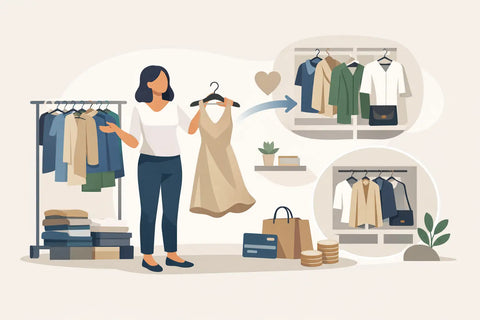
Most people do not have a clothing problem. They have a filtering problem.
That is the real question behind how to buy fewer clothes. Not how to stop wanting things entirely, and not how to become severe about dressing. The goal is simpler - fewer purchases, better decisions, more wear. A wardrobe with less churn and more use.
For anyone who already pays attention to cut, cloth, and construction, this shift is less about restraint than clarity. You are not trying to own nothing. You are trying to remove noise.
How to buy fewer clothes starts before checkout
Most overbuying happens long before the cart. It starts with a vague wardrobe and a constant intake of newness. If you cannot describe what your wardrobe is for, everything starts to look useful.
A better approach is to define your system. Think in terms of silhouette, function, climate, and frequency. Which shapes do you actually wear? Straight or full trousers. Cropped or longer jackets. Crisp shirts or softer overshirts. Which garments move across work, travel, weekends, and weather shifts without becoming a compromise in each setting?
When that framework is clear, shopping gets quieter. You can spot the difference between a true addition and a duplicate with slightly different pockets.
This is where many experienced buyers become more disciplined. Not because they stop appreciating clothes, but because they get more precise. Precision cuts volume.
Build a wardrobe system, not a rotation of moods
Buying fewer clothes becomes easier when your wardrobe has internal logic. Pieces should speak to each other through proportion, fabrication, and use.
That does not mean everything has to match or flatten into uniform dressing. It means your garments should have a reason to coexist. A sturdy worker jacket that layers over an oxford shirt and a knit. Utility trousers that hold their shape with a fine jersey or a structured coat. Denim that works with boots, sneakers, or loafers without changing its character.
The point is continuity. If a garment only works with one very specific version of you, it is often less versatile than it first appears.
This is also why seasonless thinking matters. The best pieces do not disappear for ten months of the year. They adapt. Fabric weight, layering capacity, and ease of styling matter more than novelty. A garment with range earns its place faster.
Start with your repeat silhouettes
Look at what you wear on ordinary days, not idealized ones. The trouser you reach for twice a week tells you more than the statement piece you admire once a month.
If you keep returning to relaxed, slightly architectural shapes, buy within that language. If you prefer clean, workwear-derived structure, stay there. Chasing unfamiliar silhouettes often creates wardrobe friction. Sometimes that friction is useful. Often it becomes dead stock in your own closet.
Let frequency decide value
Price matters. Cost per wear matters more.
A well-made shirt worn eighty times is cheaper than a cheaper shirt worn six. The math is simple, but the deeper point is about confidence. You buy less when you trust that a garment will hold up physically and visually. Durable twill, dense jersey, compact poplin, stable denim - these are not abstract quality signals. They shape how often a piece gets worn, washed, repaired, and kept.
Stop shopping for a missing feeling
A lot of unnecessary buying is emotional, but not always in an obvious way. It is rarely pure impulse. More often, it is a quiet belief that one more piece will sharpen your identity, reset your routine, or close the gap between how you dress and how you want to be seen.
Sometimes it does. Often it does not.
The useful question is not Do I like this? It is What job is this garment being hired to do?
If the answer is vague - maybe it will make basics feel less boring, maybe it works for an event that may happen, maybe it is just good to have - leave it. Good wardrobes are not built on maybes.
There is also a trade-off here. Some purchases are allowed to be emotional. Clothing is personal. Desire is part of the point. But if every purchase has to carry symbolic weight, buying gets unstable. You start collecting possibilities instead of dependable forms.
Use standards that are hard to argue with
If you want to know how to buy fewer clothes in a way that lasts, create standards before you browse.
Your standards might include fabric integrity, pocket placement, rise, shoulder shape, dye stability, or whether a garment can be worn across at least three contexts. They might be stricter: only natural fibers in certain categories, only silhouettes that layer cleanly, only colors that deepen the wardrobe instead of interrupting it.
These standards should feel a little boring. That is a good sign. Boring standards are often what protect you from expensive mistakes.
The same applies to fit. Not perfect fit in the abstract - useful fit. Can you move? Can you layer? Does the fabric sit the way it was meant to? Does the leg break where you want it to? Experienced buyers know that small construction details determine whether a piece becomes essential or neglected.
Separate appreciation from acquisition
You can admire a garment without needing to own it.
This sounds obvious, but it changes everything. A beautifully cut coat, an unusual wash, a clever military reference, a strong color story - these can all be worth noticing without becoming purchases. Design literacy should make you more selective, not more vulnerable.
Some of the best dressed people are not the ones who buy the most. They are the ones who edit hardest.
Slow the buying cycle on purpose
Speed makes weak decisions feel decisive. Limited drops, low stock, launch language, seasonal urgency - all of it pushes the same instinct. Buy now, evaluate later.
A simple countermeasure is delay. Give every non-essential purchase time. A few days is useful. Two weeks is better. If you are still thinking about the same garment after that gap, for specific reasons, it may deserve attention.
The key word is specific. Not I still want it. More like: the cloth fills a real gap between my lighter shirting and outerwear, the cut works with my existing trousers, and the finish improves with age. Specific desire is usually more trustworthy.
Another way to slow down is to keep an active wardrobe note. Not a wish list full of everything you like. A short working document of what you actually need, what you have enough of, and what failed you recently. That kind of record reveals patterns quickly. Most people do not need another jacket. They need to admit they keep buying jackets.
Buy better, but define better carefully
Buying fewer clothes does not always mean buying expensive clothes. It means buying with stricter criteria.
Sometimes better means heavier fabric and cleaner finishing. Sometimes it means easier care, because the garment has to survive real life. Sometimes it means accepting a higher price because the pattern, fabrication, and utility are all there. Other times it means not paying for branding, novelty, or exaggerated detailing that will date the piece too quickly.
There is no virtue in cheap volume, and there is no virtue in expensive clutter either.
For a brand like WORKWARE, the answer is often in garments that carry function and restraint at once - pieces with workwear roots, contemporary proportion, and enough clarity to keep earning wear. That is the standard worth looking for anywhere: forms with range, details with purpose, fabric that gets better through use.
Let maintenance replace shopping
One of the most effective ways to buy less is to keep your current clothes in better condition. Not in a precious way. In a practical one.
Wash less when possible. Repair early. Repress collars and hems. Condition leather. Rotate shoes. Store knitwear properly. Replace a button before it becomes an excuse to stop wearing the shirt. The more competent you become at keeping garments alive, the less likely you are to solve every wardrobe issue with a new purchase.
There is also a psychological shift here. Care creates attachment. Attachment reduces churn.
Clothes become more convincing over time when they are made well enough to age. Fading, softening, creasing, and wear patterns are not flaws when the original garment had substance. They are proof of use. That matters.
Leave room for change, not constant replacement
People do evolve. Work changes. Bodies change. Taste gets sharper. So the goal is not a frozen wardrobe with no movement in it.
The goal is to make fewer, more intelligent changes. Add when there is a real need. Replace when something is worn out beyond repair or no longer serves your life. Experiment in measured ways, with pieces that still connect back to the system you already have.
If you can do that, buying fewer clothes stops feeling restrictive. It starts feeling like control.
A good wardrobe should not ask for constant attention. It should support the life around it, then get better with wear.