
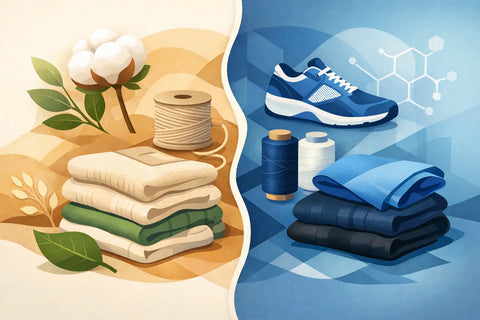
A jacket can look right on the hanger and still fail after a season. The fabric tells the truth later - after heat, rain, friction, washing, and long hours of wear. That is where natural fibers vs synthetics becomes useful, not as a slogan, but as a way to read what a garment will do over time.
The easy version says natural is better, synthetic is practical. Real wardrobes are built on sharper distinctions than that. Cotton canvas and merino jersey do not behave alike. Nylon ripstop and recycled polyester fleece do not, either. If you buy for longevity, utility, and repeat wear, the question is not which category wins. It is which fiber earns its place in a specific garment.
Natural fibers vs synthetics is really a question of use
Fiber choice is not an abstract sustainability debate when you are getting dressed at 7 a.m. It shapes drape, temperature regulation, abrasion resistance, drying time, and how a piece ages on the body. It also affects whether you keep reaching for it.
Natural fibers often appeal because they feel alive. They breathe, soften, crease, fade, and develop a record of wear. That quality matters in workwear and wardrobe staples, where character is part of the design. A cotton twill trouser that breaks in at the seat and knee can become more convincing with time, not less.
Synthetics tend to be chosen for control. They can be lighter for the same strength, faster to dry, more resistant to stretching out, and more stable in wet conditions. In the right context, that precision is valuable. A shell, lining, or hard-use bag made entirely from natural fibers can sound romantic and still perform poorly.
The better question is simple: what does the garment need to do, and what kind of aging do you want from it?
Where natural fibers excel
Cotton, linen, wool, hemp, and silk have very different personalities, but they share one advantage many experienced wearers recognize immediately - comfort that does not feel engineered.
Cotton remains the foundation for a reason. In shirting, denim, jersey, and canvas, it offers a directness that is hard to fake. It breathes reasonably well, takes dye with depth, and becomes more personal with use. In utility garments, cotton can hold structure without becoming stiff in a synthetic way. It tends to wear in rather than just wear out.
Linen does another job. It releases heat, dries quickly for a natural fiber, and gives volume without bulk. Its wrinkles are part of the point. In warm weather, linen reads as calm rather than polished, which is often exactly right.
Wool is the most misunderstood member of the group. Good wool regulates temperature exceptionally well, resists odor, and can absorb moisture without feeling immediately wet. Merino base layers, dense wool overshirts, and tailored outerwear all benefit from that range. Wool asks for care, but it repays it.
These fibers also tend to age with visible honesty. Fading, creasing, and surface wear can add clarity to a garment's shape and use. For buyers who value patina, that is not damage. It is evidence.
There are limits. Natural fibers can shrink, hold moisture, lose strength when wet, and take longer to dry. Cotton can feel heavy in rain. Linen can abrade at stress points. Wool can pill or felt if treated poorly. Natural does not mean indestructible.
Where synthetics make sense
Polyester, nylon, acrylic, elastane, and technical blends are often judged as a group, but they are tools, not a single material story.
Nylon is one of the clearest examples of a synthetic doing exactly what it should. It is strong for its weight, abrasion-resistant, and effective in outerwear, bags, reinforcement panels, and utility details. If you need a garment to handle friction and recover quickly from weather, nylon earns respect.
Polyester is less romantic, more common, and often more useful than its reputation suggests. It holds shape well, dries quickly, resists wrinkling, and performs reliably in fleeces, linings, insulation layers, and some shirting. The problem is not polyester itself. The problem is cheap polyester used where a better fiber would create a better garment.
Elastane is rarely the hero, but it changes wear. A small percentage can improve mobility and shape retention. Too much, and the fabric can feel overbuilt, shiny, or quick to lose integrity. Stretch is helpful. Constant recovery pressure is not always comfort.
Synthetics also solve problems natural fibers struggle with. They are often better in sustained wet conditions. They can be engineered for wind resistance, low weight, or tear strength in ways natural yarns cannot easily match. For travel, active use, or outer layers exposed to weather, that matters.
The trade-off is aging. Many synthetics do not develop character in the same way. They can pill, snag, trap odor, or acquire a tired surface without becoming more attractive. When they fail, they often fail abruptly rather than gracefully.
Natural fibers vs synthetics in real garments
The cleanest way to judge materials is by garment type.
In T-shirts and base layers, the choice depends on climate and use. Cotton jersey is breathable, familiar, and easy to live in. Merino performs better across temperature swings and repeated wear. Polyester-heavy performance tees dry fast but can hold odor. For everyday city wear, many people still prefer the hand and aging of natural fibers.
In shirts, cotton and linen usually offer the better balance of comfort, structure, and visual depth. Synthetics can help with wrinkle resistance, but too much can flatten the fabric's character. A shirt that looks crisp at purchase but never softens is often less convincing after a year.
In trousers, cotton twill, canvas, and denim remain hard to beat. They hold shape, break in well, and suit utility silhouettes. Some nylon-cotton blends work especially well here, combining strength and faster drying with a less technical look. That middle ground is often where good design lives.
In knitwear and cold-weather layers, wool is difficult to replace. It insulates without becoming oppressive and keeps working across a wide range of temperatures. Synthetic fleece can be practical and light, but it usually offers a different kind of comfort - more functional, less dimensional.
In outerwear, purity matters less than performance. A waxed cotton jacket offers weather resistance, structure, and age. A nylon shell offers lighter weight and better storm protection. Both are valid. They simply belong to different systems of dressing.
Blends are often the most intelligent choice
Some of the best fabrics are not ideological. They are blended with purpose.
Cotton with a small amount of nylon can improve tear resistance in a field shirt or utility pant without losing the dry, matte surface people want from workwear. Wool blended with synthetics can increase durability and reduce distortion in knitwear. Cotton with a touch of elastane can help movement in a fitted trouser, though restraint matters.
A good blend is designed around a clear problem. A bad blend is there to cut cost, simplify production, or imitate a better cloth. You can often feel the difference immediately. The fabric either resolves tension, or it creates new ones.
This is where experienced buyers tend to look beyond fiber labels alone. Weight, weave, finish, yarn quality, and construction matter just as much. A well-made cotton jacket can outlast a poorly made technical one. A dense wool overshirt may outperform a thin synthetic layer simply because the cloth has substance.
How to choose with more intent
Start with climate, then use, then tolerance for care. If you run warm, natural fibers with open structure may serve you better. If you commute through rain or need easy wash-and-wear performance, selective synthetics become practical. If you want a garment to show its life, choose fibers that age visibly. If you want consistency, look toward materials that hold a steadier surface.
Also pay attention to how often the piece will be worn. High-rotation garments benefit from fabrics that remain comfortable after long days, not just fabrics that look efficient on paper. That is why a cotton poplin shirt, wool knit, or dense jersey often stays in circulation longer than a more technical alternative.
At WORKWARE, this is the principle behind choosing cloth for form, use, and time. Not novelty. Not purity. Just the right material for the right garment.
Natural fibers vs synthetics is not a referendum on good taste. It is a way to ask better questions before you buy. The best wardrobes are rarely built from one side alone. They are built from pieces whose materials make sense, wear honestly, and stay useful long after the first impression fades.