
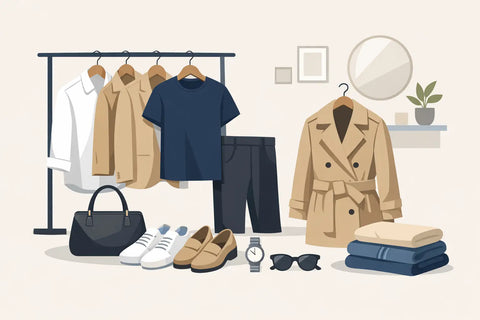
Some closets get crowded because nothing quite earns its place. You buy for a single mood, a single season, a single version of yourself, and the rail fills with compromises. Functional wardrobe staples solve that problem differently. They are not generic basics. They are the pieces that carry weight - in fabric, in use, in the way they return to rotation year after year.
The point is not austerity for its own sake. The point is a wardrobe that works harder with less noise. A good staple does more than match everything. It holds its shape, adapts across settings, and makes sense on different bodies and in different weather. Details with a past. Forms for now.
What makes a wardrobe staple functional
Function starts before styling. It begins with cloth, cut, and construction. A jacket can look clean on a hanger and still fail in daily wear if the fabric bags out, the pocket placement is awkward, or the armhole restricts movement. A shirt can read timeless but become irrelevant fast if its proportions are too tied to one trend cycle.
So a functional staple needs a few things at once. It needs durability, but not stiffness for the sake of signaling quality. It needs versatility, but not so much neutrality that it loses character. It needs enough design intelligence to feel distinct, without becoming difficult to wear.
That tension matters. The best pieces are not blank. They are resolved. Think dense cotton twill that softens with age, denim with enough structure to hold a line, or a trouser shape that gives movement without collapsing into novelty. When a garment is built well, versatility follows naturally.
The functional wardrobe staples worth building around
1. The worker jacket
Few garments do more with less. A proper worker jacket sits between overshirt and outerwear, which is exactly why it stays useful for most of the year. It layers over a tee, under a coat, and carries enough structure to finish a look without making it formal.
What matters is proportion. Too slim, and it becomes officewear with workwear references. Too oversized, and it loses precision. Look for a shape that leaves room through the shoulder and body, with practical pockets that sit where your hands actually reach. Cotton drill, moleskin, canvas, and herringbone all age well here.
If you only own one light jacket, this is the one that tends to justify itself.
2. The photographer shirt or utility shirt
A functional shirt should be able to work as a base layer, a stand-alone piece, or a light overshirt depending on weather. That usually means a fabric with body - not a limp poplin that only works tucked in and pressed flat. Oxford cloth, brushed cotton, chambray, and compact twill all give more range.
Utility details help when they stay restrained. A chest pocket that actually fits a notebook. A slightly dropped shoulder for movement. Sleeves with enough volume to roll cleanly. The right shirt should look just as natural half-buttoned over a tank as it does under tailored outerwear.
This is also where unisex dressing tends to make the most sense. A well-cut shirt can shift across bodies with very little effort. That kind of flexibility is not a styling trick. It is good design.
3. The straight or balloon trouser
Trousers often decide whether a wardrobe feels considered or merely safe. The most useful pairs are the ones with enough shape to define the silhouette on their own. Straight leg utility trousers do this with clarity. Balloon pants do it with more volume and a slightly more architectural line.
Neither is universally better. It depends on how you dress and how you move through a day. A straight cut is easier if you need one pair to bridge work, travel, and casual wear. A balloon shape offers more ease and often more visual interest, but it asks for balance up top.
In both cases, fabric is doing most of the work. A substantial cotton twill or washed canvas gives form without looking precious. The goal is not just comfort. It is repeatability - a trouser you can wear three times in a week and style differently each time.
4. The heavyweight tee
The plain T-shirt is where many wardrobes quietly fail. Too thin, and it becomes an undershirt pretending to be a finished garment. Too soft too early, and it twists, stretches, and loses authority after a few washes.
A functional tee needs weight, a stable neckline, and sleeves that sit with intention. It should skim, not cling. It should work alone with trousers and still hold up under a jacket. That sounds simple, but the difference between an average tee and a dependable one is usually visible within a month of wear.
White, off-white, charcoal, and washed black cover most needs. The best choice depends less on trend and more on what works against your outer layers and skin tone.
5. The durable denim pair
Denim earns staple status only when the cut and fabric age in the right direction. That means avoiding pairs built around short-term extremes - too sprayed-on, too exaggerated, too heavily processed. Raw and rinsed denim both have a place. Raw develops a sharper personal patina. Rinsed tends to feel easier from day one.
The more useful question is shape. A mid-rise straight leg works for most wardrobes because it accommodates different shoes, different tops, and different contexts. Wider cuts can be just as functional if the rise and seat are balanced. What matters is whether the pair keeps showing up in real life, not just in theory.
Good denim should become more yours over time, not less relevant.
6. The seasonless knit
A knit deserves space in a functional wardrobe when it layers cleanly and resists overstatement. Fine merino is useful for polish and temperature control. A denser cotton knit feels more grounded and often easier to wear across longer seasons. Lambswool gives warmth and texture, though it is less universal in warmer climates.
This is one of the clearest examples of it depends. If your wardrobe leans tailored, a finer knit may carry more value. If you live in chore jackets, fatigues, and denim, a dry cotton crewneck may prove more useful. Either way, avoid novelty stitches and decorative excess. A knit should support the system, not compete with it.
7. The long coat with room to layer
Outerwear tends to absorb budget, so it should also absorb repetition. A functional long coat needs enough volume to sit over a jacket or knit without strain. That single decision extends its usefulness dramatically. A coat that only fits over a shirt becomes narrow in purpose very quickly.
Wool blends, waxed cotton, and compact twill each offer different kinds of utility. Wool feels more formal. Waxed cotton carries weather resistance and a stronger heritage reference. Twill often lands in the middle. There is no perfect option, only the right one for your climate and habits.
Length matters too. A longer coat changes the proportion of everything under it and gives even simple clothing more presence. That can make a small wardrobe feel broader.
8. The hard-wearing bag or cap
Accessories are often treated as finishing touches. In practice, they can be part of the functional core. A durable tote, crossbody, or cap can stabilize daily wear and reduce the need for constant outfit correction. The key is choosing accessories that belong to the same material language as the rest of the wardrobe.
Canvas, ripstop, brushed cotton, and leather with restraint tend to age well. Loud branding usually does not. The piece should feel integrated, not added on afterward.
How to choose functional wardrobe staples well
Buy by use case first. Not aspiration, not social signal, not the version of your life that happens twice a year. If you commute on foot, pocket design and fabric weathering matter. If you move between studio, office, and dinner, shape and layering range matter more than novelty.
Then look closely at construction. Seams should sit clean. Collars should hold. Waistbands should feel secure without overbuilt stiffness. Hardware should justify its presence. This is where experienced buyers separate marketing from garment value.
It also helps to think in silhouettes rather than categories. A wardrobe works better when jacket volume, trouser shape, and shoe weight are in conversation. Functional pieces are easier to repeat when they share proportion.
Why fewer, better pieces change how you dress
A wardrobe built on function does not limit expression. It sharpens it. When the foundation is solid, you notice cloth, line, and wear in a more exact way. You stop compensating for weak purchases and start relying on garments that have already proven themselves.
That is the real appeal of brands like WORKWARE. Not abundance. Resolution. One garment. Different bodies. Different lives.
If a piece cannot carry years, weather, movement, and repetition, it is probably not a staple. The right one will make itself obvious by how often you reach for it, and how little you need to think after that.