
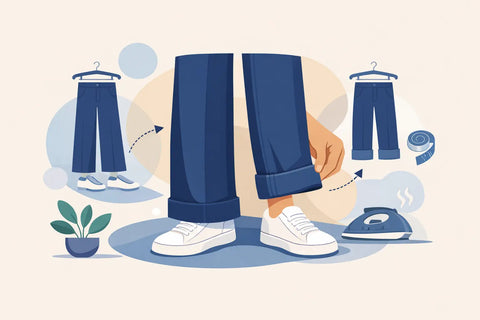
A wide trouser earns its shape through line, weight, and break. Cuff it carelessly and the hem becomes a bulky interruption. Learn how to cuff wide trousers by treating the turn-up as part of the garment’s construction, not an afterthought.
The right cuff can shorten an overlong inseam, expose a considered sock or boot, and give a full leg a firmer finish. The wrong one can make generous trousers look compressed. There is no single correct fold. Fabric, rise, leg width, and footwear decide the result.
Start With the Hem and the Shoe
Before folding anything, put the trousers on with the shoes you expect to wear most. A cuff changes the visual length of the leg and raises the hem, sometimes by more than expected. What looks clean barefoot can sit too high once a substantial boot enters the equation.
For wide trousers, aim for a controlled break or a near-break at the front. The back hem should sit close to the top of the heel without dragging across the ground. If the trouser pools before cuffing, folding may solve the length temporarily, but hemming remains the better long-term answer. A cuff should refine proportion, not compensate for several inches of excess fabric.
Look at the trouser from the side as well as the front. Wide legs have volume already. Your cuff needs enough depth to hold its own against that volume, while staying flat enough to preserve the fall of the cloth.
How to Cuff Wide Trousers With Intent
The simplest method is usually the strongest: one clean, even turn. Lay the fabric flat against the ankle, bring the hem upward, and smooth the fold around the full circumference before standing back up. Do not roll from one side to the other. That creates a twisted cuff and makes the outer seam wander forward.
A cuff between 1.5 and 2.5 inches works well on most wide trousers. The broader the leg and heavier the fabric, the more depth the turn-up can carry. A dense cotton twill, canvas, or rigid denim can support a two-inch cuff with ease. A lighter poplin or drapey rayon blend usually needs a shallower fold, closer to 1 to 1.5 inches, so the hem does not pull the silhouette inward.
Keep both cuffs identical. Measure from the original hem if needed, especially on trousers with a strong stripe, visible outseam, or contrasting selvedge. Precision reads quietly, but it changes everything.
The single turn-up
A single turn-up is the default for utility trousers, painter pants, fatigue pants, and wide denim. It keeps the leg open and architectural. The original hem remains visible inside the fold, giving the cuff enough structure without adding unnecessary layers.
This is the best choice when the trousers have a straight or gently tapered wide leg. It also works well with thicker footwear: service boots, clogs, leather derbies, and substantial sneakers. The cuff creates a deliberate stop above the shoe rather than allowing the fabric to collapse around it.
If the cuff begins to fall open during wear, the issue is usually not technique. The fabric may be too soft, the turn too shallow, or the trouser too long. Try a slightly deeper fold before reaching for pins or adhesive. A good cuff should hold through movement because the cloth has enough tension and weight.
The deep workwear cuff
A deeper cuff, around 2.5 to 3.5 inches, has a clear workwear reference. It suits rigid denim, herringbone twill, duck canvas, and trousers with a visible selvedge edge. The effect is substantial, but it asks for enough inseam to spare. Do not force a deep cuff onto a cropped trouser. It will look like the fabric has been used up.
Use this approach when you want the hem to become a visible design element. A broad indigo cuff can frame a pair of black boots. A natural cotton canvas cuff can add weight below a short worker jacket. On a full silhouette, the depth of the fold helps ground the volume above it.
The trade-off is proportion. A deep cuff visually shortens the leg, so it is often strongest with a higher rise, a tucked or shortened top layer, and footwear with some presence. If you are petite or prefer a longer line, stay nearer two inches and keep the top of the trouser uninterrupted.
The double fold for lighter cloth
A double fold works when the material is thin enough to remain flat. Make the first turn narrow, around three-quarters of an inch, then fold it again to the final depth. This hides a frayed or uneven hem and gives a softer fabric a cleaner edge.
Avoid this method on heavy denim and dense twill. Multiple layers create a thick ring at the ankle, and wide trousers do not need that extra stiffness. The leg should fall from the thigh to the cuff with continuity. When the fold becomes the widest, hardest part of the trouser, it is doing too much.
Preserve the Leg Shape
Do not pinch a wide trouser into a narrow cuff. The pinroll, effective on slim jeans, fights the purpose of a fuller cut. It draws the hem inward, creates diagonal tension through the calf, and turns a relaxed line into an improvised taper.
Instead, follow the existing circumference of the hem. Let the cuff remain wide. If the trousers have pleats, a balloon shape, or a curved outer seam, smooth the fabric downward from the thigh after making the fold. This resets the volume and helps the cloth settle naturally.
A cuff should also sit level. Check that the outseams align vertically and that the front crease, if there is one, remains centered. On trousers with a pronounced crease, press the cuff lightly rather than flattening it aggressively. Too much heat can leave a permanent horizontal line that limits how the trousers can be worn later.
Match the Cuff to the Fabric
Fabric determines how much control a cuff can hold. Rigid denim softens over time but begins with enough body for a clean, wide turn-up. Let its irregularity show. A slightly uneven fade at the fold becomes part of the garment’s record.
Cotton twill and military-style sateen tend to produce the most dependable cuffs. They are structured without feeling hard, and they pair naturally with utility details such as patch pockets, tool loops, and reinforced knees. A single cuff is usually enough.
Wool trousers require restraint. On wide wool flannel or tropical wool, a shallow, crisp cuff can look refined, but a casual roll may feel disconnected from the cloth. If the trouser was made with a finished plain hem and tailored line, consider a permanent cuff added by a tailor rather than a temporary fold.
Linen sits somewhere between. Its crease is part of its character, but repeated rolling can become loose quickly. Keep the turn narrow and accept some movement. Trying to make linen behave like canvas misses the point.
Build the Rest of the Outfit Around the Break
Cuffed wide trousers create a horizontal line at the ankle. Balance it with a top that has a clear endpoint: a tucked tee, a cropped overshirt, a worker jacket that ends near the hip, or knitwear with enough structure to hold its shape. Long, loose layers can work, but they need intention or the whole silhouette loses its frame.
Footwear matters just as much. Low-profile shoes leave more air beneath the cuff and suit a cleaner, cropped effect. Boots add visual weight and work best when the cuff stops just above the shaft or meets it lightly. Avoid a narrow shoe with an excessively wide, low cuff unless contrast is the point. The trouser can begin to look unsupported.
Socks are optional, but visible socks should be chosen as part of the outfit. A ribbed wool sock, a dense athletic sock, or a tonal cotton sock gives the gap purpose. Bare ankle can feel lighter in warm weather, though it shifts the trouser toward a more casual reading.
Know When Not to Cuff
Some hems are already resolved. Trousers with a carefully set cropped length, a curved hem, a cuffed construction, or a formal tailored finish rarely benefit from another fold. Likewise, very wide trousers that just touch the shoe may look better left long, especially when their movement is part of the design.
If you keep reaching for a cuff on the same pair, have the inseam adjusted after several wears and washes. Fabrics shrink, relax, and settle. Live with the trousers first. Then hem them for the footwear and proportion you return to most.
A good cuff is not a styling trick. It is a small decision about how the garment meets the ground. Make the fold clean, let the fabric do its work, and leave enough room for the trousers to move.