
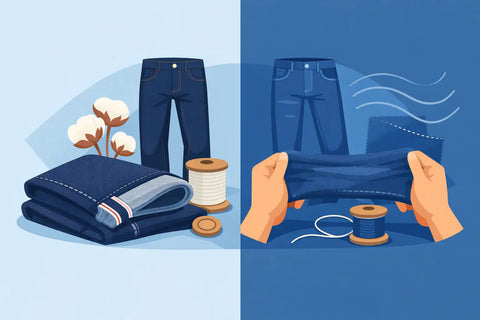
You feel it before you see it. A rigid pair of jeans has a stance. It holds shape, resists slightly at the knee, and asks for time. That is the real question inside selvedge denim vs stretch denim: not which is better in the abstract, but which one fits the way you live, move, and wear clothes over years.
For experienced buyers, this is less about hype and more about structure. Fabric choice changes silhouette, break-in, maintenance, and how a garment ages. Two pairs may look similar on a rack. Six months later, they can feel like entirely different systems.
Selvedge denim vs stretch denim: what changes in wear
Selvedge and stretch describe different things, which is why they are often confused. Selvedge refers to the finished edge of the denim fabric, traditionally woven on narrow shuttle looms. Stretch refers to fiber content, usually cotton blended with elastane or another elastic fiber to add give.
A jean can be selvedge and still have some stretch, though purists often prefer selvedge in 100 percent cotton. A jean can also be non-selvedge and completely rigid. The terms overlap in conversation, but they do different jobs.
Selvedge is mainly about weaving method, fabric character, and often a certain standard of make. Stretch is about comfort, recovery, and ease of movement. One speaks to cloth tradition. The other speaks to performance in daily wear.
What selvedge denim gives you
Selvedge denim tends to appeal to people who care about fabric behavior over time. Because it is often made from 100 percent cotton and woven more slowly, it usually starts firmer and breaks in gradually. The jean learns your body. Creases set at the lap, behind the knee, and along the hem. The result is personal wear rather than generic softness.
There is also a visual clarity to rigid denim. It holds a wider leg cleanly. It supports a straight fit without collapsing. It gives workwear silhouettes their intended line - structured, practical, architectural. If you like denim that keeps its shape through the day and gains character with use, selvedge makes sense.
Durability is part of the appeal, though it should be stated plainly: selvedge itself does not guarantee a longer-lasting jean. Construction, fabric weight, stitching, and how the garment is worn matter just as much. But many selvedge jeans are built with longevity in mind, and the fabric often develops beautifully rather than simply wearing out.
The trade-off is straightforward. Rigid denim asks more from the wearer at first. It can feel stiff. It may take weeks to soften. Fit matters more because there is no elastic buffer. If the rise, thigh, or seat is wrong on day one, time will not solve everything.
What stretch denim does better
Stretch denim is often underestimated because it has been overused in disposable fashion. That is a problem of execution, not of the material itself. A well-made stretch denim can be practical, refined, and surprisingly durable.
Its advantage is immediate comfort. You sit, cycle, commute, bend, and work without fighting the cloth. For slimmer fits especially, stretch can keep a jean clean through the leg without making it restrictive. That matters if your day moves between desk, street, studio, and travel.
Stretch also lowers the barrier to wear. A rigid pair sometimes waits for the right day. A stretch pair usually does not. It gets pulled on often, worn hard, washed without ceremony, and folded back into rotation. For many wardrobes, that consistency matters more than romance.
Still, stretch changes the aging process. Elastic fibers can lose recovery over time, especially with heat, heavy washing, or poor-quality blends. Knees may bag. The seat can relax in ways that feel less intentional than the wear patterns of rigid cotton. In other words, stretch gives early comfort but sometimes a shorter aesthetic life.
That is why fiber percentage matters. A jean with 1 percent or 2 percent elastane often behaves very differently from one with a heavier stretch blend. Small amounts can add mobility while preserving the look of real denim. Too much can flatten the fabric character and make the jean feel more like a generic pant.
Fit, silhouette, and the fabric underneath
The cleanest way to choose between them is to start with silhouette. Wide, straight, and workwear-led cuts usually benefit from rigid or mostly rigid denim. The fabric supports the shape. It gives volume where volume is intended. It lets the leg fall with weight.
Slim or tapered fits often work better with some stretch, especially if you want ease without sizing up. The fabric moves with the body and keeps the fit practical. This is less about trend and more about mechanics.
Body variation matters too. A person with athletic thighs, a high range of movement, or a commute that involves constant motion may find rigid denim less forgiving. Another person may prefer the discipline of a non-stretch fabric because it creates a more stable silhouette. Neither instinct is wrong.
For unisex dressing, this becomes even more relevant. The same jean may sit differently across hips, seat, and thigh depending on the wearer. Stretch can make cross-body fit easier. Rigid denim can make the shape more consistent and intentional. The right answer depends on whether you prioritize adaptability or structure.
How each fabric ages
This is where the split becomes clear.
Selvedge denim tends to age with definition. Fades track your habits. The surface gains contrast. The cloth softens while staying itself. If you value patina, repair, and the record of wear, selvedge is hard to replace.
Stretch denim tends to age with ease first, compromise later. It breaks in quickly and becomes part of daily life fast. But over time, repeated stress on elastic fibers can reduce snap and alter shape. Better mills and thoughtful blends improve this, but they do not erase the basic fact that elasticity has a lifespan.
Wash habits also matter. Rigid cotton often benefits from less frequent washing, especially early on, if you want stronger fade development. Stretch denim usually tolerates more regular laundering, but high heat is harder on it. Cold water and air drying help both, just for different reasons.
Price, value, and what you are paying for
Selvedge denim usually costs more. Part of that comes from slower weaving and narrower looms. Part comes from the fact that selvedge is often used in better-made garments with stronger construction details. You are often paying for fabric integrity, not just a visible outseam ID.
Stretch denim can be less expensive, but not always. Premium stretch fabrics with good recovery and a convincing hand can cost real money. The difference is that value shows up differently. With selvedge, value is often tied to longevity and the way the garment improves. With stretch, value is tied to frequency of wear and day-one practicality.
For a wardrobe built on fewer, better pieces, either can earn its place. The question is whether you want your denim to mold slowly and last visibly, or to serve immediately and effortlessly.
Selvedge denim vs stretch denim: which one should you buy?
If you care most about heritage cloth, shape retention, and the long arc of wear, choose selvedge. It suits buyers who like structure, who do not mind a break-in period, and who want denim that records use rather than hiding it.
If you care most about comfort, mobility, and easy repetition, choose stretch denim. It suits wardrobes that need flexibility and people who want denim to work from the first wear.
If you sit somewhere in the middle, look for low-stretch denim with a strong cotton hand. That middle ground is often the most useful. You keep much of the visual integrity of rigid denim with enough give for everyday use.
A good wardrobe does not need ideological purity. It needs range. One rigid pair for shape and age. One stretch pair for movement and frequency. Different bodies. Different lives.
The better question is not which fabric wins. It is which one you will keep reaching for, and which one will still make sense after the season has passed.