
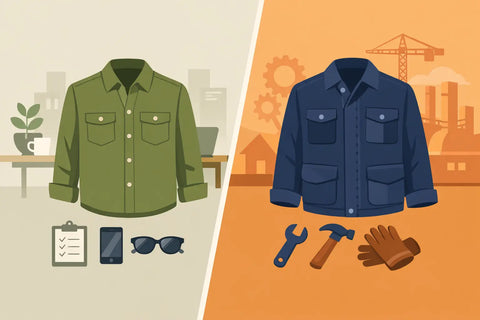
A good overshirt vs work jacket decision is rarely about formality. Both sit between shirt and coat. Both borrow from utility clothing. Both can become the piece you reach for most. The difference is in what each garment is built to carry: an overshirt favors flexible layering, while a work jacket is made to hold its shape, take abrasion, and define an outfit.
The names overlap because their histories do. A heavy twill shirt, a French chore coat, a military field layer, and a workshop jacket all share useful details: patch pockets, generous cuts, sturdy buttons, and cloth that improves through wear. Still, construction tells the clearer story. Look beyond the label.
Overshirt vs Work Jacket: the Essential Difference
An overshirt begins with the logic of a shirt. It is usually cut with a collar, a front placket, cuffs, and a hem designed to sit cleanly over a T-shirt, knit, or another shirt. It may be made from brushed cotton, flannel, corduroy, wool blend, ripstop, or a lighter twill. The point is adaptability. It closes the gap between indoor dressing and a mild day outside.
A work jacket begins with the logic of outerwear. Its fabric is typically denser, its body more structured, and its pocket arrangement more deliberate. Think cotton drill, canvas, duck, herringbone twill, moleskin, or heavyweight denim. It is intended to protect the clothes beneath it and to remain useful when the day has edges: a commute on a bike, a cold studio, a loaded tote, a weekend spent moving between street and workshop.
That distinction is not absolute. A heavy overshirt can function as a jacket in early fall. A lightly constructed chore jacket can feel shirtlike indoors. Vintage workwear was never concerned with category purity. It was concerned with whether a garment did its job.
Start With Fabric Weight and Structure
Fabric is the fastest way to understand the garment in your hands. A lighter overshirt often has some drape. It follows the body rather than standing away from it, even when cut generously. That makes it easy to layer under a coat or wear open over a tank, tee, or poplin shirt.
A work jacket has more presence. Its cloth may feel dry, compact, and slightly resistant at first. That is not a flaw. Dense natural fibers often need time to soften, crease, and settle into their wearer. The best versions become more personal without losing their architecture.
Weight alone does not decide the category. A wool overshirt can be warmer than an unlined cotton worker jacket. What matters is the relationship between cloth and construction. If the fabric is paired with a jacket-length body, reinforced seams, substantial pockets, and a shape that remains stable over layers, it is functioning as a work jacket.
For a single layer that can travel across most of the year, midweight cotton twill is hard to improve on. It breathes, wears in well, and has enough density to create a clear silhouette. It also accepts repair. A small mend on a twill jacket reads as continued use, not failure.
Construction Reveals Intent
The details that make a work jacket useful are often quiet. Large patch pockets keep a notebook, phone, gloves, or tools close without making the garment feel technical. Bar tacks at pocket corners and points of stress reduce strain. A reinforced placket, durable buttons, and clean topstitching keep the jacket dependable over repeated wear.
An overshirt may share several of these features, but its details are usually scaled for light duty. Chest pockets are common. Side-entry hand pockets are less so. The cuffs may be more tailored, the shoulder less reinforced, and the body shorter. This is appropriate when the garment is meant to move easily between layers rather than serve as the outermost piece every day.
Lining changes the equation. An unlined work jacket is often more versatile than a lined one because it can be worn from cool spring mornings into late fall. A lined jacket provides warmth and a smoother feel over knitwear, but it is less likely to become a year-round uniform. Neither is inherently better. Choose according to climate and how much time you spend outdoors.
Pay attention to closures as well. Buttons are repairable and visually grounded in workwear tradition. Snaps make quick work of a layer worn on and off throughout the day. A zipper offers wind protection but can make a garment feel more overtly outerwear-led. Each choice changes the jacket's character.
Fit Changes How the Layer Works
An overshirt needs enough room for a base layer, but not so much that it collapses beneath a coat. It should sit comfortably over a tee and allow a lightweight sweater without pulling at the upper back or buttons. If you plan to wear it mostly buttoned, check that the hem and chest do not strain when you sit.
A work jacket benefits from a little more air. It should accommodate a sweatshirt, overshirt, or textured knit while preserving the line of the shoulder. Movement matters more than a close fit. Reach forward. Cross your arms. Put your hands in the pockets. If the jacket rides sharply up your torso or restricts the back, size and cut deserve another look.
For unisex garments, shoulder measurement is useful but not final. A dropped shoulder can be intentional. So can a boxier body, a shortened length, or a fuller sleeve. Assess the complete proportion: where the hem lands, how the sleeve stacks, and whether the garment creates room around the body without appearing accidental.
A cropped worker jacket can sharpen high-rise trousers, balloon pants, or a long skirt. A longer chore-style jacket creates a calmer vertical line over denim and utility trousers. An overshirt often works best when its hem is visibly distinct from the layer beneath, giving the outfit depth without excess bulk.
When an Overshirt Is the Better Choice
Choose an overshirt when your day moves mostly indoors, temperatures are moderate, or you need a layer that can disappear into a larger system. It is the more adaptable option for travel, office air conditioning, restaurants, galleries, and transitional weather.
It also has an advantage under outerwear. A brushed twill or wool overshirt adds texture beneath a topcoat or parka without the stiffness of two jackets competing at the shoulder and sleeve. Worn open, it gives a simple T-shirt and trousers enough structure to feel considered.
An overshirt is not merely a lighter jacket. Its value is in its ability to behave like a shirt when needed. That makes it particularly useful for people who prefer a small rotation of garments with multiple roles.
When a Work Jacket Earns Its Place
Choose a work jacket when you want one layer to carry the visual weight of the outfit. Its structure makes even a plain tee, washed denim, and worn-in shoes feel complete. It is also the better choice when pockets, durability, and repeated outerwear use are priorities.
A classic worker jacket is especially effective in a wardrobe built around texture. Pair it with chambray, denim, canvas, wool, corduroy, or jersey. The proportions remain straightforward, but the materials do the work. This is where heritage references feel current: not as costume, but as practical design refined through repetition.
The trade-off is bulk. A heavyweight canvas jacket may feel too rigid for a warm commute or too substantial beneath a fitted coat. It can also require a break-in period. If you want immediate softness and frequent indoor wear, a lighter twill work jacket or a substantial overshirt may be the more honest choice.
Build the Better Layering System
The strongest wardrobes do not force one garment to solve every condition. An overshirt and a work jacket can work together without duplicating each other when their weights are clearly separated. Keep one light and pliable, the other structured and durable.
For example, a cotton poplin or brushed-twill overshirt handles mild weather and indoor layering. A cotton drill worker jacket takes over when the temperature drops or the outfit needs more shape. Both can be worn with the same trousers, knitwear, and footwear, which is how a focused wardrobe gains range without gaining clutter.
Color matters here. Dark navy, faded black, olive, ecru, and workwear blue tend to age well because they accept wear and pair easily across seasons. A lighter jacket can show its marks more readily, but that may be part of its appeal. Choose the color you are willing to live with, not only the one that looks untouched on day one.
The right layer is the one you do not need to protect from your life. Buy for the movement, weather, and repetition that define your actual week. Then let the fabric record the rest.