
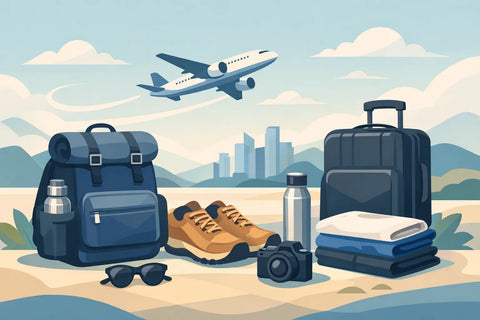
A good travel wardrobe should not feel like a separate wardrobe. The best durable basics for travel are the pieces you already want to wear at home: garments with enough structure for a long day, enough ease for movement, and enough character to improve with use. Pack less. Choose better.
The useful question is not how many outfits fit in a carry-on. It is whether each piece can carry more than one role. A jacket becomes a plane layer, a weather buffer, and an evening outer layer. A shirt works open, closed, tucked, or thrown over a tee. Pants need to handle transit, walking, sitting, and an unplanned dinner without asking for special care.
What makes a travel basic durable?
Durability starts before the first wear. Look for fabrics with density, not simply weight. A heavy garment can still feel slack or lose its shape; a tightly woven cotton twill, sturdy poplin, or well-made denim often holds up because its yarns and weave do the work. Natural fibers are especially useful on the road when they are chosen for purpose: cotton for breathable everyday structure, wool for odor resistance and temperature range, and linen blends when heat is the priority.
Construction matters just as much. Cleanly finished seams, reinforced stress points, durable pocket bags, secure buttons, and room to move all extend a garment's useful life. Fit is part of construction, too. A piece pulled tight across the back, seat, or thigh will wear out faster than one with considered ease.
Do not mistake durability for stiffness. The best pieces break in rather than break down. They take on creases, fades, and small signs of travel without looking spent.
8 best durable basics for travel
1. A worker jacket with real utility
A short worker jacket is one of the hardest-working layers you can pack. Its straight, unfussy shape sits easily over a tee, knit, or button shirt, while patch pockets keep a phone, passport, or transit card close when you do not want to carry a bag.
Choose cotton drill, canvas, or densely woven twill over a thin fashion overshirt. The trade-off is bulk: a substantial jacket takes up room in a small bag. Wear it in transit instead of packing it. In mild weather, it may be the only outer layer you need.
2. A substantial pocket tee
The ideal travel tee has a little body. It should skim rather than cling, keep its collar after repeated washes, and feel presentable beneath an open shirt or jacket. A chest pocket is optional, but it gives a familiar workwear reference without turning a basic into a costume.
Avoid treating ultra-light cotton as universally practical. It dries quickly, but it can twist, show moisture, and wear through sooner. Midweight cotton is often the better balance for city travel and repeat use. Pack two or three, depending on laundry access, rather than a different top for every day.
3. An overshirt or photographer shirt
A relaxed, long-sleeved shirt is a small system in itself. It protects from sun, cool air conditioning, and a chilly late train. Worn buttoned, it reads more composed than a tee. Worn open, it becomes a light layer. In a crisp cotton poplin or textured chambray, it can move between day and dinner without effort.
Look for a cut with enough shoulder and sleeve room to layer underneath. This is especially relevant for unisex garments: the right fit is not about a prescribed body type, but about proportion, movement, and how you prefer the silhouette to sit. WORKWARE approaches that flexibility as a practical design requirement, not an afterthought.
4. Utility trousers that can take a full day
Travel pants should not be performance costumes. A well-cut utility trouser in cotton twill gives you useful pockets, a stable silhouette, and the ability to sit for hours without looking like you dressed for the gym.
Prioritize a comfortable rise and enough room through the thigh. Tapered or balloon proportions can both work, depending on your shoe and preferred volume. A darker neutral hides transit dust and minor spills, though lighter khaki and olive can be just as versatile in warm places. Skip delicate crease-dependent trousers unless the trip is built around formal settings.
5. One pair of honest denim
Denim earns its place when the trip includes cooler weather, casual evenings, or long stretches between washes. A medium-weight pair with a relaxed straight leg is usually more useful than rigid skinny denim or heavily distressed jeans. It can take wear, gains character, and pairs with nearly every layer listed here.
There is a limit. Denim is slow to dry and can feel heavy in humid climates. For a beach week or tropical work trip, leave it home in favor of twill trousers. Durability is only useful when it suits the climate and the itinerary.
6. A compact knit layer
A wool or cotton-wool knit handles temperature changes with unusual range. It can be worn on a cold flight, tied over the shoulders during the afternoon, or layered under a jacket after dark. Merino is particularly practical when packing light because it resists odor better than many fibers, although fine merino needs more care around rough surfaces and sharp hardware.
For a more workwear-oriented wardrobe, a dense cotton knit has a different advantage: it is easier to wash, more resistant to abrasion, and carries a clean, grounded shape. Choose based on destination. Wool is stronger for variable weather; cotton is simpler for frequent laundering.
7. A weather-ready shell, not an emergency poncho
If rain is likely, bring one proper outer shell. It does not need excessive branding or a technical appearance. What matters is a useful hood, dependable closure, room for layers, and a fabric that can handle repeated wet commutes. A simple coated cotton or lightweight technical shell is enough for most urban travel.
The common mistake is packing a rain layer too fitted to wear over anything. Test it over your jacket or knit before leaving. A shell that only works over a tee is not a reliable travel layer.
8. Leather shoes built for walking
Shoes decide whether a compact wardrobe works. Bring one pair that can manage miles and still look right with trousers, denim, shorts, or a skirt. A low-profile leather shoe, sturdy derby, or well-made boot can fill that role if it has already been broken in.
Never make a trip the first test of a new pair. Even excellent footwear needs time to shape to your stride. Consider the ground, too: smooth city pavement asks less than wet cobblestone, trail paths, or long airport connections. A second, lighter pair is worth the space when the destination demands it.
Build around repeatable color and proportion
A travel wardrobe becomes easier when the pieces share a visual language. Work from two or three base colors - washed black, navy, olive, ecru, brown, or faded blue - then let texture create distinction. Canvas beside denim, poplin beside wool, and matte leather beside twill keep a restrained palette from feeling flat.
Proportion does more than color. If your trousers have volume, keep the jacket reasonably short or the shirt lightly tucked. If your outer layer is oversized, use a straighter pant beneath it. These are not rules for looking polished at all times. They are ways to make fewer garments feel intentional together.
Avoid packing hypothetical versions of yourself. The sharply tailored piece for a dinner you may not attend, the pristine white shoe you will avoid in rain, and the thin layer that only works in one exact temperature all consume space. Travel clothing should meet the trip as it is, not as an idealized packing list imagines it.
Care is part of the garment's lifespan
Durable clothing still needs sensible maintenance. Air out wool and denim before deciding they need washing. Spot-clean when possible. Wash cottons in cool water, close buttons and zippers, and avoid high heat that can shrink fibers and fatigue elastic components. A small fabric brush and a compact stain treatment take up almost no room and can save a garment mid-trip.
Most of all, allow clothes to be used. A jacket with softened cuffs, trousers with a repaired seam, and denim marked by years of movement are not failures of a wardrobe. They are evidence that the right pieces traveled with you, then kept going.