
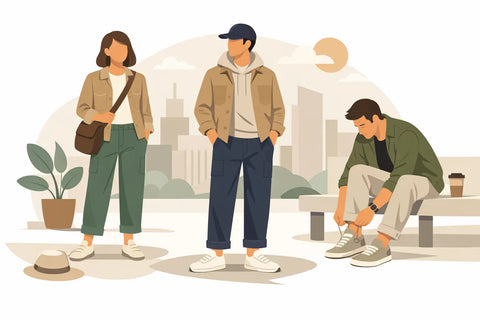
Chore pants are not a costume piece. Their appeal comes from the opposite: a plainspoken silhouette, useful pockets, substantial cloth, and a history of being worn hard. Knowing how to style chore pants starts with respecting that directness. Keep the outfit considered, but never overworked.
The best pairs carry a little volume through the leg and enough structure to hold their shape. They ask for balance, not decoration. A close-fitting knit, a cropped jacket, or a clean leather shoe can shift them toward the city. A washed tee and canvas sneaker returns them to their working roots. Same pants. Different purpose.
Start With the Shape of the Chore Pant
Chore pants usually sit between a traditional fatigue trouser and a painter pant. The rise is often medium to high, the leg is straight or gently tapered, and the fabric has more presence than a standard chino. This is why proportion matters more than any single styling rule.
A full, straight leg benefits from a defined top half. That does not mean tight. It means intentional. Try a heavyweight jersey T-shirt that ends around the hip, a fine-gauge crewneck tucked at the front, or a boxy overshirt that stops above the widest point of the thigh. Each creates a clear line without making the outfit feel precious.
If your chore pants are cropped or have a shortened inseam, let the ankle do some work. A ribbed sock, a low-profile sneaker, or a substantial loafer gives the length a clean finish. With a longer, pooling hem, choose footwear with enough visual weight to anchor it - a derby, lug-sole boot, or sturdy canvas shoe. Thin running shoes can disappear beneath a generous leg opening.
The waistband matters, too. A high-rise chore pant looks especially strong with a tucked shirt or a shorter layer, because it reveals the construction of the trouser. A lower-rise or more relaxed pair can take a longer shirt, provided the fabric stays light and the hem does not extend too far past the crotch. Volume on volume can work, but only when there is a deliberate break in length, texture, or color.
How to Style Chore Pants Through Contrast
Workwear becomes more versatile when it meets something refined. The tension is useful. Chore pants in brushed cotton or cotton twill look sharper alongside merino wool, crisp poplin, smooth leather, or a compact nylon shell. The pants retain their practicality while the rest of the outfit establishes the setting.
A white or ecru shirt with olive chore pants is a reliable place to begin. Leave it untucked for an easy daytime shape, or tuck it in and add a belt when the occasion needs more definition. Choose a shirt with some substance rather than a thin, glossy dress fabric. Oxford cloth, cotton poplin, chambray, and washed linen all hold their own against twill.
For colder months, pair dark navy or charcoal chore pants with a fine knit and a short wool coat. The coat should end at the hip or upper thigh, not mid-calf, unless the trousers are relatively narrow. This is a matter of scale. Long, wide, and loose can look intentional, but it requires confidence and enough structure in the outer layer to avoid a collapsed silhouette.
Texture can do more than color. A dry canvas pant with a soft lambswool sweater feels composed without looking matched. A herringbone work pant with a smooth cotton jersey top has the same effect. Avoid making every surface rugged at once. Heavy flannel, distressed denim, waxed canvas, and worn suede can become overly literal together.
Build a Practical Color System
Chore pants are strongest in colors that age well: ink, faded black, tobacco, olive, stone, ecru, and deep brown. These shades are useful because they allow repetition. You do not need a new outfit formula every time you wear them.
Stone or ecru pants make a dark top feel clearer. Try a navy sweatshirt, charcoal overshirt, or black knit with shoes in brown suede or off-white canvas. Dark chore pants offer the reverse: a faded blue chambray shirt, an oatmeal sweater, or a white tee keeps the outfit from becoming too dense.
Olive deserves its reputation, though it does not need to be treated as a neutral in every outfit. It works naturally with cream, indigo, navy, black, rust, and faded pink. Keep the shades muted rather than overly saturated. The goal is a wardrobe that can be combined in low light, on rushed mornings, and across years of wear.
Choose Tops That Hold Their Own
The simplest answer is often the best one: a properly weighted T-shirt, chore pants, and a jacket with a clean line. The T-shirt should not be overly long or flimsy. A dense cotton jersey with a firm collar gives the pants an equal counterweight. In warm weather, this combination is enough.
A photographer shirt, band-collar shirt, or open-collar camp shirt brings a little shape around the neck without forcing the outfit toward formality. Wear it open over a tee, or button it fully and tuck it into a higher rise. If the pants have prominent patch pockets, keep the shirt relatively plain. Let one garment carry the utility detail.
Sweatshirts work particularly well with chore pants because both pieces are democratic and durable. A neat crewneck in gray, navy, or washed black is more useful than a graphic-heavy layer. For a softer silhouette, choose a roomy sweatshirt with a shorter body. For a cleaner one, choose a compact knit with ribbing that sits at the waistband.
A tailored shirt and chore pants can work for informal professional settings, especially in dark cotton or wool-blend trousers. The key is restraint. Skip the sharp business shirt, high-shine belt, and aggressively pointed shoe. Instead, use a washed blue button-down, simple black belt, and plain derby or loafer. The result is relaxed, not careless.
Add Layers Without Adding Noise
Chore pants already have a functional vocabulary. Pockets, bartacks, and sturdy seams are part of their language. Outerwear should either echo that utility quietly or provide a clean contrast.
A worker jacket is the obvious partner, but matching fabric and color can read as a uniform. That can be excellent when the set is designed as one, or when the tones are slightly different. Otherwise, separate the pieces: navy jacket with stone pants, olive jacket with faded black pants, or indigo denim with ecru twill.
Short bomber jackets, cropped field jackets, and simple zip blousons also work because they preserve the trouser's shape. Longer overshirts are useful as a middle layer under a coat, but worn alone they need a controlled hem length. Aim for a hem that sits near the top of the hip, or make a clear contrast with a slimmer pant.
Let the Shoes Set the Register
Footwear decides whether chore pants feel like a weekday uniform, a studio outfit, or something suited to dinner. Canvas sneakers keep the look grounded. Choose simple shapes in white, black, or natural rubber rather than overly technical styles.
Leather derbies and loafers make even faded chore pants feel more composed. Black leather creates a sharper edge; brown suede softens it. For rain, travel, or colder days, a round-toe work boot gives the trousers a natural base. Keep the boot shaft under the hem rather than stuffing wide pants inside it.
Sandals can work with cropped chore pants in summer, especially with a tucked tee or open shirt. The pants should be light enough for the season - cotton poplin, linen blend, or washed canvas rather than dense winter twill.
Wear Them Across Different Days
For a day involving walking, errands, or a long flight, chore pants earn their place through ease. Pair them with a tee, overshirt, and sneakers. Use the pockets, but do not load them until the silhouette pulls forward. A small bag keeps the pants looking like trousers rather than equipment.
For a creative workplace, dark chore pants with a tucked knit polo or button-down strike the right note. The outfit has structure, but it does not borrow the stiffness of conventional office dressing. Add leather shoes when the setting asks for polish, or clean sneakers when it does not.
For dinner, the same pants can move quietly upward. Start with black, ink, or deep brown. Add a fine knit, a crisp shirt, or a compact jacket. Avoid trying to make them formal through accessories alone. Their strength is their honesty.
Chore pants improve with repetition. Learn where the fabric creases, how the color softens, and which layers make the shape feel most like your own. Wear them often enough for the answers to become obvious. That is how a useful garment becomes part of a system.