
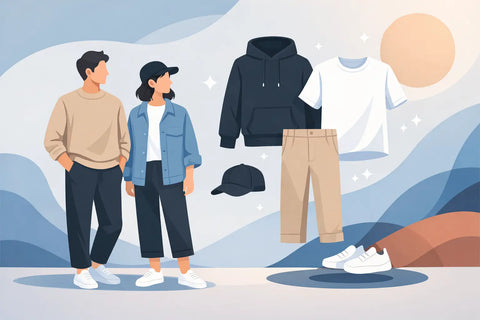
A worker jacket passed between partners will not fit the same way twice. One wearer rolls the cuff. Another lets the shoulder sit low. Both should find the garment convincing. That is the real work of unisex fashion: not removing identity from clothing, but making room for different bodies, habits, and ways of moving.
The best shared garments do not rely on a label alone. They begin with proportion, fabric, and construction. They consider how a collar frames the neck, where a pocket lands, how much room a sleeve needs, and whether the cloth will improve after a hundred wears. Details with a past. Forms for now.
Unisex Fashion Is a Design Decision
A unisex garment is not simply a men's size made smaller, or a women's block made roomier. Those shortcuts often leave the wearer negotiating with the clothes: shoulders that pull, rises that sit incorrectly, sleeves that feel too long, or excess volume with no shape.
Good unisex fashion starts with a clear design position. The silhouette needs enough generosity to accommodate variation, but enough structure to retain intention. A straight leg can work across many bodies when its rise, seat, and hem are carefully balanced. A relaxed shirt can feel precise when the collar, placket, and sleeve pitch are properly resolved.
This is why fit should be read beyond a size label. Measurements matter, but so does the garment's relationship to the body. A boxy photographer shirt may be chosen for its easy chest and clean shoulder line. Balloon pants may be chosen for volume through the leg, then controlled at the ankle. The point is not to make every piece look identical on every person. It is to give the form a strong enough logic that it remains itself.
The pattern carries the argument
The pattern is where inclusivity becomes practical. A well-made unisex piece accounts for movement rather than asking the body to conform. Room through the armhole, a useful rise, articulated shaping where it serves the garment, and a waistband that sits without restriction all change how often something gets worn.
There are limits. A single cut cannot deliver a perfect fit for every body, and pretending otherwise is not useful. Shoulder width, torso length, hip shape, and preferred ease vary widely. The better approach is honest sizing, clear garment measurements, and silhouettes designed to welcome styling adjustments. A cuff can be turned. A waist can be defined or left loose. A jacket can be worn close or layered over knitwear.
Ease is not the same as oversizing
Oversized clothing can be expressive, but size alone does not create a unisex form. When every dimension is enlarged equally, the result can lose function. Sleeves swallow the hand. Trouser hems drag. Pocket placement becomes decorative rather than useful.
Ease needs direction. Workwear offers a useful reference because its volumes developed around activity. A chore coat has space for layers and reaching. Utility trousers allow the wearer to sit, cycle, climb stairs, and carry what the day requires. These are not costumes. Their proportions have a job to do.
Why Workwear Continues to Matter
Heritage workwear was never designed as a trend category. Its familiar elements came from use: reinforced seams, durable twill, patch pockets, button closures that can be repaired, and room for movement. That history makes it a natural foundation for gender-inclusive clothing.
A worker jacket does not need to declare who it belongs to. Its usefulness is visible. The same is true of a sturdy overshirt, a fatigue pant, or a denim skirt with real pocket depth. When the design is grounded in utility, the garment has a reason to exist beyond novelty.
This does not mean every reference should be reproduced exactly. Vintage pieces often carry dated proportions, limited sizing, or construction choices that do not suit contemporary life. The value is in studying the original function, then refining the form. A heavier fabric may be softened with a better wash. A traditional pocket can be repositioned. A wide trouser can be cut with a cleaner line.
At WORKWARE, this approach keeps the focus on garments with a long working life. The aim is not to make clothing neutral by making it anonymous. It is to make pieces specific enough to be remembered, and adaptable enough to be worn by more than one person.
Fabric Gives the Form Its Memory
Unisex fashion depends on fabric more than many people expect. A silhouette can look balanced on a hanger and fail once it is worn if the cloth is too thin, too stiff, or too eager to lose its shape.
Cotton twill, dense jersey, textured linen, and substantial denim each bring their own behavior. Twill holds a pocket and gains character at stress points. Denim settles to the wearer over time. Linen breathes and softens, though it asks the wearer to accept its natural crease. A fabric's limitations are part of its appeal when they are understood rather than disguised.
Weight matters, but it is not the only measure of quality. A heavy cloth can feel restrictive in a narrow cut. A lighter cloth can still be durable when the weave is tight and the construction is sound. The right material depends on the garment's purpose and climate. A summer utility shirt needs air and movement. A winter overshirt needs enough density to work as a layer.
The most useful fabrics record wear without looking spent. Fading, softening, and small signs of repair should add to the garment's character. Buy better. Keep forever.
Building a Unisex Wardrobe System
A lasting wardrobe does not need many pieces. It needs pieces that understand one another. Start with a few forms that can move across settings: a work jacket, a relaxed shirt, a pair of utility trousers, straight denim, and a layer with enough warmth for changing weather.
Choose each item for more than one role. A photographer shirt can sit under a jacket for work, open over a tee on a weekend, or become a light outer layer in warm weather. Utility pants can carry a sharper shoe without losing their purpose. A dress or skirt in sturdy cloth can be worn with a structured overshirt rather than saved for a particular occasion.
Color helps the system hold together. Washed black, indigo, ecru, olive, stone, and deep brown are not rules, but they make repeat wear easier. They also allow texture and proportion to do more of the talking. A faded denim jacket beside crisp cotton poplin creates interest without needing a graphic or seasonal color story.
Fit should be adjusted through styling before replacing a garment. Try a different tuck, a rolled cuff, a shorter hem, or a layer underneath. If the garment still works, those small changes can extend its range. If it consistently fights your movement or sense of proportion, it is not the right piece, no matter how well it is made.
Care Is Part of the Design
Clothing made for years needs ordinary care, not ceremony. Wash less when a garment is not actually dirty. Mend a loose button before it becomes a missing one. Air out wool and denim. Follow the fabric's needs rather than treating every item the same.
Repair is especially relevant to workwear-rooted pieces. A visible mend on a knee or elbow can be honest and useful. Replacing a button, reinforcing a seam, or patching worn cloth is not a failure of the garment. It is evidence that it has earned its place.
The strongest unisex wardrobe is not built around permission or performance. It is built around clothes that meet the body where it is, then continue with it. Choose the form you reach for without thinking. Wear it hard enough to let it become your own.